Single Leg Hop Test Calculator
Compare right and left hop distances, score limb symmetry, and estimate the exact distance needed to meet your selected return-to-sport benchmark.
📌Presets
Each preset fills a realistic hop test profile and recalculates symmetry, distance gap, and normalized hop output.
⚙Calculator
Hop symmetry snapshot
Enter both sides to calculate limb symmetry and distance gaps.
📊Hop Metrics
📑Reference Tables
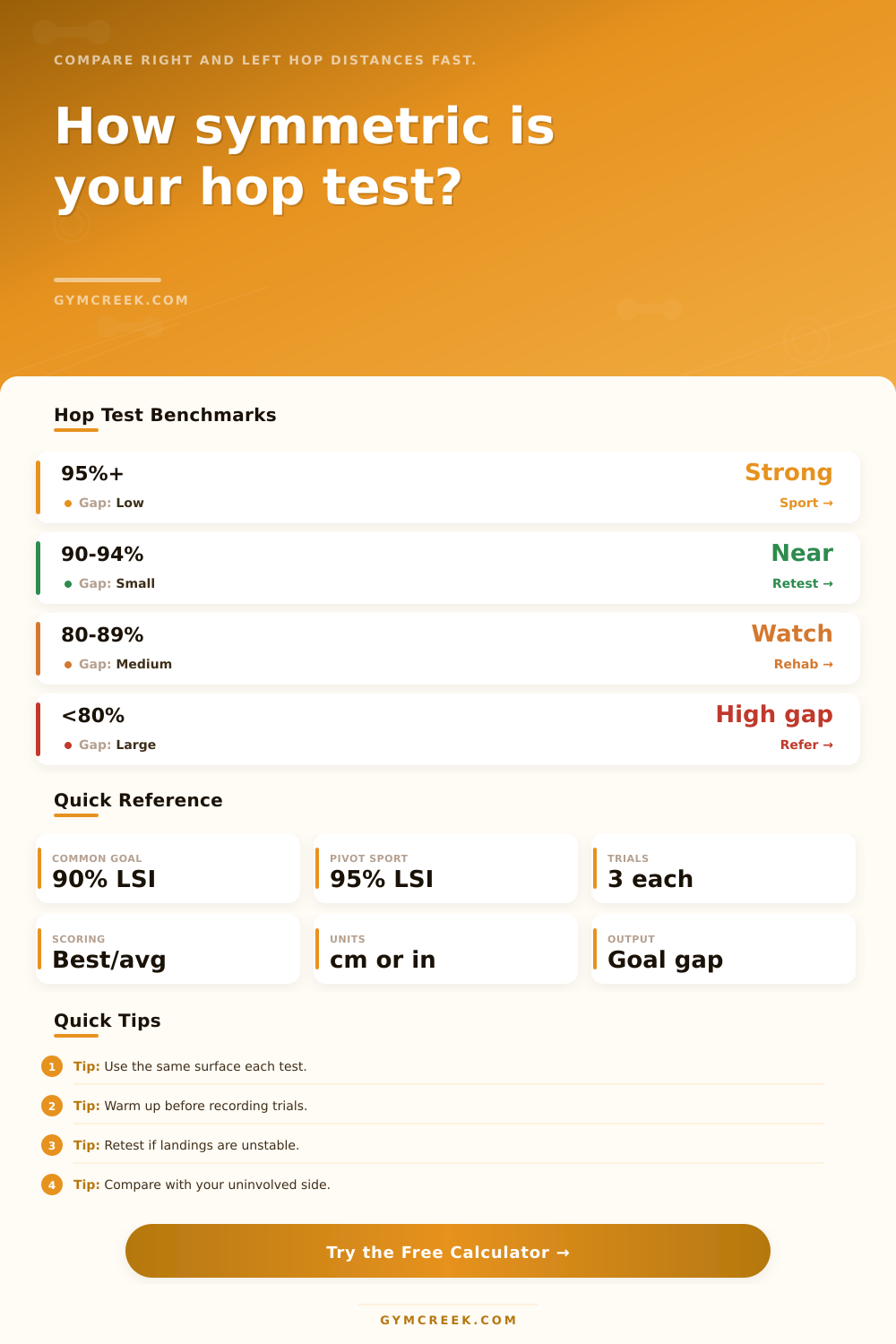
| LSI Range | Interpretation | Distance Gap | Typical Action |
|---|---|---|---|
| 95%+ | Strong symmetry | Very small | Sport-specific testing |
| 90-94% | Near target | Small | Retest and compare quality |
| 80-89% | Meaningful gap | Moderate | Continue focused rehab |
| Below 80% | Large gap | High | Review with clinician |
| Test Type | Scored Output | Hop Count | Best Use |
|---|---|---|---|
| Single hop | Total distance | 1 | Basic power symmetry |
| Triple hop | Total distance | 3 | Repeated power |
| Crossover hop | Total distance | 3 | Control across midline |
| Medial hop | Total distance | 1 | Frontal-plane control |
| Scenario | Common Goal | Key Metric | Watch For |
|---|---|---|---|
| Return to run | 90% LSI | Single hop | Landing control |
| Field sport | 95% LSI | Triple hop | Fatigue gap |
| Pivot sport | 95%+ LSI | Crossover hop | Side-to-side control |
| Baseline test | Record best | Both sides | Consistent trials |
| Formula | Variables | Result | Notes |
|---|---|---|---|
| LSI | Inv / Uninv | Percent | Higher is closer |
| Gap | Goal x Uninv | Distance | Extra needed |
| Asymmetry | Side diff | Percent | Uses stronger side |
| Height ratio | Hop / height | Percent | Per-hop context |
💡Tips
“Sometimes you can get all the way through rehab and you’re not sore anymore and you’re not swollen anymore, but you put your weight on it and you don’t believe it.” Your knee appears okay, but memory of injury lingers in your mind. That mental void is often more important then any physical loss.
Objective feedback is what’s needed at this stage, which brings us to the one-legged hop test. By taking away subjectivity, it quantifies how far you go. Pushing with only your bad leg expose deficiencies that could be hidden during a basic squat.
How to Use Hop Tests for Knee Recovery
When they evaluate you, main measurement they will be using is called The Limb Symmetry Index (LSI). It’s a percentage that measures how far you can hop on your good leg compared to your hurt one. Ninety percent is considered near normal by most program, and that’s when you’re allowed back to full sports participation. For pivoting type athletes like basketball guards or soccer players who cut a lot, it may be more like 95 percent due to additional force on the joint.
There’s a calculator available online to give you the answer, but knowing what it tells you is just as important than knowing the answer. If you have a great score, you’ll know your power output has been restored, but that doesn’t mean your joint is stable yet. A lot of athletes mistake control for power.
For example, they may be able to create enough force to get a long hop. However, they may lack good stabilizing muscles or has to use their hips to keep balance. Remember, landing quality also matters. Do you take additional steps? Do you wobble? Then your control isn’t very good.
In fact, the test isn’t measuring power at all. It is measuring how you recover from failure if you can’t stay up on one leg. The distance doesn’t matter. A clean landing means your neuromuscular system isn’t just barely getting by; it is coordinating movement well.
Pick a hop variation appropriate for your sport. For example, an explosive-power test like the single hop would be good for establishing a baseline measurement. This is because it require less midline control and repetition-resistance (tolerance to repeated impact) compared to a crossover hop or triple hop. These two are variations of each other that better reflect the stop-and-start nature of many sport activities.
To match tests to athlete profiles, you can consult reference tables. For instance, a volleyball player would benefit from the crossover variation to deal with lateral loads whereas a runner may want to focus on the single hop for forward drive.
To really see progress, test consistency. Record trials on the same type of surface (best: non-slip court floor) each time to keep friction levels consistent. Test while warm; don’t underestimate your capability because of cold muscles. Measuring from one foot’s toe line to the other’s heel at landing, along with other small details like this, help keep measurement exact.
Average several tests; or record only the best, but stick to the same method in how you score it so there’s no artificial “inflating” of the results. The next level adds height normalization, which accounts for the athlete’s body size. If you’re looking at symmetric motion between limbs, raw distance traveled can be deceiving: longer-levered athletes will cover greater distance just from their height. By adjusting for height, we see how each limb performs compared to that specific athlete’s frame, shedding light on efficient movement instead of maximum strength output. For youth athletes, this is especially valuable as growth spurts throw things off if left unaddressed.
Recovery isn’t a light switch. It’s a slow return to sport. It builds confidence between your body and brain, and the hop test offers proof to make that confidence well-founded. You should of used it more often. Numbers add up with solid landings and fear eases. Now you’re thinking about performing instead of fearing not performing.
That mental transition is one of the most difficult aspects of recovery and is possible with hard data. How far you go tells you where you are at; knowing how you got there builds confidence. Actualy, it helps alot.