Calories Burned Shoveling Snow Calculator
Estimate shoveling calories from body weight, duration, snow depth and density, shovel load, pace, temperature, breaks, driveway length, effort level, and seasonal frequency.
📌Snow Shoveling Presets
Presets fill realistic snow-removal jobs. Adjust any field for your storm, shovel size, and actual breaks.
⚙Calculator Inputs
Snow burn snapshot
Enter your storm and driveway details to estimate calories, loads moved, work rate, cold-stress effort, and weekly or season burn.
📊Metrics Grid
📑Reference Tables
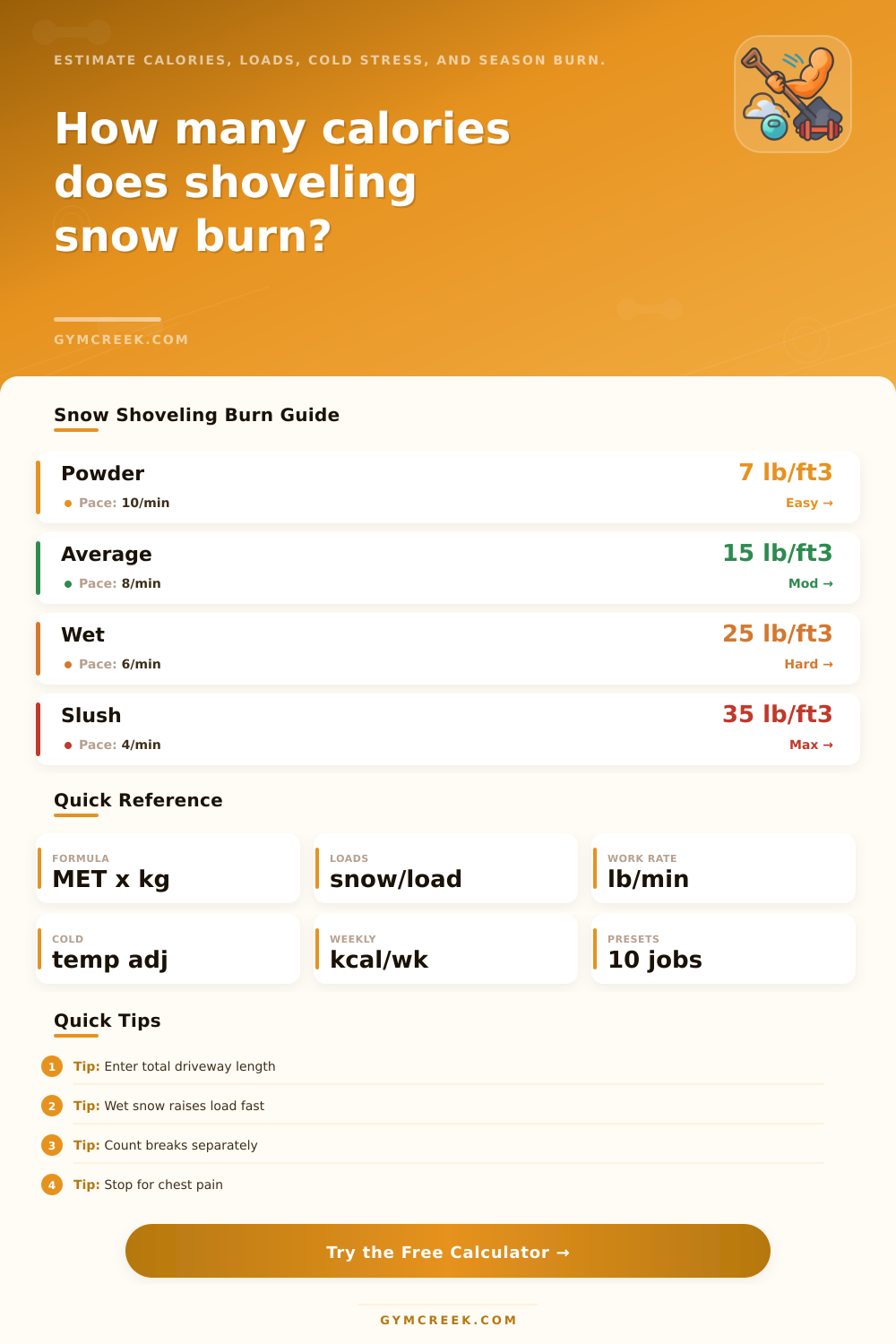
| Snow type | Typical density | Load effect | Calculator use |
|---|---|---|---|
| Powder snow | 6 to 8 lb per ft³ | Light but bulky | More scoops, lower lifting strain per load. |
| Light snow | 9 to 12 lb per ft³ | Manageable | Good default for dry storms and quick clearing. |
| Average packed snow | 14 to 18 lb per ft³ | Moderate | Typical driveway shoveling estimate. |
| Wet heavy snow | 22 to 28 lb per ft³ | High | Raises work rate and cold-stress effort. |
| Slush | 30 to 40 lb per ft³ | Very high | Use smaller loads and more breaks. |
| Effort | Base MET | Typical pace | Best match |
|---|---|---|---|
| Easy steady scooping | 4.5 | 3 to 5 loads/min | Light snow, pushing, short walks, low toss height. |
| Moderate driveway pace | 5.8 | 5 to 8 loads/min | Common driveway work with some lifting. |
| Hard lifting and throwing | 7.0 | 6 to 10 loads/min | Wet snow, repeated tosses, or faster pace. |
| Very hard deep snow | 8.0 | 4 to 8 loads/min | Deep banks, heavy loads, frequent bracing. |
| Max effort cleanup | 9.0 | 3 to 7 loads/min | Storm cleanup that feels like hard intervals. |
| Cold-stress score | Label | Meaning | Adjustment idea |
|---|---|---|---|
| Under 70 | Low | Breathing controlled and workload modest. | Keep a steady rhythm and avoid rushing. |
| 70 to 120 | Moderate | Normal winter effort with noticeable fatigue. | Use short breaks before technique changes. |
| 120 to 180 | High | Heavy loads, cold, or pace may be stacking strain. | Reduce load size and split the job. |
| 180 plus | Very high | Session resembles a hard outdoor interval workout. | Pause, warm up, or use mechanical help. |
| Metric | Formula used | Output | Why it matters |
|---|---|---|---|
| Calories | MET x 3.5 x kg / 200 x minutes | kcal | Standard exercise-energy model adjusted for shoveling intensity. |
| Snow weight | Area x depth x density | lb or kg | Estimates the total snow mass to move. |
| Loads moved | Snow weight / shovel load | loads | Connects storm size to actual scooping volume. |
| Work rate | Moved snow / active minutes | mass/min | Shows how hard the job is independent of total time. |
| Season burn | Session kcal x season sessions | kcal | Turns one storm into winter workload context. |
💡Tips
Shoveling snow can require alot of energy from teh body, and can also place a significant amount of stress on the heart and the back of the body. Many peoples finds that shoveling snow is a difficult task, especially due to the fact that the heart must work more harder when it is in cold temperatures to move the bodys blood, and the bodys back muscles must exert a lot of force to push the heavy snow. Thus, understanding the energy that is required for shoveling snow can allow an individual to decide how best to shovel the snow, whether they should divide the task into two section of shoveling, for example.
The snow calculator above can help an individual to calculate the energy cost of shoveling snow. The calculator consider the body weight of the individual, the length of time that they will be shoveling, and various characteristics of the snow that is to be shoveled. Characteristics of the snow include snow density (heavier snow will have more mass than light snow of the same depth), shovel load (how much snow is shoveled at once with the shovel), and the work pace (how fast the individual will shovel).
Shoveling Snow: How to Plan and Stay Safe
The calculation of an energy cost will also consider the effect of cold temperatures on the body. While it is tempting to focus on the total length of time that is required to shovel all of the snow on the walk, an individual should actualy focus upon the length of time that they are actively shoveling the snow. While it is true that taking breaks and reducing the total length of time that it takes for an individual to shovel all of the snow will reduce the total length of time and calories required to shovel the snow, it is also true that taking breaks will also affect the amount of snow that can be shoveled prior to the individual becoming fatigue.
Thus, by separating these two calculations within the snow calculator, an individual can more easily determine whether or not their session was productive relative to the total length of time spent shoveling snow. Finally, the snow calculator will calculate for an individual a cold-stress score, which is a score that considers how the load that is shoveled, the pace at which the snow is shoveled, and the air temperature interact with one another. A moderate cold-stress score indicates that the physical activity of shoveling snow was within normal limits for the body, while a high score indicate that the effort required was similar to shoveling snow at a rate similar to a hard interval workout.
Safety considerations relate to the knowledge that shoveling snow increases an individuals heart and blood pressure rate. Thus, individuals should be aware that shoveling snow is more physically demanding in temperatures that is below freezing. The reference tables above can help to indicate the various loads of snow of different types, and the effort (MET) values of different levels of physical exertion.
These tables can help to ensure that the individual know that the load and the pace at which they shovel snow is appropriate relative to the type of snow that must be shoveled. Snow conditions can be inconsistent between driveways, due to the effect of the wind. Plow piles of snow often contain heavier snow than the remainder of the driveway.
Thus, the calculations can be performed twice with the snow calculator to provide an individual with a more accurately estimation of the total energy that will be required to shovel all of the snow on the driveway. Each calculation can be performed separately for the snow that is found in the driveways (light snow) and the plow piles (heavy snow). Additionally, an individual can account for how often they shovel snow.
The individual that must shovel a long rural driveway will have a higher total workload than an individual that only has to shovel a short city sidewalk. Various other factors will impact the energy that is felt by an individual while shoveling snow, though not factors that are accounted for in the calculator. For example, using a smaller shovel will reduce the amount of snow that must be shoveled at once (load), but may require the individual to take more scoop to shovel all of the snow.
Pushing the snow instead of lifting it will reduce the MET value of shoveling snow, but only applies to flat surfaces. Additionally, attempting to reduce the strain on the back by keeping the shovel close to the body and using the legs instead of the back will have the same total mass of snow that must be shoveled. The snow calculator can assist an individual in planning the shoveling of snow.
By entering the characteristics of the snow before shoveling snow, an individual can make a determination as to whether or not shoveling snow should be divided into two sessions. Additionally, planning the shoveling snow in advance will ensure that an individual maintains a safer cold-stress score, and reduces the risk of developing any injury from shoveling snow at rates that are too strenuous for the body. You should of used the calculator more often to avoid being tired.