Shoulder Width Calculator
Estimate shoulder breadth, shoulder-to-height ratio, V-taper score, symmetry notes, and measurement quality from bony landmark and tape measurements.
📌Presets
Use a preset to see how direct shoulder breadth, circumference, waist, posture, and method quality change the estimate.
⚙Calculator
Shoulder width snapshot
Enter your measurements to estimate shoulder breadth and frame ratios.
📊Measurement Metrics
📑Reference Tables
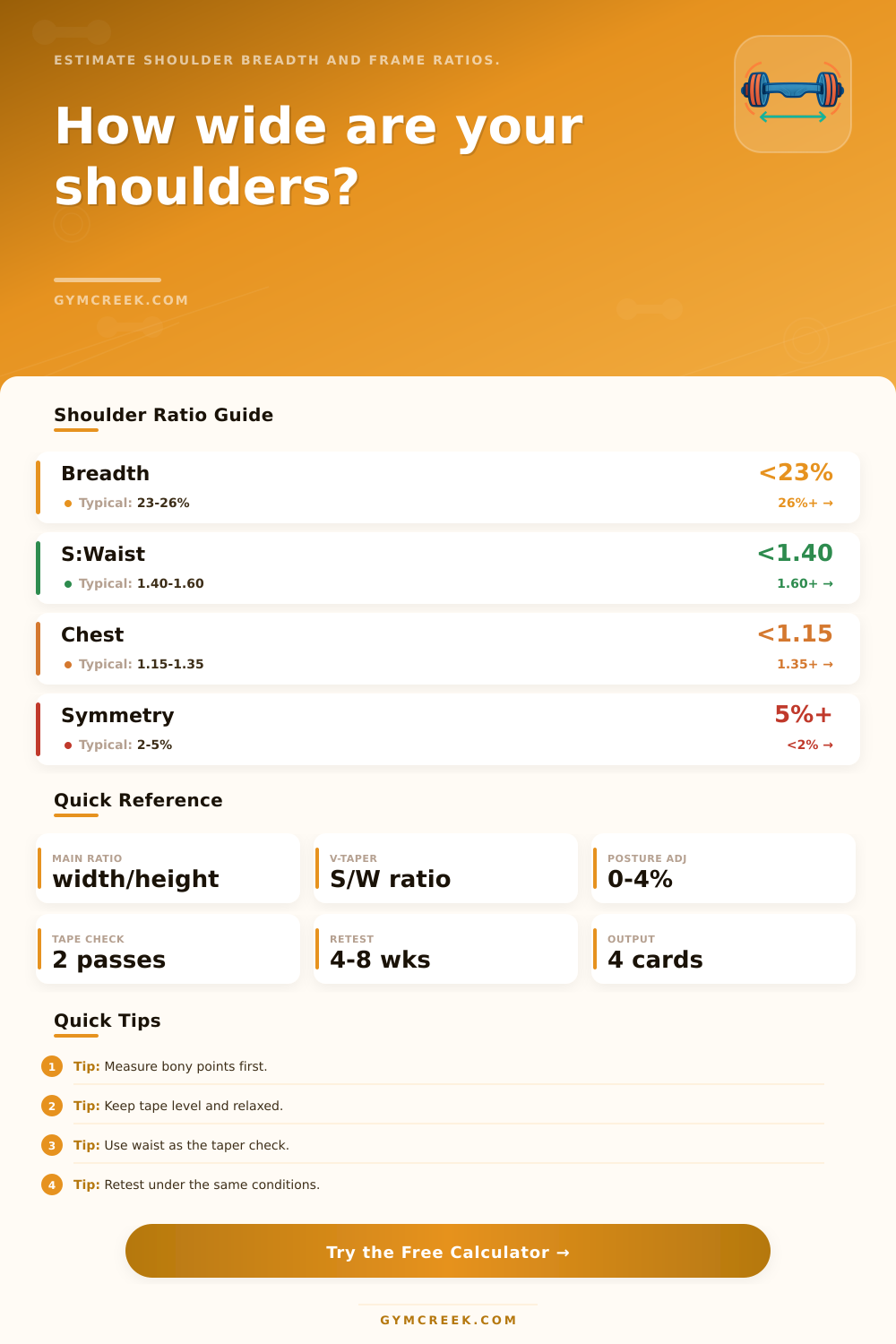
| Ratio | Frame read | Common note | Use |
|---|---|---|---|
| Under 22% | Narrow | Smaller frame | Baseline |
| 22-24% | Moderate | Common range | Compare |
| 24-26% | Broad | Wide frame | Track |
| 26%+ | Very broad | Large breadth | Verify |
| Metric | Formula | Typical | Flag |
|---|---|---|---|
| V-taper | Shoulder / waist | 1.40-1.60 | Low under 1.35 |
| Chest ratio | Shoulder / chest | 1.10-1.30 | Check tape |
| Hip ratio | Shoulder / hip | 1.15-1.35 | Shape context |
| Symmetry | Gap / width | Under 2% | Retest 5%+ |
| Method | Adjustment | Confidence | Best use |
|---|---|---|---|
| Caliper | 0% | High | Anthropometry |
| Helper tape | 0-1% | Good | Home tracking |
| Wall marks | 1% | Moderate | Self measure |
| Photo estimate | 3-5% | Low | Rough check |
| Layer | Input | Output | Reason |
|---|---|---|---|
| Direct breadth | Acromion width | Raw cm | Main input |
| Circ estimate | Shoulder tape | Width cm | Backup |
| Posture | Stance choice | Adj cm | Setup error |
| Ratios | Height, waist | Scores | Context |
💡Tips
Understanding shoulder breadth require you to understand the difference between muscle mass and frame structure. Most people use celebrity and athlete to compare their shoulder breadth. However, using an athlete as a point of comparison for shoulder breadth are inaccurate because an athlete’s frame cannot be altered.
To understand there frame, an individual must separate their muscle mass from their frame structure to determines their true frame. To understand their frame, an individual must first understand the difference between circumference and breadth. Many individual may take a tape measure around the shoulder to measure their circumference.
How to Measure and Understand Your Shoulder Width
However, this does not provide an accurately measurement of shoulder breadth. To obtain an accurate measurement of an individual’s shoulder breadth, they must calculate their biacromial breadth measurement. The biacromial breadth is the distance between the two bony point on an individuals shoulder.
This measurement will provide an accurate measurement of shoulder breadth. To calculate their biacromial breadth, an individual may struggle with the positioning of the tape measure on their body. It may be difficult for an individual to accurately measure the biacromial breadth of their body by themself.
To work around the difficulty of accurately calculating this measurement themself, calculators is available online to estimate an individual’s width. These calculators ask for raw breadth, circumference, and chest measurement. Calculators provide an adjusted width measurement because when individuals use tape measures to measure their shoulders, the tape measure may curve over the trapezius muscle.
This curvature may produce an inaccurate reading of the actual breadth of an individual’s shoulders. Using body markings in a photo of an individual or using the markings on a wall where the individual stood while taking the measurement may also introduce error into the calculation of an individual’s shoulder breadth. Calculators for determining shoulder breadth may incorporate a correction to the measurement if these methods is used to calculate the breadth of an individual’s shoulders.
Once an individual calculates their adjusted width, they can compare this to their height to determine their frame ratio. The frame ratio help an individual to determine the relationship between an individual’s shoulder breadth and their height. For instance, a person who has a shoulder breadth of eighteen inches and stands at six feet is more different than someone whose height is five feet five inches and who has the same eighteen inch shoulder breadth.
Using the frame ratio, an individual can determine the relationship between their frame to their height to determine whether their frame is narrow, moderate, or broad. An individual should also calculate their V-taper score. This score compare an individual’s shoulder breadth to their waist circumference.
For instance, an individual may have very broad shoulders, but if that individual also has a broad waist, their shoulders will not appear broad to the outside observer. The V-taper score is a measure of the contrast between the width of an individual’s shoulders and the narrowness of their waist. An individual’s V-taper score can be increase by focusing on increasing the narrowness of their waist while maintaining their shoulder breadth.
Athletes may focus on their V-taper score because a high score indicate that they have a broader frame. An individual’s posture can play a major role in their shoulder breadth. Poor posture can cause the shoulders of an individual to appear narrower than they are when standing in proper posture.
If an individual rolls their shoulders forward, their breadth will appear more narrower. An adjustment to their posture will help to provide a more accurate measurement of their shoulder breadth. An individual’s symmetry is another measurement that can be calculated.
An individual is not likely to be perfectly symmetrical on each side of the body. A large gap between an individual’s left side and right side of the body could be an indication of an injury to one side of the body. Any large gap in symmetry may not accurately reflect an individual’s true shoulder breadth.
However, if an individual monitors their symmetry, they can ensure that their muscle growth are even on each side of their body. Each of these measurements provide an individual with an understanding of their body frame without having to guess at their measurements. Each of these measurements can also help an individual to determine their goals for their body.