Shoulder-To-Waist Ratio Calculator
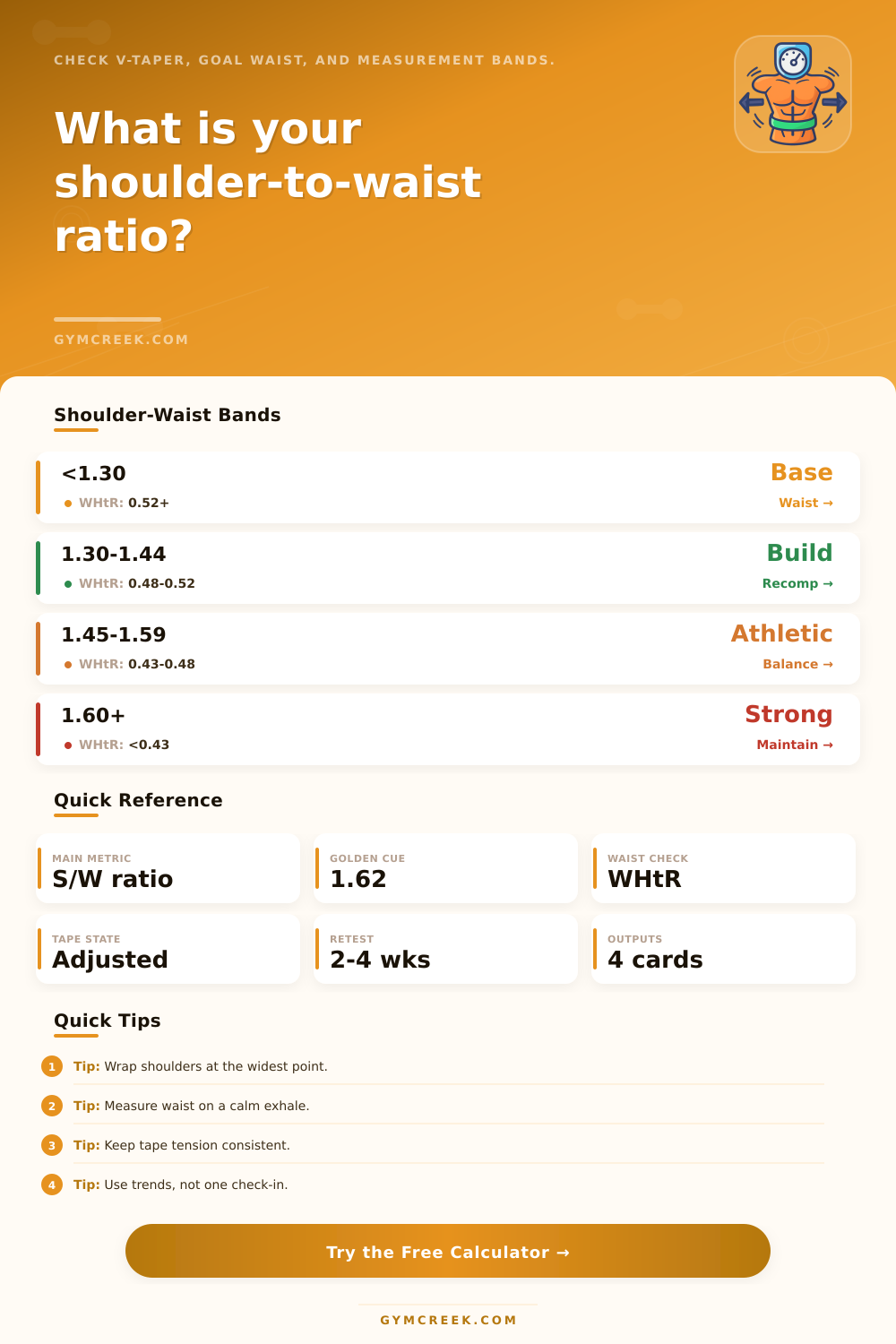
Calculate shoulder-to-waist ratio from corrected tape measurements, compare your V-taper band, estimate goal waist or shoulder targets, and check waist-to-height context.
📌Ratio Presets
Each preset fills a real tracking scenario, including tape posture and waist state, so you can see how the same ratio changes across cutting, bulking, sport, and recomposition contexts.
⚙Profile And Measurements
Shoulder-to-waist snapshot
Enter shoulder and waist measurements to calculate your ratio and target lane.
📊Metrics Grid
📑Reference Tables
| Template | Base | Athletic | Strong taper |
|---|---|---|---|
| Male V-taper | Under 1.35 | 1.45-1.59 | 1.60+ |
| Female athletic | Under 1.25 | 1.35-1.47 | 1.48+ |
| General frame | Under 1.30 | 1.40-1.54 | 1.55+ |
| Classic cue | Below target | Near 1.55 | Near 1.62 |
| WHtR | Read | Ratio effect | Tracking note |
|---|---|---|---|
| Under 0.43 | Very trim | Ratio rises fast | Verify energy |
| 0.43-0.48 | Athletic | Balanced lane | Track slowly |
| 0.48-0.52 | Moderate | Waist lever | Use trends |
| 0.52+ | Higher waist | Ratio capped | Health context |
| Input state | Shoulder adj | Waist adj | Why it matters |
|---|---|---|---|
| Slouched | Add 1.0 cm | No change | Shoulders read low |
| Lat spread | Subtract 1.4 cm | No change | Shoulders read high |
| Braced waist | No change | Add 1.8 cm | Waist reads low |
| Post-meal | No change | Subtract 1.2 cm | Waist reads high |
| Metric | Formula | Use | Output |
|---|---|---|---|
| S/W ratio | Shoulder / waist | Main taper | Band |
| Goal waist | Shoulder / target | Waist target | Length |
| Goal shoulder | Waist x target | Shoulder target | Length |
| Navy check | Ht, waist, neck, hip | Body-fat context | Percent |
💡Practical Tips
The shoulder-to-waist ratio is a measurement of the width of the shoulders relative to the width of the waist of an individual. The ratio of these two measurement creates a number that represents the wearer’s torso silhouette. While the calculator included in this tool can help an individual to calculate the ratio of they’re torso measurements, it is essential to understand the inputs and outputs of the tool in order to effectively use the shoulder-to-waist ratio.
The shoulder measurement is typically taken at the widest point of the shoulders and the upper back of an individual. The waist measurement is typically taken either at the navel of an individual or at the narrowest portion of an individuals waist above their hips. The calculator incorporated waist and shoulder measurement that account for factor that may influence those measurements, such as post-workout muscle pumps or the effect of a meal consumed recently.
How to Measure and Use Your Shoulder-to-Waist Ratio
The reference band that are represented in this calculator will shift based off whether an individual is selecting a template that represents a male, female, or general population measurement. Each of these group have physical differences due to differences in their skeletal structures, leading to the need for adjustment of the target ratio for each group. Furthermore, each individual should not aim to achieve the target number represented by the calculator, but should focus upon any change to that ratio over time.
The waist-to-height ratio for each individual can help to explain the influence that the waist measurement may have upon the shoulder-to-waist ratio. For individuals with low waist measurement, the ratio may naturaly be higher despite the shoulders of that individual remaining unchanged. Conversely, individuals with high waist measurements will have a lower ratio, even if their shoulders increase in size.
Thus, this calculator can help to an individual to determine whether they should increase their training volume for their shoulders or to focus upon managing their waist measurement. An individuals body fat percentage and level of physical activity will influence these suggestion for each individual. The goal lens option for the calculator will help to indicate to each individual the target ratio that they may aim for.
For individuals who wish to focus upon their health as the top priority, the calculator will indicate a more moderate target for their ratio. However, the calculator will increase their target ratio for individuals who desire to aim for either a classic V-taper or stage-lean definition of muscularity. Additionally, the calculator can indicate the goal waist or shoulder measurement that an individual must attain in order to reach that target if one of the measurement remains the same.
Thus, each individual can transition from a general goal to a specific step that they can take towards achieving that goal. A common mistake for individuals using this calculator is to believe that every measurement session represents the same level of reliability. A single measurement can drastically alter your shoulder-to-waist ratio more than a whole month of training can do.
The quality setting for the calculator assigns a lower confidence score if you use a photo or a single pass to measure your ratio. This score does not alter your ratio, but it warns you to exercise caution with the displayed measurement until youve taken a few check on your ratio. Another common error is trying to change your shoulder-to-waist ratio without understanding the different requirements for the shoulders and the waist.
Shoulders gain from heavy pressing and lateral raises, while the waist gain from diet and core exercises. The lever output for your results will show you which will have the fastest impact on your ratio. You can only change this if you can meet the requirement of that variable.
Your age and activity level can impact your target ratio. Since age impacts the amount of muscle your body carries and how your waist distributes the fat, younger individual tend to gain more muscle in their shoulders than older individuals. Activity level also affect your muscle mass.
The calculator accounts for this by capping your target ratio higher if you are more active. Your shoulder-to-waist ratio can interact with other body proportion. The calculator also provides you with the measurements of your chest-to-waist and shoulder-to-hip ratio.
A high chest-to-waist ratio and a low shoulder-to-waist ratio indicate that your bodys tapering comes from your rib cage rather than the muscle of your shoulder. This is crucial information because if your waist is the limiting factor in your ratio, then increasing the size of your shoulders will not necessarily help you with your ratio. Keep track of your measurement.
People tend to see the biggest change in the first 8-12 weeks of training and then gradually level off in the following training blocks. Retesting every 2-4 weeks will allow you to see if you are making any change to your ratio. For the ratio to work for you, ensure that you are taking the same measurement at the same time of the day and with the same tension on the tape measure.
Finally, you must also consider why you want to track your shoulder-to-waist ratio. For some individuals, the ratio is a health measurement like the waist-to-height ratio. For others, it is a measure of there physique.
The calculator allows you to switch between these goal to show you how changing your target waist or target shoulder can help with your goals. A shoulder-to-waist ratio is a neutral number, and ultimately, it is up to you what you want to prioritize with your body. This ratio can help you to understand if you need to focus more on one part of your body rather than the other.