Sheiko Program Calculator
Estimate Sheiko-style powerlifting loads from your squat, bench, and deadlift maxes, then preview weekly volume, average intensity, exercise frequency, and recovery flags.
📌Presets
These presets model practical Sheiko-style blocks rather than copying any official program sheet.
⚙Calculator
Sheiko-style block snapshot
Enter maxes to estimate loads, volume, and recovery demand.
📊Block Metrics
📋Weekly Program Table
| Week | Phase | Bench | Squat | Deadlift | Tonnage |
|---|---|---|---|---|---|
| 1 | Base | --- | --- | --- | --- |
📏Current Load Landmarks
| Lift | 60% | 70% | 80% | 85% | 90% |
|---|---|---|---|---|---|
| Squat | --- | --- | --- | --- | --- |
| Bench | --- | --- | --- | --- | --- |
| Deadlift | --- | --- | --- | --- | --- |
📑Reference Tables
| Template | Best use | Intensity | Volume |
|---|---|---|---|
| #29 base | Intro block | Moderate | Medium |
| #37 build | Volume base | Moderate | High |
| #30 bridge | Heavy practice | Higher | Medium |
| #32 prep | Meet approach | Peaking | Lower |
| Lift | Common work | Heavy cap | Watch |
|---|---|---|---|
| Bench | 60-85% | 90% | Elbows |
| Squat | 60-82% | 88% | Back fatigue |
| Deadlift | 55-80% | 85% | Recovery |
| Variations | 50-75% | 80% | Technique |
| Fatigue | Action | Intensity | Volume |
|---|---|---|---|
| 1-3 | Proceed | Normal | Normal |
| 4-6 | Monitor | Normal | Trim extras |
| 7-8 | Reduce | -2 to -4% | -10% |
| 9-10 | Deload | -5%+ | -20%+ |
| Formula | Input | Output | Use |
|---|---|---|---|
| Training max | 1RM x TM% | TM load | Cap work |
| Load target | TM x pct | Bar weight | Sessions |
| Tonnage | Load x reps | Volume | Stress |
| Stress score | Vol + pct | Flag | Recovery |
💡Tips
Sheiko-style training involve distributing the training volumes over several days, so that no exercise is tasked with performing the entire volume of training for that particalar lifter. Such training involve the use of specific intensity for the various lifts to build strength within those lifters, while also aiming to avoid excessive fatigue for those lifters. For these reasons, lifters often experience tightness and soreness after performing heavy squats, for instance, which can impact there ability to perform other exercises like deadlifts.
Furthermore, because the calculator incorporate each lifter’s maximum lifts, the frequency with which they perform these exercises, and their level of current fatigue, the calculator allows lifters to understand their tonnage and intensity for each week of training. Thus, using the calculator allows lifters to avoid guessing at their training volume and intensity. Many lifters make mistake when first using the calculator.
How to Use the Sheiko Training Calculator
For instance, many lifters set each percentage to a target value. These percentages, however, are only useful if the lifter understands their training maximum, which should be related to their one-rep maximum strength. Thus, the ability to adjust the training maximum percentage within the calculator is a helpful feature; lifters who exhibit high levels of fatigue, for instance, should begin with a lower percentage for their training maximum.
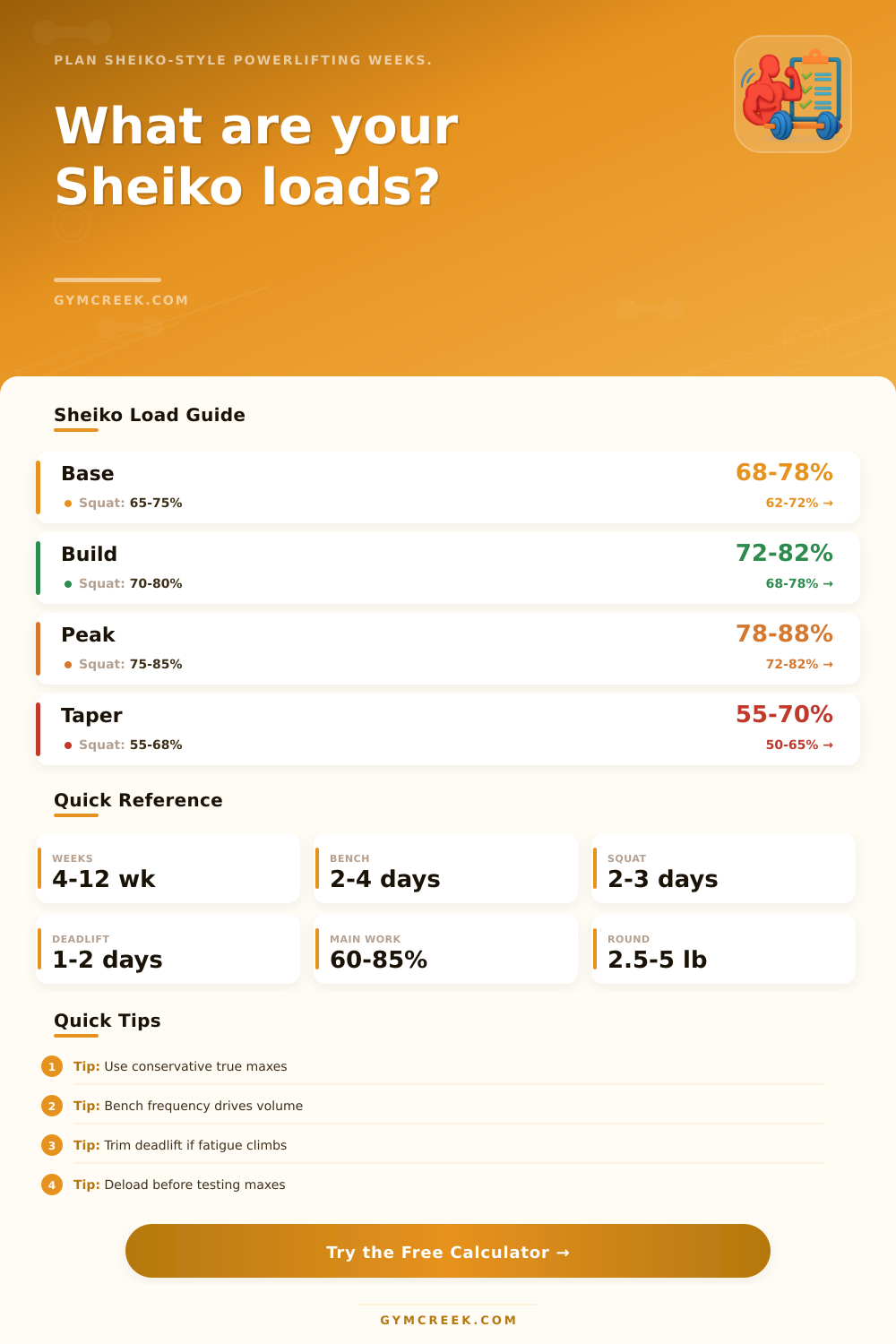
Furthermore, changing a percentage from one value to another will impact the number of repetitions that lifters perform over an eight-week period, which will help to avoid pain in joints like the elbows or the lower back. In addition to the percentages, the frequency with which lifters perform each exercise is another factor that should be considered. For instance, the lifter may perform the bench press three to four times each week, while the squat and the deadlift may only be performed two and one times each week, respectively.
Furthermore, the ability to select the number of days for each exercise within the calculator allows lifters to better understand how the tonnage rises with increased performance of each exercise. If the tonnage begins to rise too highly within the calculation, lifters may be required to either reduce their training intensity, or to take a deload period in their training program. Other considerations for lifters include there age and level of current fatigue.
These factors influence the recovery flag that the calculator produces. For instance, lifters who are of an older age may see a caution flag produced by the calculator, even with the same tonnage as younger lifters. Furthermore, while the caution flag isnt a hard stop for lifters, they may use the warning to adjust the number of accessory exercises that they perform, or to change a heavy exercise to a lighter variation.
Thus, changing the execution of the program will ensure that it can remain sustainabley for that individual’s body. The reference tables that are included within the calculator allow lifters to make decisions regarding their training. For instance, tables include the distribution of intensity for programs that include a base volume of training, or programs that is used to prepare for meets.
Each table can be used to match these training templates to an individual’s actual calendar. Thus, ensuring that the program matches an individual’s calendar will ensure that the calculations will fit the lifestyle and schedule of that lifter. The volume modifier is another setting for lifters to adjust within the calculator.
Furthermore, the volume modifier setting is quite sensitive to changes; changing from the standard setting to the high setting will compound the effort for each exposure. Thus, the lifter can see the average tonnage within the calculator, which will tell lifters if the increased training volume is worth the increased effort to recover from that type of training. Furthermore, if lifters feel that they are already near fatigue, increasing the volume to the high setting may lead to the lifters technique failing during the last sets of each exercise within the training sessions.
Finally, another factor that should be considered is the frequency for deadlifts. Deadlifts take more time to recover from than other exercises. Thus, the calculator defaults to one day of performing deadlifts each week.
Furthermore, if that is changed to two days each week, the tonnage for that exercise will rise. Thus, if lifters increase the number of days of deadlifts, their recovery flag may move to a caution setting earlier in their training phase. Furthermore, if the number of deadlift days is changed to two days each week, their technique with the deadlift should be monitored for those two days, and they should be ready to remove any accessory exercises if their back feel flat.
By calculating these variables in advance, lifters can have an overall view of their training program. Furthermore, such an understanding is better than understanding each session alone. Furthermore, lifters can understand how a deload period may impact their average intensity for each session, or how their date for competition may impact the taper period in their training.
While each adjustment may be small for any given day, those adjustments impact how lifters feel at the reach of the testing week for those lifter. Finally, while the training calculator is not a replacement for the judgment of a coach, it does remove the need to perform the math for those lifters. Thus, if the recovery and tonnage variables indicate that an individual may experience fatigue during that week, that coach will know the start of the program.
Furthermore, should the numbers indicate that adjustments to the program should be made, the coach will be notified in advance, thus avoiding any surprise to the lifter of the need to make those changes. Thus, using the numbers within the calculator will ensure that lifters training is both productive and not difficultly to endure.