Sets Per Muscle Group Calculator
Estimate weekly hard sets for any muscle group using training age, frequency, current volume, recovery, intensity, and exercise overlap.
📌Presets
Presets fill realistic volume profiles and calculate automatically so you can compare beginner, maintenance, hypertrophy, and priority-block scenarios.
⚙Calculator
Weekly set target
Enter your training profile to estimate a recoverable weekly set range.
📊Volume Metrics
📑Reference Tables
| Muscle Group | Maintenance | Growth Range | High End |
|---|---|---|---|
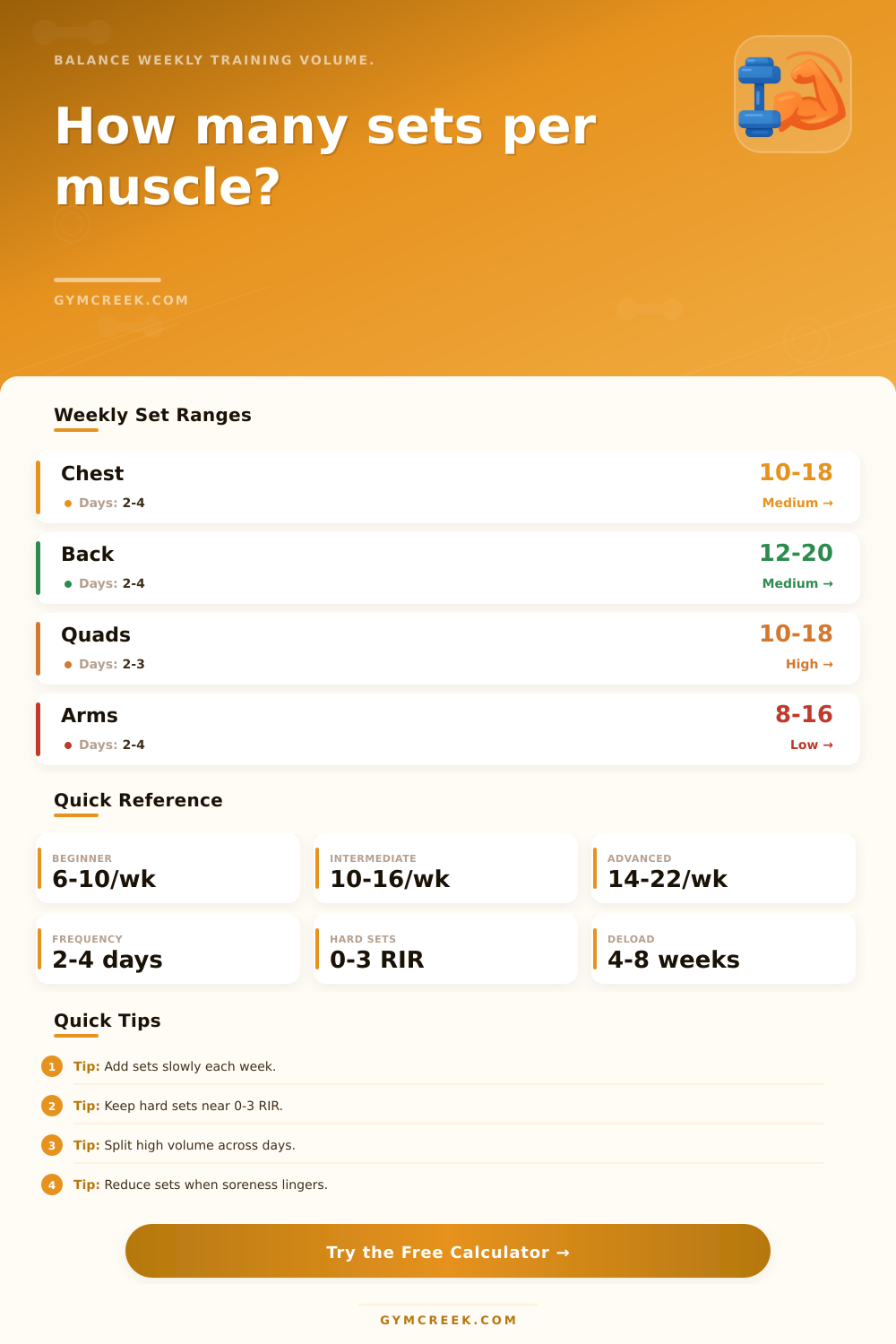
| Chest | 6-8 sets | 10-18 sets | 20+ sets |
| Back | 8-10 sets | 12-20 sets | 22+ sets |
| Quads | 6-8 sets | 10-18 sets | 20+ sets |
| Hamstrings | 5-7 sets | 8-16 sets | 18+ sets |
| Glutes | 6-8 sets | 10-20 sets | 22+ sets |
| Shoulders | 6-8 sets | 10-18 sets | 20+ sets |
| Biceps / Triceps | 4-6 sets | 8-16 sets | 18+ sets |
| Calves / Abs | 4-8 sets | 8-18 sets | 20+ sets |
| Training Age | Starting Volume | Weekly Change | Notes |
|---|---|---|---|
| Beginner | 6-10 sets | 0-2 sets | Technique limits volume |
| Novice | 8-12 sets | 1-2 sets | Progress from basics |
| Intermediate | 10-16 sets | 2-4 sets | Needs more specificity |
| Advanced | 14-22 sets | 2-4 sets | Use planned volume waves |
| Goal | Volume Bias | Effort Target | Best Split |
|---|---|---|---|
| Maintain muscle | Low to moderate | 1-4 RIR | 2 days per muscle |
| Build muscle | Moderate to high | 0-3 RIR | 2-4 days per muscle |
| Priority block | High for target | 0-2 RIR | 3-4 days per muscle |
| Fat-loss phase | Reduced slightly | 1-3 RIR | 2-3 days per muscle |
| Deload / rebuild | Low | 3-5 RIR | 1-3 days per muscle |
| Adjustment | When It Applies | Effect | Use |
|---|---|---|---|
| Recovery | Poor sleep or soreness | Drop 2-4 sets | Protect performance |
| Overlap | Heavy compounds | Count indirect work | Avoid hidden volume |
| RIR | Many sets at failure | Reduce top end | Manage fatigue |
| Frequency | High weekly sets | Split across days | Keep set quality high |
💡Tips
Many individuals who intends to build muscle often do a high amount of exercises at the gym. However, many peoples do too much and fail to see any results. Even though the belief of many gym-goers are that performing more exercise will result in more muscle growth, there is a limit to an amount of exercise that the body can use to create muscle growth.
Performing too little exercise will result in the individual being unable to build as much muscle as they could of. At the same time, performing too much exercise will also prevent the individual from being able to build muscle, as they will be too fatigue for there muscles to grow, as they will experience pain in there joints from overexertion. Therefore, there must be some specific amount of exercises that is productive for the individual’s body.
How many sets should you do for each muscle each week
The concept of weekly volume is the total amount of hard set that an individual performs each week. To keep track of the total amount of exercise that an individual performs each week, the sets per muscle group calculator will help to determine the amount of volume that each individual should perform each week. The reason that each individual will not have the same amount of weekly volume is due to each individual’s training age.
The more inexperienced individual with the muscles will require a lesser amount of volume to adequately stimulate the growth of that individuals muscle. However, the more experienced individual will require a much more higher amount of volume to stimulate the muscles to grow. An essential exercise variable that will impact the amount of volume that can be performed is that of recovery.
If an individual does not sleep enough or if they have high levels of stress, their body will not have enough time to recover from the amount of exercises that they perform. An individual that works in a sedentary office job will require a different amount of recovery than an individual that has high levels of physical activity during there daily work. A sets per muscle group calculator will account for the difference in recovery between individuals.
Another component of the training routine is the amount of intensity with which the sets are performed. The higher the intensity with which the sets are performed, the more fatigue that will be place into the muscles. If the sets are of high intensity with the goal of reaching 0 reps in reserve (RIR), the body will experience fatigue with the performance of such sets.
In this case, the individual should decrease the total number of sets to avoid overexertion of their muscles. The intensity of the sets that are performed will also impact the total amount of sets that are performed. The concept of compound overlap ensure that one exercise can work two or more muscle group at the same time.
For example, performing a bench press will result in the triceps and shoulders also performing work with the movement of the body. If too much volume is performed for these muscles after performing a bench press, an individual will be overexerting these muscles. A sets per muscle group calculator accounts for this compound overlap in the calculation of the total amount of sets for each muscle group.
A sets per muscle group calculator will provide an individual with a recommended range for the amount of sets that they perform each week. The concept of a recommended range acknowledge the biological process of muscle growth. If the sets per muscle group calculator shows that an individual should increase the number of sets that they perform for each muscle group, they should slowly increase the number of sets.
If an individual’s performance decreases over two training session in a row, they are overdoing the amount of exercise that they should perform. The volume of sets that must be performed will differ when an individual is in a fat loss phase. An individual will not be able to recover as much from the amount of exercise that is required of them when they are losing fat.
Therefore, the individual will have to incorporate a lower volume of exercises into the training routine. A high volume of exercise when dieting will put the body in danger of injury. During the fat loss phase, the amount of sets that are performed should be the minimum amount necessary to preserve the existing muscle of the body.
Too much exercise will use up all of the energies of the body. Using a system to calculate the starting volume of sets for each muscle group will prevent an individual from performing too little or too much exercise. Some individuals can take in high amounts of exercise, while others will be unable to take in too much volume with their muscles.
The goal of the training program for an individual will be to find the amount of volume that will challenge their muscles to the point of muscle growth, while providing enough recovery for them to train again. With an understanding of the variables of sets per muscle group, individuals can begin to move away from guessing the amount of exercise that they should perform each week, and instead use a system that is sustainable for each individuals body.