Session RPE Calculator
Estimate internal training load from duration and RPE, then adjust for modality, intensity block, soreness, readiness, session goal, athlete type, weekly load pattern, and recovery context.
📌Named Session Presets
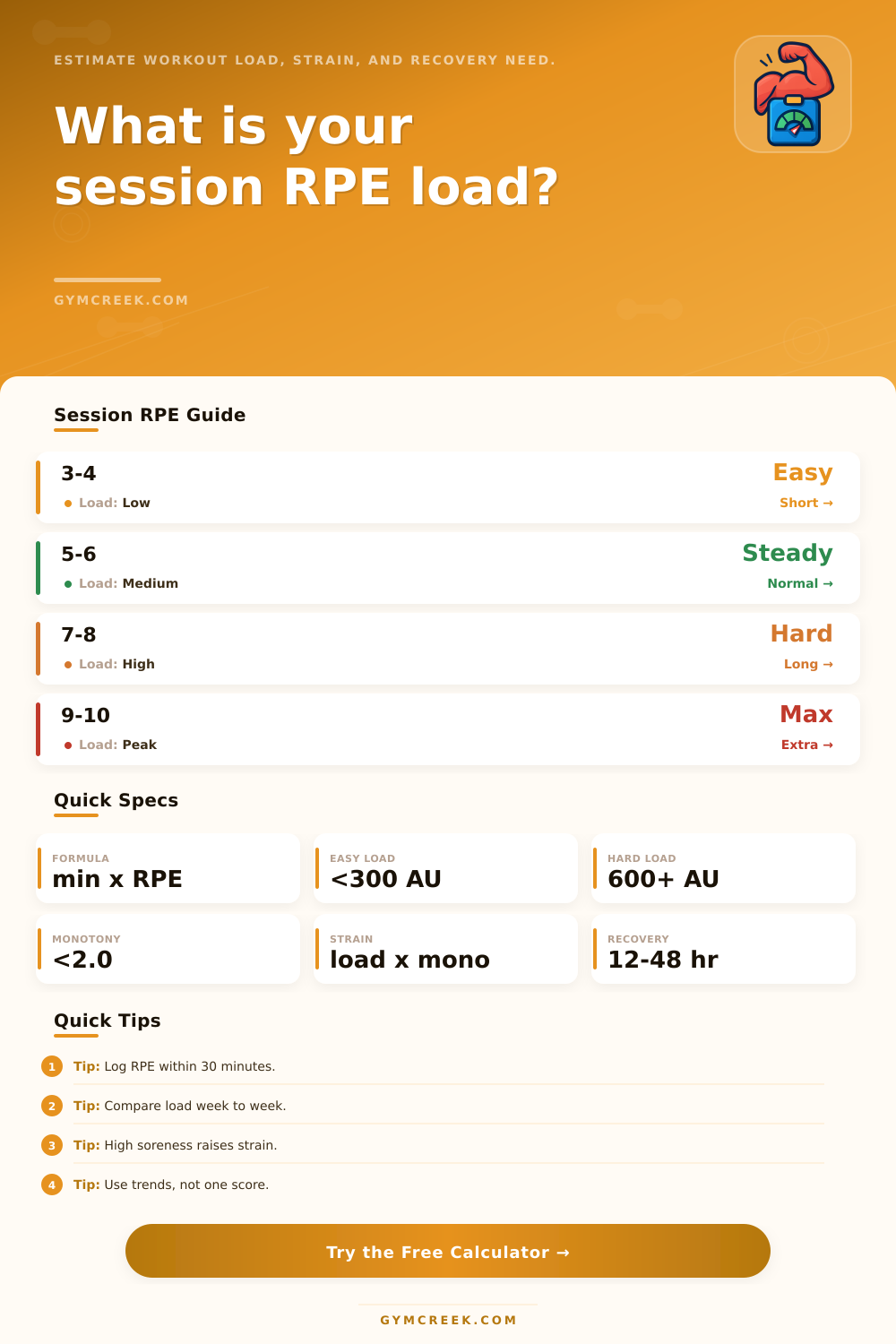
Session RPE load is commonly logged as duration in minutes multiplied by a 0 to 10 perceived exertion score, then interpreted against trends.
⚙Session Inputs
Session RPE snapshot
Enter session details to calculate load, strain, readiness impact, and recovery spacing.
📊Session Metrics Grid
📑Session RPE Tables
| Component | Input | Multiplier | Effect |
|---|---|---|---|
| Duration | --- | --- | --- |
| Band | Load Range | Typical Feel | Usual Follow-Up |
|---|---|---|---|
| Recovery | 0-199 AU | Easy, low fatigue | Can repeat or pair with skill |
| Moderate | 200-399 AU | Useful training, manageable | Normal next-day training |
| Hard | 400-699 AU | Meaningful strain | Separate hard work when possible |
| Peak | 700+ AU | High internal load | Plan recovery and monitor soreness |
| Session Type | Load Trait | Watch Signal | Good Use |
|---|---|---|---|
| Running or court conditioning | High eccentric cost | Calf, quad, tendon soreness | Base, threshold, race prep |
| Strength and hypertrophy | Joint and tissue stress | Bar speed, deep soreness | Strength, size, testing |
| Swimming or cycling | Lower impact load | Power drop or heavy breathing | Volume, aerobic work, recovery |
| Mixed or team sport | Variable spikes | Collision, change of direction | Specific conditioning and skill |
| Caution Score | Meaning | Next Hard Work | Coach Note |
|---|---|---|---|
| Low | --- | --- | --- |
💡Session RPE Tips
There are days where a workout appears doable on paper, yet by day’s end you’re fatigued. Perhaps you slept poorly the night before. Maybe it was a hot day in the gym due to high humidity levels. Often times, there’s a bigger cost to your body then expected based off planned reps and sets.
Session RPE help close that gap between “plan” and “reality”. It focuses attention less on what you do and more on how your body respond. It’s a simple multiplication thing. Multiply subjective effort scores by total minutes. It sounds like a raw number that doesn’t tell the full story, a sixty minute sprint and a sixty minute walk are both sixty minutes, yet they needs varying amounts of recovery. The calculator takes care of that math for you.
How Session RPE Helps You Train Smarter
The data becomes useful when it add a bit of context to your life. Modifiers include type of work, muscle soreness, and current readiness. They’re the difference between a productive session and an overreach. Each modality have its own level of stress to the body. Swimming is easier on your connective tissue, whereas running put high levels of eccentric load on your joints. Modality input impacts the stress score and accounts for physical toll of the activity. This helps promote long term health.
For example, many people treats their high impact running workout as a low impact cycling workout. This is an invitation for injury. The other danger is monotony, working out too similarly, day after day. Your body will stop adapting if each session in a given week contain the same load. You’ll begin breaking yourself down rather than adapting.
Calculate your overall load ratio for the week, as well as standard deviation on how hard each day’s workout was. Is this showing that you’re in a rut? Are you approaching burnout? Finding the balance between high strain and purposeful recovery are the goal. Take these as a guideline rather than a hard and fast rule. So if the algorithm says wait another forty eight hours before you go at it again but you’re feeling peppy, follow your gut. But when your muscles is still deeply sore and caution scores are creeping up, heed the warning. You should of listened to your body sooner.
It’s an even split between challenge and recuperation. You want to be on the edge of your limit without crossing into systemic fatigue. Trends matter more than individual instances in training. An isolated high-load workout is fine. Stacking max load workouts for weeks with no recovery will lead to burnout. Log it. Track your readiness over time. Let numbers guide your hunches. That’s how you transform guesswork into a thoughtful plan for improvement.