Sedentary Calorie Calculator
Estimate a low-activity maintenance target, goal calories, sitting-load context, protein range, and weekly calorie target from body size and real desk-day habits.
◎Presets
Presets load realistic sedentary profiles and recalculate instantly.
⚙Calculator
Sedentary calorie snapshot
Enter your body stats and desk-day habits, then calculate.
▦Fitness Metrics
▣Reference Tables
| Sedentary signal | Typical range | Calorie effect | How to use it |
|---|---|---|---|
| Very low steps | Under 3,000/day | Lower TDEE | Use a conservative maintenance estimate |
| Desk baseline | 3,000-6,000/day | Near 1.20-1.30x BMR | Common office-worker starting point |
| Frequent breaks | 8+ breaks/day | Small NEAT lift | Useful before cutting more food |
| Exercise minutes | 60-180/week | Raises weekly average | Spread calories across the whole week |
| Goal mode | Daily target | Best rate | Review note |
|---|---|---|---|
| Fat loss | 10-20% below maintenance | 0.25-0.75% BW/week | Keep steps consistent before adjusting |
| Maintenance | Near maintenance | Stable trend | Use a 14-day weight average |
| Recomposition | Small deficit or hold | Slow scale change | Prioritize protein and training quality |
| Lean gain | 5-10% above maintenance | 0.1-0.3% BW/week | Small surplus is usually enough |
| Profile | Sitting | Steps | Expected multiplier |
|---|---|---|---|
| Remote desk day | 9-11 hours | 2,500-4,500 | About 1.18-1.24x BMR |
| Office plus commute | 8-10 hours | 4,000-6,000 | About 1.22-1.30x BMR |
| Desk plus light gym | 7-9 hours | 5,000-7,500 | About 1.30-1.40x BMR |
| Limited mobility | 10+ hours | Under 3,000 | About 1.12-1.20x BMR |
| Formula piece | Inputs | Used for | Why it matters |
|---|---|---|---|
| Mifflin-St Jeor | Age, sex, height, weight | BMR baseline | Strong general starting estimate |
| Katch-McArdle | Lean body mass | BMR alternate | Useful if body fat is known |
| Sedentary multiplier | BMR and movement | Maintenance | Captures low-activity energy needs |
| Energy balance | Goal rate | Target calories | Turns weekly weight goal into kcal/day |
◇Tips
You’ve got an idea of how many calories you should be consuming. You might recall a biology lesson or maybe saw a number appear on a fitness app, it is more complicated. Calories don’t just get burned on the treadmill; they’re burned when you sit at your desk, fiddle with your phone during calls, keep your heart beating.
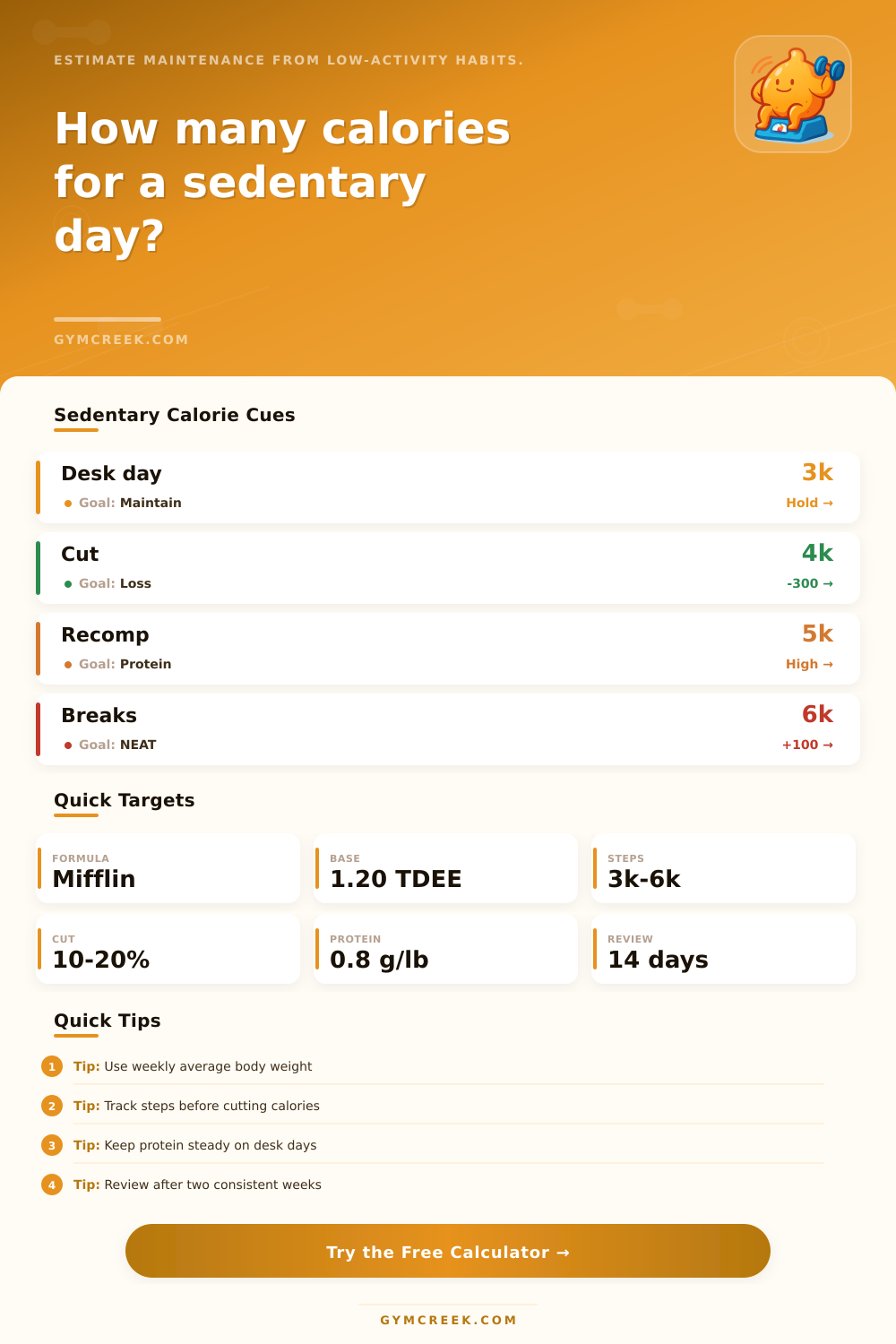
Enter your stats into the calculator above and it’ll do the math for you, spares you having to guess what coefficient best match your specific lifestyle. Start at the bottom with your Basal Metabolic Rate (BMR). How much energy does your body need in order to maintain life if you were in bed all week? Weight, height, sex and age determines BMR. For this reason, most calculators uses the Mifflin-St Jeor formula, which has been found to be more accurate then previous ones.
How to Count Calories on Rest Days
But here’s where most of us screw up. Most of us see the BMR number and call it quits. BMR isn’t even the beginning; its just the starting line. From the moment your feet hit the floor in the morning until you pass out in bed at night, everything you do should factors into equation.
So let’s talk about NEAT: Non-Exercise Activity Thermogenesis. What does that mean? It means the calories you burn from all of the movement you do in your daily life, other than your structured exercise sessions. These include standing up when you need to get water, walking to printer, and pacing while on phone. It accounts for a huge range of activity if you’re sitting at work all day long. A guy with only six little breaks throughout the day could be burning far more then an office bro who sits down for eight straight hours.
To account for this sneaky calorie-burner, the calculator will ask you how often you stand up, how many steps you take per day and how many hours you sit every day. It doesn’t sound like much, those three hundred additional steps adds up to a big difference between staying the same and gaining half a pound each month.
For fat loss, this is important because when you cut aggressively on low activity days, it tend to backfire. You’ll eat 1500 (strict) but maintain at 2000. So your metabolism slows down. All of the things it doesn’t need to do slows down. The tool guards against this by applying a floor to the number of calories you can consume, based off your size & inputs. It keeps you from starving yourself, ensuring recovery is possible.
Once you reach this bottom floor, then yes, it’s time to add something instead of cutting more away. Let’s take another peek at protein. Muscle preservation is more difficult with decreased activity. Sure, you’re not breaking down muscle fibers on a busy desk day like you would during a heavy lifting session, but you do requires amino acids for daily repair. Set your per-pound-of-body-weight protein target in the calculator. Maintaining protein intake on desk days will help save muscle tissue on a deficit. There’s no magic number here. This simply supplies enough substrate to ensure that your body isn’t resorting to muscle for energy.
The reference tables included with the tool offer context that raw numbers can’t provide: they show how different profiles, like remote workers versus commuters, shifts the expected multiplier. These demonstrate what happens when various profiles change resulting multiplier. Obviously, if you’re a commuter, you’ll burn more energy through transit than if you work from home and walk nowhere. Knowing this means trusting in results. It’s data informed, not set in stone.
Lastly, check in every two weeks. Don’t worry about day-to-day fluctuations; use average weights from each week instead. Slowly nudge your steps and/or calories if you’re stuck in a rut. Remember that this should of been sustainable, not a one-off shock to the system.
When you treat your sedentary days as intentionally as workout days, you take back control over those invisible variables. Now, you’re controlling the energy balance of an office day. This mindset change turns passive time into an active part of your strategy.