Seated Row to Barbell Row Calculator
Estimate a realistic bent-over barbell row target from your seated cable or machine row load, reps, pulley ratio, handle style, and technique confidence.
📌Row Conversion Presets
Presets load realistic seated row situations. Adjust the pulley multiplier if your machine feels lighter or heavier than the number on the stack.
⚙Calculator
Barbell row conversion snapshot
Enter your seated row set to estimate a barbell row target.
📊Fitness Metrics Comparison
📑Reference Tables
| Seated Row Setup | Typical Base Transfer | Why It Changes | Use In Calculator |
|---|---|---|---|
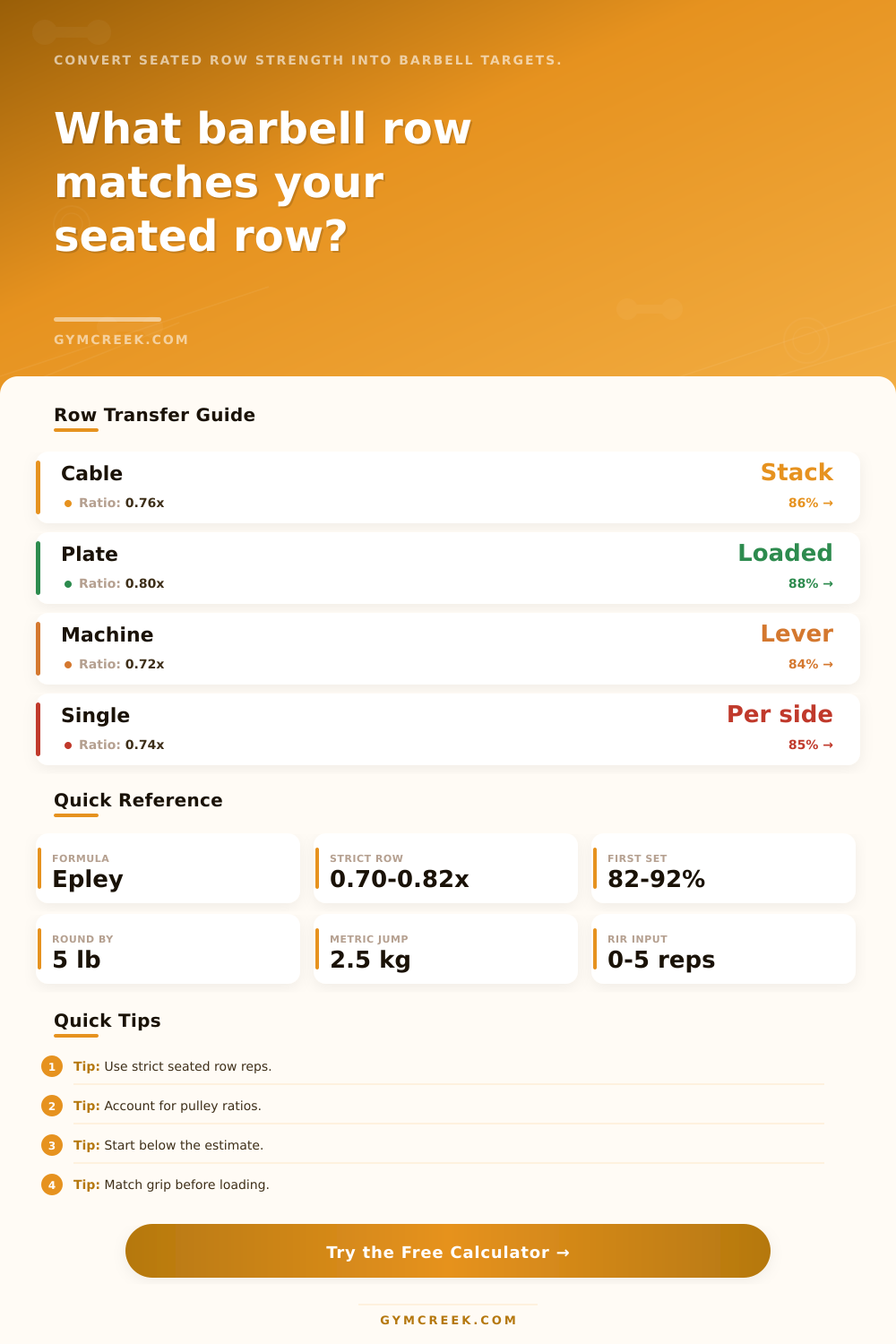
| Cable stack seated row | 0.74-0.80x seated 1RM | Stable pulley row loses support when you hinge over a barbell | General cable conversion |
| Plate-loaded seated row | 0.78-0.84x seated 1RM | Often closer to free-weight loading if the path is not too guided | Heavy plate row transfer |
| Selectorized lever row | 0.68-0.76x seated 1RM | Machine path and torso support reduce trunk demand | Conservative machine transfer |
| Chest-supported machine row | 0.66-0.74x seated 1RM | Chest pad removes much of the hinge and bracing work | Pad-supported conversion |
| Single-arm cable row | 0.70-0.78x two-side equivalent | Unilateral control transfers well, but barbell grip fixes both hands | Single-arm row comparison |
| Barbell Row Style | Load Effect | Best Comparison | Technique Note |
|---|---|---|---|
| Strict bent-over row | Baseline | Cable row with little torso swing | Keep hips back and torso steady |
| Pendlay row from floor | Lower working load | Dead-stop machine row or paused cable reps | Every rep starts from the floor |
| Underhand barbell row | Slightly higher load | Underhand seated row handle | Biceps and lats may contribute more |
| High-torso Yates row | Higher working load | Upright seated row path | Shorter lever and more upright torso |
| Confidence Level | First Set Factor | Use When | Practical Check |
|---|---|---|---|
| New to barbell rows | 82-84% of target | Hinge, grip, and bar path feel unfamiliar | Leave several clean reps in reserve |
| Some barbell row practice | 86-88% of target | You know the motion but need rhythm | Verify torso angle before adding load |
| Steady and repeatable | 90-92% of target | Technique looks the same across sets | Warm up and match rep speed |
| Advanced row technique | 92-95% of target | You already train heavy barbell rows | Use normal ramp-up sets |
| Formula Step | Formula | Variables | Purpose |
|---|---|---|---|
| Normalize seated load | Shown load x pulley x side factor | Load, multiplier, arm setup | Estimates comparable resistance |
| Seated row 1RM | Load x (1 + reps / 30) | Adjusted reps plus RIR | Uses the Epley rep formula |
| Barbell row 1RM | Seated 1RM x transfer factors | Equipment, support, handle, style | Maps guided row to free row |
| Target working load | 1RM / (1 + target reps / 30) | Barbell 1RM, target reps | Finds the set weight to load |
| Common Scenario | Likely Result | Main Limiter | Adjustment |
|---|---|---|---|
| Heavy chest-supported row | Barbell target drops more | No torso bracing on machine | Use a lower first set |
| Strict cable row with pause | Cleaner transfer | Grip and torso angle | Match elbow path |
| High-rep seated row set | Less exact 1RM estimate | Endurance affects Epley math | Retest around 6-10 reps |
| Single-arm cable row | Good lat transfer, lower bar load | Fixed bar path changes shoulder motion | Start conservative |
💡Tips
If you go into a commercial gym, there’s going to be somebody who can pull two-hundred pounds on a seated cable row. They has good posture. Their breath is under control. Their lats are firing up. They also have a look on their face like they could handle something similar with a barbell for bent-over rows. You’d think so, but more often than not, you’d be mistaken.
Free-weight hinging and supported pulling don’t relate in a straight line. In fact, it takes posterior chain endurance, core bracing, and stability, which are all things the seated machine doesn’t ask for nearly as much.
Why Machine Rows Are Easier Than Barbell Rows
When you enter your rep count and the machine load into the calculator above, it spit out the answer for you. No more figuring out conversions, no more guesswork with coefficients. But it will still make your number smaller and here’s how: The pad is taking some of the work off of your back when you’re sitting up against a thigh brace or chest plate. Your torso is now essentially a part of the machine itself. You don’t have to use your back muscles to prevent yourself from folding over. Those same muscle have to stabilize the hinge position under tension as your arms pull the bar during a strict barbell row. This increases the demand on your hips and midsection, so your lats move less total load.
When people compare exercises they only consider grip style and/or handle style (i.e., an overhand barbell grip vs. A neutral cable handle). But there’s more. The path of weight changes, which shifts the leverage around the shoulder joint. For instance, with a Pendlay row you have to bring the bar back down to the floor after each repetition. That dead-stop adds a lot to the amount of starting force needed. This is different from a touch-and-go rep on a machine where momentum can help pull you past the hard part.
When someone has low confidence in their hinge mechanics, then the tool will recommend a conservative first set because technique failure typically happens before muscular failure in this type of transition.
Grip width matters less than you might think, provided your elbows track similarly. That said, it’s not nearly as important as your total body position during the seated row. Did you swing wildly to finish out those final couple of reps? Momentum will increase the machine load number. This is why the calculator leaves room for reserve; the more reserve, the lower the estimated one-rep max. Since we’re trying to keep our barbell prediction on the safe side, the lower estimate is preferable. You don’t want to go up there with the idea you’ll be able to crank three hundred pounds, only to have your core stabilize at two hundred. Under-predicting a bit is safer than overestimating.
To get a sense for these translations, check out the reference tables within this tool. For example, the movement path of plate-loaded machines tends to be closer to a free-weight experience, which translates into better strength transfer different than selectorized lever machines. The latter is so tightly guiding the motion that it conditions you to work very specific angles instead of just general pulling strength. So while weight might look lighter on paper then what you’re accustomed to, your body will feel out-of-whack when attempting a barbell for the first time if it’s been conditioned to a highly guided machine. This is not necessarily due to any weakness in your back muscles, but rather an unfamiliarity with holding tension through an unsupported range of motion.
For the first week or two, start lighter than the estimate suggests. Treat the number from the calculation as a ceiling rather than a goal to reach by Day 1. When starting out, your back muscles will be ahead of your stabilizer muscles (hip hinge, grip). Over time, as they all come into form, your barbell row should gradualy match your seated row.
You’re trying to build a back that is strong enough to move heavy loads and stable enough to keep your spine protected. It’s much better to learn to support yourself versus having a machine perform the task for you. Whether you’re pulling off a cable stack, a rack or the ground, the same level of discipline applies. You should of practiced more.