Scrambled Egg Calorie Calculator
Estimate scrambled egg calories from egg size, count, egg whites, milk, butter, oil, cheese, vegetables, meat add-ins, pan retention, cooking loss, servings, and fitness context.
📌Scrambled Egg Presets
Presets fill real scrambled egg scenarios. Adjust the retained pan fat if butter or oil remains in the skillet after cooking.
⚙Calculator Inputs
Scrambled egg nutrition snapshot
Enter eggs, milk, fat, add-ins, and servings to estimate the pan.
📊Scrambled Egg Metrics Grid
📑Reference Tables
| Egg Input | Typical Amount | Calories | Protein |
|---|---|---|---|
| Small whole egg | 43 g edible | 54 kcal | 4.7 g |
| Medium whole egg | 50 g edible | 63 kcal | 5.6 g |
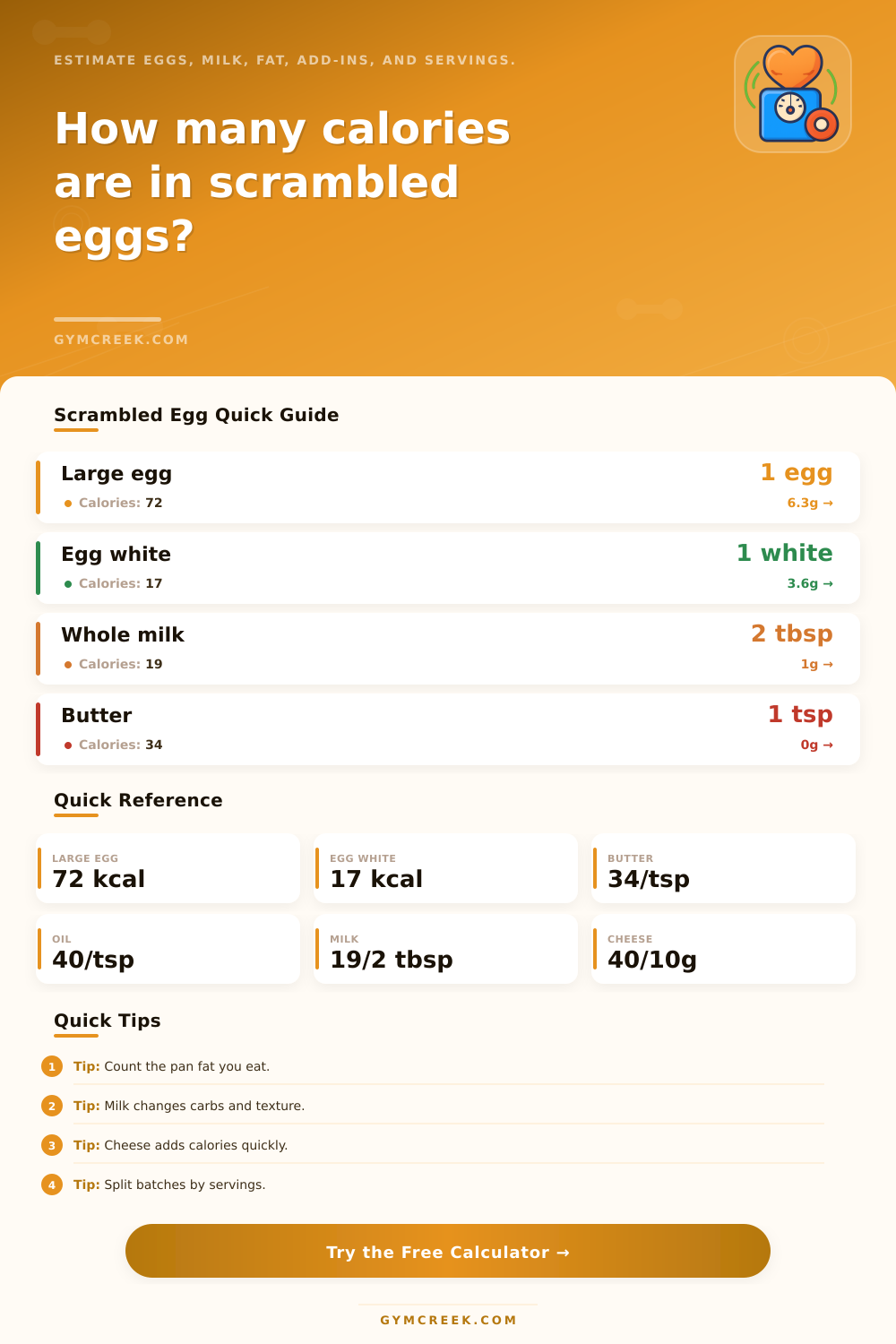
| Large whole egg | 56 g edible | 72 kcal | 6.3 g |
| Extra large egg | 63 g edible | 80 kcal | 7.0 g |
| Jumbo whole egg | 70 g edible | 90 kcal | 7.9 g |
| Egg white | 33 g edible | 17 kcal | 3.6 g |
| Milk Or Fat | Calculator Role | Calorie Basis | Macro Note |
|---|---|---|---|
| Skim milk | Moisture | 34 kcal/100 ml | More carbs |
| 2% milk | Classic texture | 50 kcal/100 ml | Protein plus fat |
| Whole milk | Richer texture | 61 kcal/100 ml | Higher fat |
| Butter | Pan fat | 7.17 kcal/g | Mostly fat |
| Olive oil | Pan fat | 8.84 kcal/g | All fat |
| Spray | Light coating | 6 kcal/g | Small dose |
| Add-In | Typical Use | Calories | Macro Note |
|---|---|---|---|
| Cheddar | Flavor and melt | 40 kcal/10 g | Fat and protein |
| Mozzarella | Mild cheese | 30 kcal/10 g | Protein support |
| Vegetables | Volume | 25 kcal/100 g | Carb and fiber |
| Lean turkey | Protein add-in | 135 kcal/100 g | High protein |
| Cottage cheese | Soft curds | 98 kcal/100 g | Protein plus sodium |
| Scramble Style | Water Loss | Calories | Use Case |
|---|---|---|---|
| Soft scramble | 8% | No change | Creamy eggs |
| Medium curds | 12% | No change | Everyday plate |
| Firm scramble | 16% | No change | Meal prep |
| Dry scramble | 20% | No change | Lower moisture |
💡Tips
With eggs, we’re generally used to thinking about them as multiples: Two eggs equals a normal portion; four equals a nice serving. But an egg isn’t a caloric capsule; it’s an ingredient whose nature change based upon its use (what else you cook with it) and how much fat lingers in your pan. A scramble begins life as protein, then becomes a vehicle for oil or butter if unguarded. You want to achieve certain macro goals while avoiding transforming breakfast into grease trap. Actual intake is important; the number of shells doesn’t matter. But by far, single largest variable is cooking fat.
It’s easy to guess you used half a tablespoon of butter, but did you measure? How can you be sure if you didn’t? There are about seven calories in each gram of butter, which mean an extra couple of grams adds a dozen calories to your breakfast. Doesn’t sound like much, right? Until you do this three times a week for a month. By asking how many grams of actual fat made their way into your mouth, the calculator helps here as well.
Why Tracking Eggs Helps You Reach Goals
Maybe you slid your eggs onto a plate and left puddle of melted butter in pan; those calories never touched your body. If you account for that retention rate, you’ve got lean protein meal instead of heavy start to the day. And then there’s milk, which do more than just fluff things up. Whole milk brings in fat and saturated carbs. Skim milk contributes primarily moisture and lactose.
That standard thirty milliliter splash of whole milk provides roughly one gram of protein and nineteen calories. Sounds trivial, but it tips the macronutrient scales a bit in favor of carbs rather than straight-up protein. And if you’re on a diet where carbs are watched or calories, that splash counts. It’s not simply water; it’s liquid nutrition, and unless you measure it instead of pouring by feel, it can add up fast.
Then there are solids, like adding cheese. It’ll pack in calories (ten grams of cheddar equals 40) and pile up on sodium big time. Mushrooms and spinach, however, have almost no caloric cost but will load up your omelet with fiber and bulk, an ideal way to feel full without overdoing it. Turkey or ham can pack even more protein, but be aware that lean meat also comes with a fat makeup based off the cut. With this tool, you enter the additional ingredients separately so you know exactly what each one do to total calorie count.
Guessing that a cheese-laden scramble isn’t far from its naked counterpart? That is rarely true. The amount of food matters, but so does way it’s prepared: although the calorie content of eggs doesn’t change based on how you cook them, weight changes. For example, a moist, soft egg white scramble has more weight on the scale than a similar portion of a dry, firm scramble… Since some of water was lost to evaporation while cooking. But calories weren’t lost to evaporation. In fact, they were increased with the loss of water.
That’s why it’s important to consider water loss when you’re weighing cooked foods: the weight isn’t necessarily what you should of care about. That’s where the tool comes in: its reference tables displays the impact of various textures on weight, but not on calories. Knowing this helps eliminate confusion when you see your scale read higher (or lower) post-cook than pre-cook.
The last step is to turn your data into a plan by dividing your total amount into servings. When making a large batch of something (e.g., for meal prepping), divide the total into portions to get exact per-serving amount. Don’t fall into the trap of eyeballing portions! Underestimating calorie content by as much as 20 percent or more happens all too often with eye-balled foods. Track accurately when you know exactly how many calories is in every container.
Do not guess; just eat. Scrambled eggs are ultimately a canvas. They can be rich and indulgent. Or they can be light and protein focused. Your choices aren’t judged by the math, which simply speaks to the truth of what you eat and what goes into it. Control the input and you have control of the output. And that’s precisely why a balanced diet doesn’t feel restrictive.