Sandbag Weight Calculator
Estimate filled sandbag weight from dimensions, shape, fill material, fill percentage, shell weight, and target training load.
📌Training Presets
Each preset changes the bag dimensions, shape, fill density, target load, and training context before recalculating.
⚙Calculator
Sandbag loading snapshot
Enter bag dimensions and fill details to estimate the final load.
📊Fitness Metrics Comparison
📑Reference Tables
| Fill Material | Typical Density | Training Feel | Best Use |
|---|---|---|---|
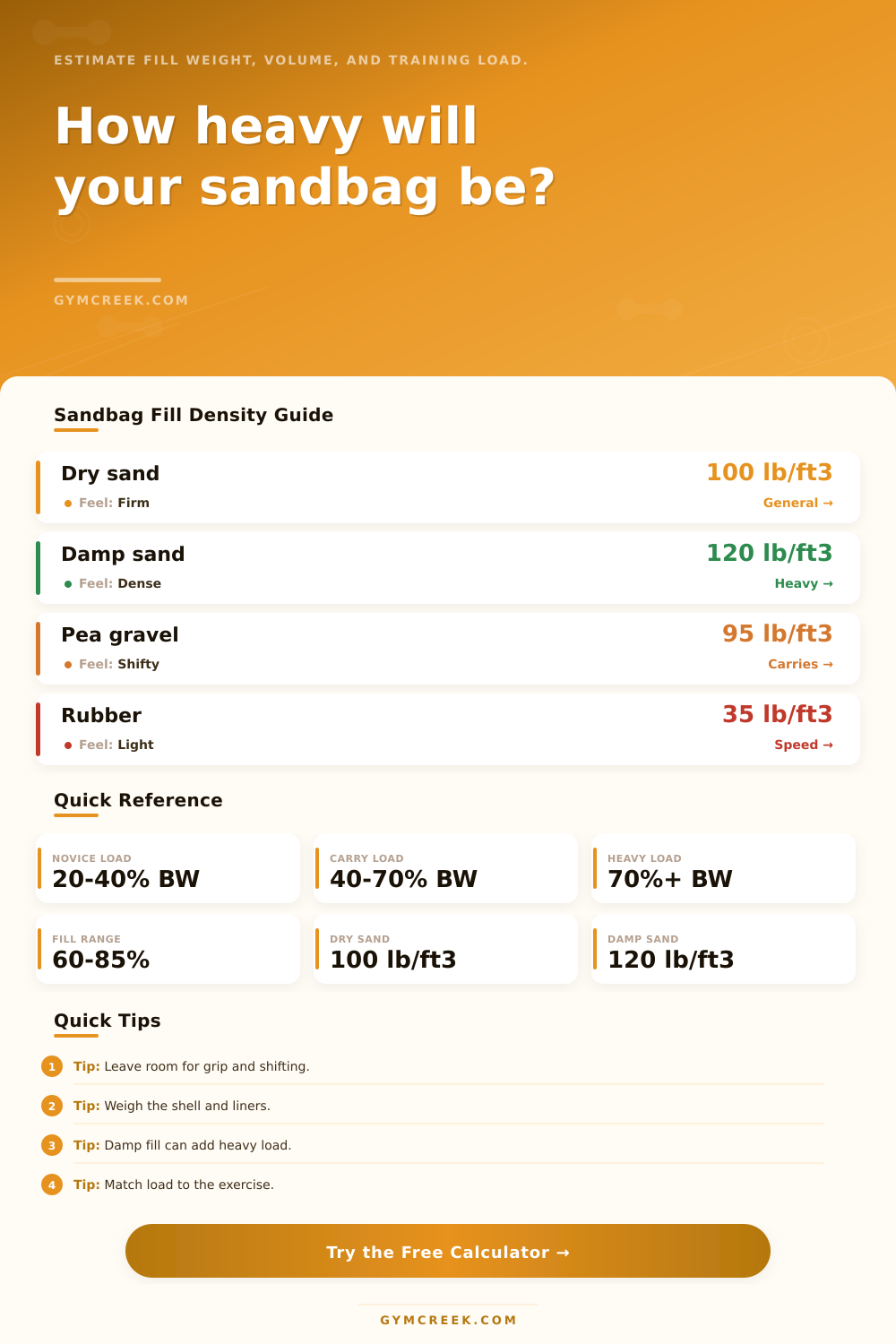
| Dry play sand | 100 lb/ft³ / 1600 kg/m³ | Firm and predictable | General training bags |
| Damp sand | 120 lb/ft³ / 1920 kg/m³ | Denser and less forgiving | Heavy loading practice |
| Pea gravel | 95 lb/ft³ / 1520 kg/m³ | Shifty with hard edges | Carries and carries only |
| Rubber crumb | 35 lb/ft³ / 560 kg/m³ | Bulky and lighter | Speed drills and beginners |
| Rice or grain | 45 lb/ft³ / 720 kg/m³ | Softer and fast shifting | Light technique bags |
| Exercise Type | Beginner Range | Strong Range | Calculator Use |
|---|---|---|---|
| Bear hug carry | 30-50% body weight | 70-100% body weight | Loaded carries |
| Sandbag clean | 20-35% body weight | 50-80% body weight | Reps and power |
| Platform load | 35-55% body weight | 80-120% body weight | Heavy loading |
| Conditioning circuit | 15-30% body weight | 35-55% body weight | Repeatable volume |
| Fill Percent | Bag Behavior | Grip Effect | Common Use |
|---|---|---|---|
| 50-60% | Very floppy | Hard to stabilize | Skill work |
| 60-75% | Moves naturally | Good hand purchase | Carries and cleans |
| 75-85% | Firm but workable | Less shifting | Loading drills |
| 85-100% | Tight and dense | Reduced grab space | Max weight tests |
| Formula | Variables | Result | Use |
|---|---|---|---|
| Cylinder volume | π x radius² x length | Cubic feet | Round duffel bags |
| Box volume | Length x width x height | Cubic feet | Filler blocks |
| Fill weight | Volume x fill % x density | Material load | Weight estimate |
| Total bag | Fill + shell + liners | Training load | Workout planning |
💡Tips
But when it comes to beginning sandbag training, most folks makes a simple mistake regarding volume. They purchase what appears to be a large bag. They load it full of random stuff from around their house’s garage. They expect heavy feel to translate straight onto the bathroom scale.
Nope. That’s because sandbags aren’t dumbbells. Because of this, they settle and they shift. And perhaps most significantly, if you don’t factor in how much space the air inside take up, it’ll take up just as much space as any sand or gravel.
How to Fill Your Sandbag Correctly
Don’t go through the effort of carrying heavy fill material into your home gym without knowing how volume and density work together. This knowledge will save you from making a bag that is either too light to be a challenge or so dense you can’t comfortabley grasp it. After selecting your desired fill material and plugging those dimensions into the calculator (above), it spit out the answer. This removes the guesswork of comparing how 100 lbs of pea gravel feels versus rubber crumb or sand.
General training calls for dry play sand, which packs down to roughly a hundred pounds per cubic foot. Underneath the shoulder, its solid and offers a reliable surface on which to work. Go with wet sand, however, and that number drastically increase. The bag gets bulkier, less forgiving, and changes how each lift feel. You’re no longer simply moving weight; you’re dealing with something that will shift its form during the rep.
The other variable that catches beginners off guard is shape. While most normal bags are cylinders, other fillers will have a more rectangular block shape. Since formula for calculating volume varies depending on whether it’s round or flat, we account for this in calculator. It sounds small, but it is enough to make the calculated weight inaccurate, which matters when you are targeting an exact amount to train with.
The tool uses length and width measurements to estimate how much the bag is filled and then multiple that number by whatever percent of density you entered. Trainers generally suggest filling bags between 60-85% full. That extra space isn’t empty, however. You need to leave room; otherwise, the bag will become so stuffed that it turns into a brick and slides from your hands during a carry or clean.
Consider your application, Are you planning a heavy platform load? Will it be more of a bear hug carry? Each require different dimensions. On the page I have included a reference table that lines up exercises with applicable percentages of body weight. For beginners, think in the range of 20-40% of total body weight. Advanced exercisers may go as high as 70+%. This isn’t random. It is based off what the human body can handle during an unstable situation and still maintain proper form.
Keep in mind, if you’re working through conditioning circuits or speed drills, a light fill such as rice or rubber will permit quicker movement patterns while still maintaining the awkwardness inherent to sandbag workouts.
Remember to account for the weight of empty shell and any liners inside the pack when weighing out the fill. The tarp itself (a thick canvas bag with heavy duty handles) weighs several pound by itself. Not accounting for the tare weight means you’re going to be making mistakes with your end estimate. And if you’ve been attempting to increase your load by five pounds per week, that three pound shell will throw everything off. It’s an easy mistake to make but one that adds up.
To conclude. Sandbag training is all about managing chaos. Too tight and it’ll be unmanageable. Not tight enough and the bag will lack resistance and shiftiness. You’re looking for that sweet spot where the weight tests the limits of your structure without destroying your grip. Begin with a moderate fill percentage, try it out, and go from there. Your arms and back will tell you if the load is working. The numbers just point you in the right direction.