Sandbag Carry Calorie Calculator
Estimate calories, adjusted METs, work time, load distance, and grip fatigue for bear hug, shoulder, Zercher, suitcase, and overhead sandbag carries.
📌Presets
Presets load real sandbag carry sessions, then calculate using load-adjusted METs and a grip fatigue model.
⚙Calculator
Sandbag carry estimate
Enter a load, distance, rounds, terrain, pace, and rest ratio to estimate the session.
📊Session Metrics
📑Reference Tables
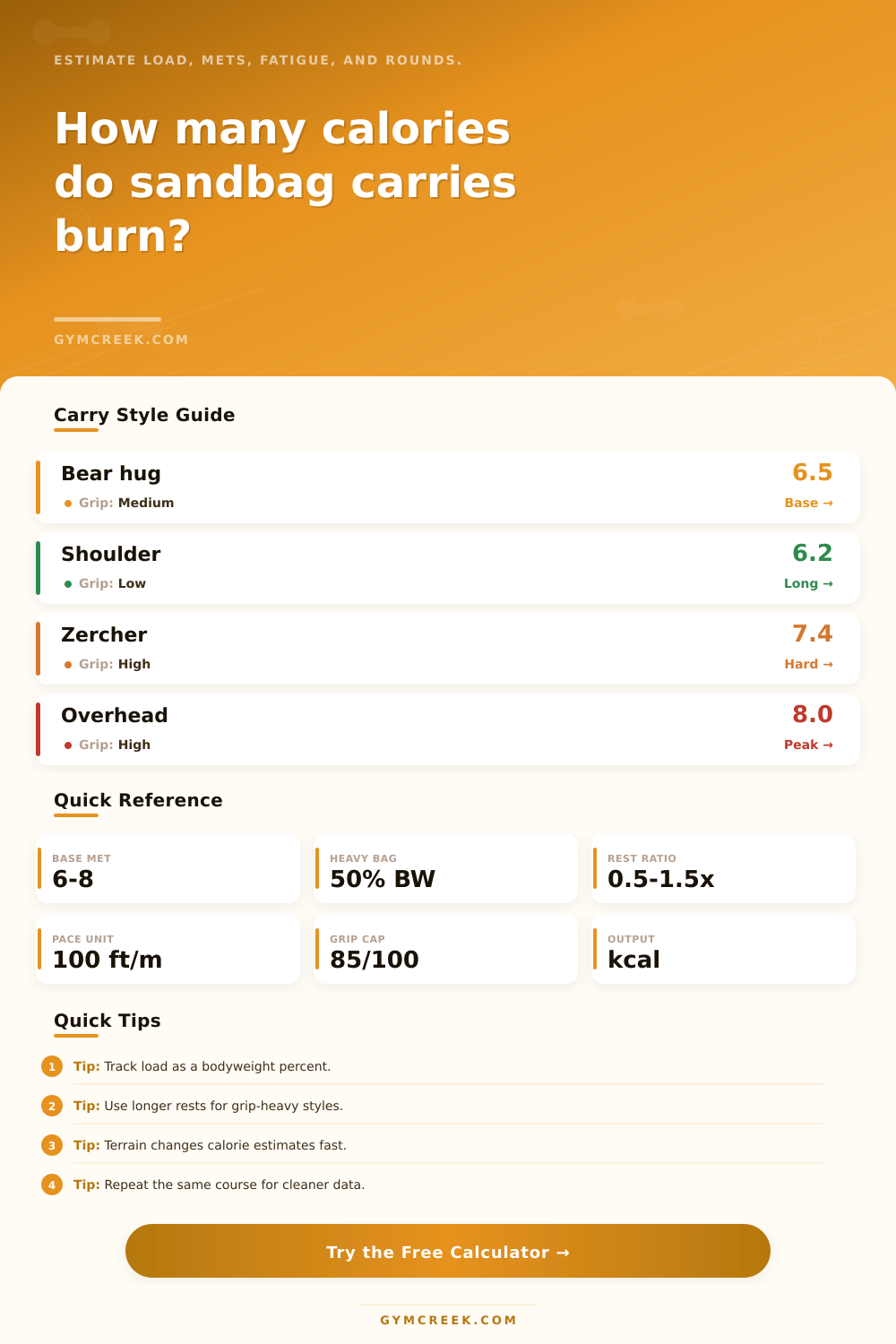
| Carry style | Base MET | Grip demand | Best use |
|---|---|---|---|
| Bear hug | 6.5 | Medium | General conditioning with strong trunk demand. |
| Shoulder | 6.2 | Lower | Longer carries where the bag can be braced. |
| Zercher | 7.4 | High | Heavy short rounds with upper-back bracing. |
| Front rack | 7.1 | Medium-high | Front-loaded breathing and posture work. |
| Suitcase | 6.8 | High | Anti-lateral-flexion and grip-biased carries. |
| Overhead | 8.0 | High | Short technical efforts with high stability demand. |
| Terrain | MET multiplier | Grip effect | Use note |
|---|---|---|---|
| Flat gym floor | 1.00 | Low | Cleanest comparison between sessions. |
| Track or turf | 1.03 | Low | Slight extra effort from surface give. |
| Grass or field | 1.08 | Medium | Uneven foot placement raises effort. |
| Hill or ramp | 1.18 | Medium | Higher leg drive and trunk bracing. |
| Stairs or step-ups | 1.35 | High | Large vertical demand; pace often slows. |
| Sand, mud, or snow | 1.28 | High | Foot slip and instability raise fatigue. |
| Load ratio | Intensity band | Typical rest | Grip caution |
|---|---|---|---|
| Under 25% BW | Light | 0.25-0.75x | Mostly pace-limited. |
| 25-50% BW | Moderate | 0.5-1.25x | Grip matters late. |
| 50-75% BW | Heavy | 1.0-2.0x | Round quality can drop. |
| Over 75% BW | Very heavy | 1.5-3.0x | Stops may be grip-driven. |
| Formula piece | How it is used | Output | Why it matters |
|---|---|---|---|
| MET calories | MET x 3.5 x kg / 200 | kcal/min | Converts intensity to energy. |
| Load estimate | Bag/bodyweight ratio | MET bump | Heavier bags raise effort. |
| Carry distance | Distance x rounds | kg-km or lb-mi | Shows loaded work volume. |
| Grip index | Style, load, terrain, rest | 0-100 | Flags likely fatigue limits. |
💡Tips
It is the kind of tired that settles into your lower back, the one that feels like a gritty burn across your shoulders and forearms. Different than even tired of running down a track. Most will load up the bag so it’s heavy, then keep walking until their arms begins shaking.
You can’t make something better if you don’t know how much it costs. Before you commit to those rounds, you has to know cost of work. When you plug in your stats, the calculator above do all the work for you. You no longer have to guess about conversions and coefficients. It takes your scenario and turns it into a grip fatigue index, an adjusted metabolic equivalent, and calorie estimate.
How the Calculator Works
Of those, the grip fatigue index is most useful. Many people stop their carry session prematurely due to grip failure. Your legs can be strong enough to get further, but bag drops because you’re too tired or your fingers are numb. That’s what the tool models. It looks at how much rest time you take, which terrain you’ll be on and what kind of carry style you’ll do. Then it tell you when you’re approaching a dangerous point… Where your form starts breaking down and safety can become an issue.
The physical demand depend on the choice of carry style. For example, a bear hug is efficient; the bag rides up against your chest so your torso stabilizes weight. Your core and heart do most of the work, but you spare your grip. With a Zercher carry, the load get shifted higher, forcing you to brace from your abs and upper back. Each carry style are given a base MET value by the reference table on the page. At the top of the scale is the overhead carry. Constant micro-corrections has to come from all muscles of your posterior chain as you hold a shifting mass above your head. You are not just carrying weight; you are fighting gravity’s instability with every step.
These equations take terrain into account as well. The control variable is walking on a flat, non-slippery surface like a gym floor. You know what you’re going to get. Now walk on sand or grass. Suddenly, the energy cost increase a lot. Your feet has to dig in just slightly with each step to keep moving forward, creating resistance that feels like extra weight. Snow and mud behave similarly, but add balance factors that engage more of your core.
The calculator addresses this by adding multipliers to baseline metabolic cost. It’s little stuff but it counts. What might feel easy on a concrete surface become a tougher workout on a muddy trail.
People also overlook pace. Because they’re lugging a sack of sand around, they think it has to be slow. That’s mostly right if you’re going really far with a realy heavy load. But for short distances, how fast you go matter. For example, a faster pace increase your calorie burn and metabolic demand, even if you are covering a shorter distance. You have to enter your pace into the tool in seconds per hundred feet. It’ll force you to tell the truth: Did you walk fast using your body weight? Or did you plod along because weight was too much?
Regardless, your resting time is just as vital. Do you rest half as much as you work? Then you have a hard workout that improves stamina. Rest double what you worked? Then you can handle more weight with good form. No wrong answers here, just different goals.
For planning, it has an output called the grip index. When this number goes over eighty-five, the tool recommend transitioning down in grip style or taking a longer break. Good advice if you want to end a work session on a high note. Avoid the frustration of running out of steam and giving up before your time is up with a fatigued set of hands.
And more importantly, recognize the value in progressive overload. Not every workout needs to become harder by increasing weight. Sometimes it’s better to go farther, take fewer breaks or walk on different terrain. With the calculator, you’ll know. You’ll see that adding five pounds to the bag might be less effective then adding ten feet to the carry.
Train smart. Train hard. Build your strength and conditioning through function with sandbags. Copy the unpredictability of in-the-moment loading conditions. Make it random acts of suffering without data. Make it random suffering turned into structured progress by understanding the variables. Begin to see exactly where that burn comes from and how to control it. Know exactly what makes that bag feel the way it does when you pick it back up again. Knowing this make training more than a waste of time. It’s a workout.