Salt to Sodium Converter
Convert salt into sodium or sodium into salt across milligrams, grams, teaspoons, servings, bottles, and sweat-loss replacement targets for athletes.
📌Presets
Each preset loads a real salt, sodium, serving, or sweat-loss scenario and calculates the athlete context automatically.
⚙Calculator
Salt and sodium snapshot
Enter salt, sodium, teaspoon, and sweat values to convert the amount.
📊Conversion Metrics Grid
📑Reference Tables
| Salt Amount | Sodium | Salt Grams | Common Use |
|---|---|---|---|
| 1/8 tsp table salt | 295 mg sodium | 0.75 g salt | Small bottle tweak |
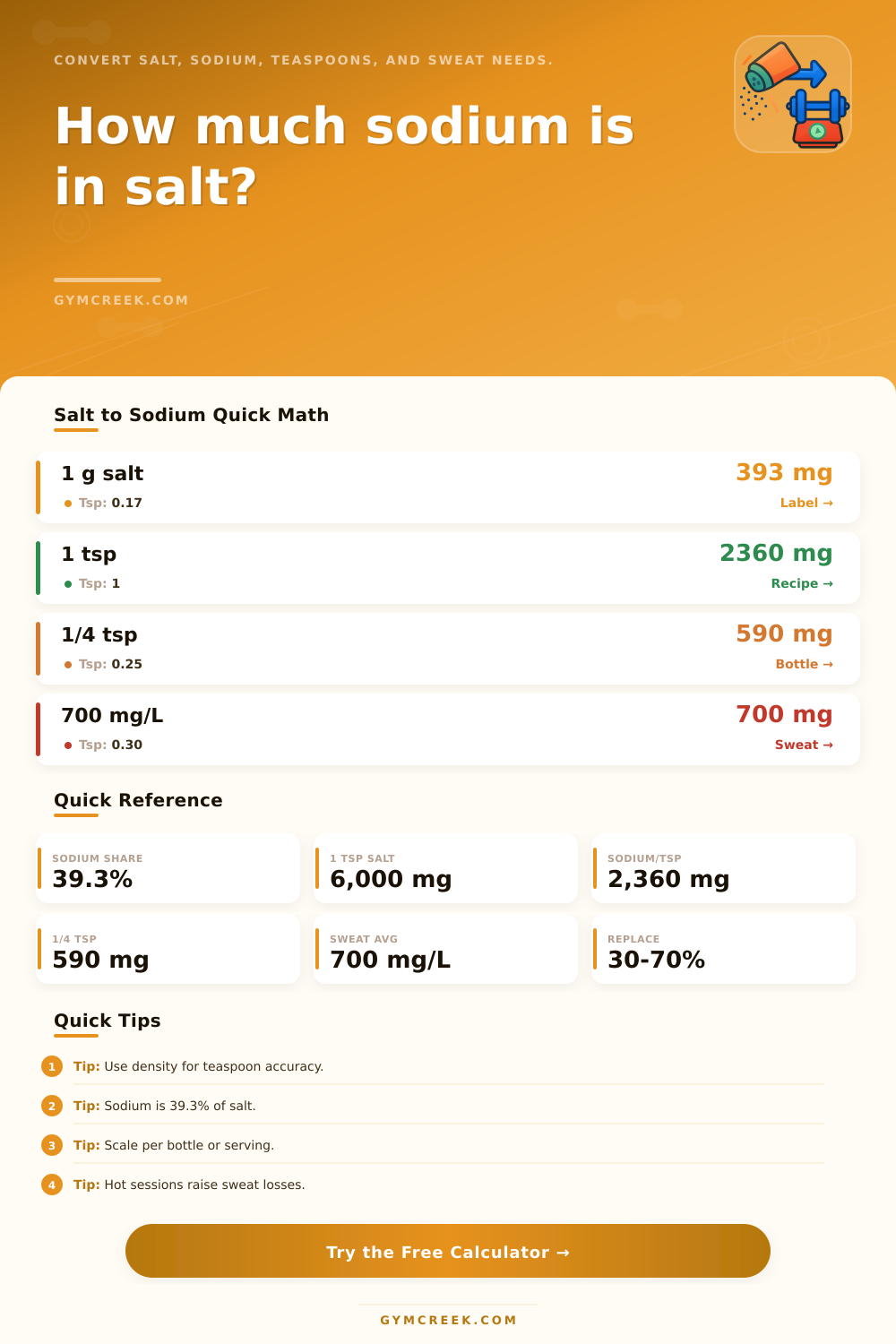
| 1/4 tsp table salt | 590 mg sodium | 1.50 g salt | Electrolyte bottle |
| 1/2 tsp table salt | 1180 mg sodium | 3.00 g salt | High sodium mix |
| 1 tsp table salt | 2360 mg sodium | 6.00 g salt | Recipe conversion |
| Salt Type | Approx g/tsp | Sodium/tsp | Why It Changes |
|---|---|---|---|
| Table salt | 6.0 g | 2360 mg | Fine, compact crystals |
| Fine sea salt | 5.6 g | 2200 mg | Fine but variable grains |
| Kosher salt | 4.8 g | 1888 mg | Larger flaky crystals |
| Coarse salt | 5.0 g | 1967 mg | Air gaps in spoon |
| Training Context | Sweat Sodium | Replace During | Typical Note |
|---|---|---|---|
| Easy cool session | 300-600 mg/L | 0-30% | Food may cover it |
| Endurance run | 500-900 mg/L | 30-60% | Watch bottle sodium |
| Hot long ride | 700-1200 mg/L | 40-70% | Higher hourly loss |
| Heavy sweater | 1000-1600 mg/L | 50-80% | Test in training |
| Formula | Calculation | Variable | Best Use |
|---|---|---|---|
| Salt to sodium | Salt mg x 0.3934 | NaCl mass | Recipe to label |
| Sodium to salt | Sodium mg / 0.3934 | Sodium mass | Label to salt |
| Teaspoons | Salt g / g per tsp | Density | Spoon measure |
| Sweat target | L/hr x hr x mg/L x % | Sweat loss | Athlete fueling |
💡Tips
Long run just ended on a hot day. Despite staying hydrated, you’re exhausted. Legs feel heavy. It is not just dehydration. Electrolyte crash. You got water back into your system, but not mass of solutes. Without sodium to anchor that extra water in the cells, body can’t retain it.
Now that you’re all salty, drinking plain water actualy makes you more tired and causes cramps to come on quickerer. This is because you’re literally diluting the small amount of sodium you have left.
Sodium and Salt Are Not the Same
The first key to solving this issue are understanding that there’s a difference between sodium and salt. They sound alike so most people use them interchangeably as if they were the same terms, they aren’t. Salt is a compound: sodium chloride. Sodium is one component of that chemical compound. Chlorine is the other. Understanding this difference helps you read nutrition labels correctly, avoid mixing up drink bottles, and prevent costly mistakes when managing your health and performance.
There’s one basic rule to keep in mind: Salt consists of approximately thirty-nine percent sodium. Whether it’s kosher flakes, sea salt, or good old table salt, the ratio remain the same. Never. Ever. What varies is density. Flakes of kosher salt are big and don’t fit snugly inside a spoonful. Fine, dense grains make up table salt. Even though a teaspoon appear to be the same size as another teaspoon, a tablespoon of table salt will have far more actual sodium than its kosher counterpart. That’s where athletes and home cooks who measure according to volume instead of weight gets tripped up on their recipes.
Once you pick your type of salt, the calculator takes over the math for you. No need to guess how much powder made it into the glass.
Now let’s look at some real world applications of this information when filling bottles on race day. Let’s say the sports drink has 600 milligrams of sodium per bottle and you want to double that with a half teaspoon of table salt. Wrong. A half a teaspoon of table salt is roughly three grams. Sodium accounts for thirty-nine percent of that total. So when you add a half teaspoon of table salt, you’re really adding approximately one-thousand-two-hundred milligrams of sodium. Instead of doubling what you set out to do, you’ve tripled it. Now you run the risk of stomach issues or an unneeded increase in thirst.
The charts on the page detail exactly how much each type of salt impact the end milligram number per teaspoon. As you’ll notice easily enough, measuring with spoons isn’t as accurate as weighing them on a digital scale.
There’s also the issue of sweating. Everyone sweats differently. Some people lose very little sodium while others lose massive amounts in their sweat. That’s simply genetics, which accounts for why two runners will follow exact same hydration plan and one runner will feel great while the other crash due to hyponatremia. By entering an estimate of your sweat rate and length of your run into the tool, it’ll help you determine how much sodium you actualy need to replace.
Most experts recommend that you only replace up to 30-50% of what you lose during the race itself. You don’t need or want to try to match every single milligram you’ve lost, it’ll just slow down your digestion when you’re running hard. A good goal is to keep your blood sodium levels steady without making yourself sick by overdoing it.
More sweat means more sodium lost. When it’s hot and humid out, that amount of sweat is much higher. That’s why you can’t apply a “one size fits all” approach to drinking. Environment factors into this. How do you manage a hot day running versus a cool early morning run? The built-in presets are meant to make those situations real. Load up a typical number for heavier sweater and you’ll see how much salt they’d require on a longer endurance run. With those numbers as a starting point, you’ll be able to mix your bottles ahead of time to plan instead of guessing once you’re already outside.
This helps you plan ahead instead of guessing as you go. So yes, it’s really all about balancing your electrolytes and hydrating. But beyond that, it’s also about understanding yourself. You can use tools to estimate your sweat rate and determine how much water and sodium you actualy need. But the amount of salt? You can calculate that based off the type of salt and your own sweat rate. Beyond the generic “drink this much” guidance, you’ll find what works for you, within your bodys limits.
And that means respecting your own physiology and creating a plan just for you. Try things out in training and make little tweaks rather than testing the waters come race day. Experiment with your mixes. Pay attention to your body. Adjust the numbers as needed until you get them dialed in just right. And when you do, your body will let you know.
Your pre-race crash would of been a distant memory, and from the very first mile onward, you’ll fuel properly to cross the finish line strong.