Salsa Dancing Calorie Calculator
Estimate calories burned from salsa socials, partner practice, classes, shines, turn patterns, tempo, song count, duration, rest ratio, body weight, and adjusted MET logic.
📌Presets
Each preset loads a realistic salsa session and recalculates from mode, songs, tempo, shines, partner load, class drills, and rest time.
⚙Calculator
Salsa dancing calorie snapshot
Enter songs, tempo, partner load, shines, drills, and rest to estimate salsa calories.
📊Fitness Metrics
🧮Formula Cards
Calories per minute = MET x 3.5 x body weight in kg / 200. Salsa dance, drill, filler movement, and rest minutes are calculated separately.
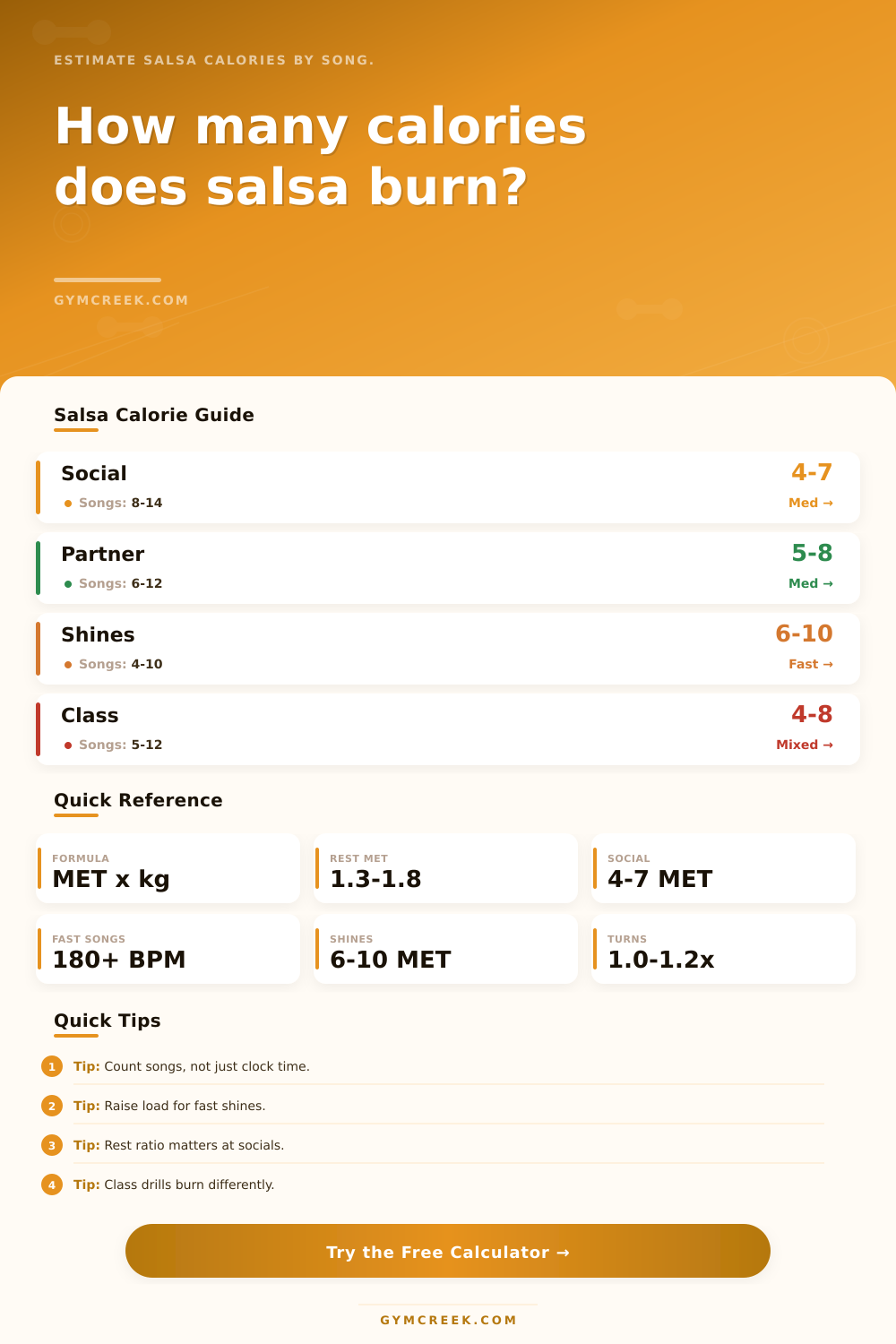
Social dancing, partner practice, classes, shines, rehearsal, and workshops start with different MET bands, then song tempo adjusts the base load.
Song count estimates dance minutes, shines raise solo footwork demand, and turn pattern load adjusts for repeated rotation and traveling patterns.
Mifflin-St Jeor estimates BMR from age, size, and gender, then the activity multiplier gives TDEE so the salsa session can be compared with a day.
📑Reference Tables
| Salsa Mode | Light | Moderate | Vigorous |
|---|---|---|---|
| Social dancing | 4.0 MET | 5.6 MET | 7.2 MET |
| Partner practice | 4.6 MET | 6.1 MET | 7.8 MET |
| Technique class | 3.8 MET | 5.4 MET | 7.0 MET |
| Solo shines | 5.5 MET | 7.4 MET | 9.6 MET |
| Rehearsal | 5.0 MET | 6.8 MET | 8.8 MET |
| Session Type | Songs | Rest Ratio | Best Input |
|---|---|---|---|
| Short class | 4 to 8 | 15 to 35% | Drill minutes |
| Social hour | 8 to 14 | 20 to 45% | Songs danced |
| Club night | 15 to 30 | 30 to 55% | Total time |
| Workshop day | 10 to 24 | 25 to 60% | Class blocks |
| Dance Demand | Input Signal | Modifier | Meaning |
|---|---|---|---|
| Compact basics | 0 to 15% shines | 0.96x | Low travel |
| Normal social | 16 to 35% shines | 1.00x | Balanced work |
| Footwork heavy | 36 to 65% shines | 1.09x | Higher load |
| Performance pace | 66 to 100% | 1.18x | Peak demand |
| Formula | Variables | Output | When Used |
|---|---|---|---|
| MET kcal | MET, kg, min | Calories | Main estimate |
| Song work | Songs, length | Dance min | Social sets |
| Drill kcal | Drill MET, min | Drill burn | Classes |
| TDEE share | kcal, TDEE | Percent | Daily context |
💡Tips
We all have some intuitive idea of how hard we’re working when we dance on the floor through the muscle burn and the perspiration. But few of us realy have any clue about how much energy it require.
The calorie calculator helps bridge that gap between sensation and information. It express physical output as a numerical value you can follow. This might be helpful if you need to control your weight. It may also help if you’ve noticed that an hour-and-a-half class doesn’t seem like much, while a two-hour social leave you exhausted.
How the Salsa Calorie Calculator Works
Now how does it work? The key is knowing exactly what it’s measuring. When we think of “dancing,” we don’t just think about one thing. It’s a blend of high- and low-intensity movement with periods of recovery in between. To account for that, the calculator provides a place for you to enter actual amount of songs (or dances) that you’ve danced.
That’s the big change most people overlook. For example: if the DJ plays 30 songs during a night but you only dance for 15 of them, then you are burning far fewer calories then your total time spent on the dance floor. The program distinguishes the rest vs. These are active dance times. Setting the rest ratio should of reflect the amount of time you take out to change partners, watch, or rehydrate. This makes sense because social dancing isn’t always continuous; it typically stop and starts.
But then again, tempo make all the difference. Dancing a high energy mambo will get your heart pumping way more than a slow ballad. For this reason, metabolic equivalent for songs ranges from very low (slow romantic song) to very high (high energy mambo). And the faster the song, the more quickly it demand directional change, so the harder you have to work your feet.
Also take into account shines. When you solo with your feet, you’re creating all the momentum yourself which can be more challenging than when dancing in partnership. This means you use more energy. How much time do you spend shining rather than connecting with your partner? This is where the tool allows you to play with that % value. If you like doing pachanga styling, lots of Suzy Qs, that % value go up along with your calorie estimate.
Partnership Dynamics: Leading and following is about more than just style; it is about physics. More than a matter of style, leading and following is physics. Heavier patterns and complex wraps adds to the load. The calculator takes that into account through its turn pattern load setting. Frequent turns require more rotational power and core stability, which burns more fuel than simple side-to-side steps.
Another factor is the type of drill. While muscle memory is built from repeated practice, the way muscle fatigue occurs in different dance activity differs from how it happens in social dancing. Social sets use energy differently than class drills. These are typically repetitive and steady while social dancing is unpredictable and reactive.
On the website are reference tables where all of this is laid out. You can see how the MET values change with speed (which lets you calibrate your expectation). If it’s a slow night, an experienced dancer may think it won’t be too tiring, while the newbie will underestimate the burn because they’re dancing to a faster track. This is what the tool does: takes standard metabolic equations but tweaks them for salsa-specific reality.
Your age and your weight matters, since those affect your baseline energy requirements (you want a personalized estimate), not an average one. This knowledge will help you plan. Want to conserve energy? Favor partner connection and go for slower songs. Want to burn more? Do more fast turns, and focus on fast songs. This info helps you make intentional decisions. It turns what could be random exercise into a planned activity.
You can track where you are at compared to other weeks. Did you burn more last week because there were more song? Or did the songs have a higher tempo? The numbers will show you.
Salsa’s all about rhythm and connection at the end of the day. But knowing how much it costs your body lets you keep up with it. If you honor the effort, you can push yourself further and harder for a longer period of time.
The calculator gives you that value as a number. It makes the otherwise intangible work into something concrete, and lets you know just how much the night will cost you. And you get to choose whether or not it was worth it.
And most times, it was.