🚲 Saddle Height Calculator 109
Estimate a practical cycling saddle height from inseam, crank length, pedal stack, cleat position, terrain, mobility, and your current bike setup.
Your Saddle Height Result
Results appear after calculation.
| Method | Formula or Cue | Best Use | Watch For |
|---|---|---|---|
| LeMond baseline | Inseam x 0.883 | Fast first pass for road, gravel, and trainer fits | Does not know your crank, pedals, or mobility |
| Heel check | Heel on pedal, leg nearly straight | Quick garage sanity check after the calculator | Too much toe point can hide a tall saddle |
| Knee angle check | Roughly 25–35° flexion | Video or fitting app comparison | Requires consistent camera alignment |
| Ride feedback | Stable hips, no reaching | Final outdoor confirmation | Wind, fatigue, and saddle tilt can confuse feedback |
| Riding Style | Bias | Why It Moves | Typical Feel |
|---|---|---|---|
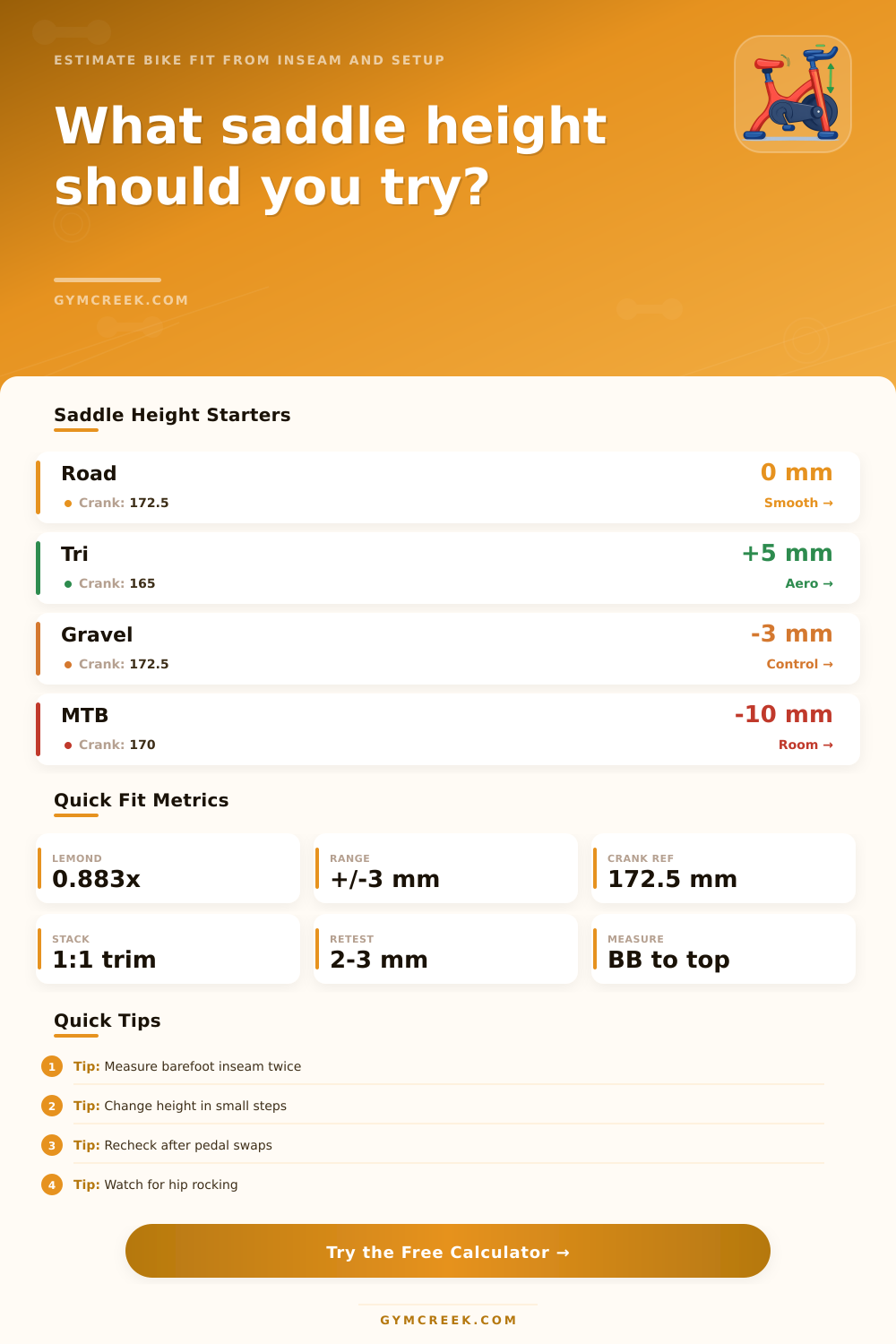
| Road endurance | 0 mm | Balanced seated pedaling and comfort | Neutral spin |
| Road race | +2 mm | More steady seated output for trained riders | Efficient but sensitive |
| Triathlon or TT | +5 mm | Aero position and shorter cranks often open the top stroke | Taller front-loaded feel |
| Gravel adventure | -4 mm | Rough surfaces reward control and less reaching | Calmer over chatter |
| Trail mountain bike | -10 mm | Technical terrain needs room to move around the bike | Lower and looser |
| Setup Change | Calculator Rule | Example | Interpretation |
|---|---|---|---|
| Shorter crank | 172.5 minus crank | 165 mm = +7.5 mm | Less knee rise can support more saddle height |
| Longer crank | 172.5 minus crank | 175 mm = -2.5 mm | More knee rise usually needs a small trim |
| Taller pedal stack | Subtract the stack increase | +3 mm stack = -3 mm | Foot sits closer to the saddle |
| Rearward cleat | Small negative trim | -3 mm | Less ankle reach often feels better slightly lower |
| Setback increase | Small negative trim | +20 mm = -2 mm | Farther back can increase effective leg reach |
| Scenario | Main Input Shift | Likely Result | Next Check |
|---|---|---|---|
| New shorter cranks | 172.5 to 165 mm | Target often rises several millimeters | Confirm hips stay quiet at cadence |
| New taller pedals | Stack up by 4 mm | Target comes down about 4 mm | Check cleat bolts and shoe feel |
| Moving to gravel | Road to rough terrain | Target trims lower for control | Test seated climbing traction |
| Indoor trainer fit | Stable surface, no terrain movement | Can sit close to road baseline | Watch numbness and saddle tilt |
| Hip rocking | Feedback flag selected | Calculator lowers the test window | Reduce in 2 mm steps |
Saddle heights is a variable that can determine how a bicycle feel to the person. However, saddle height is also a variable that can impact the physical health of the person who ride they’re bicycle. If a person set the saddle height too high, then the person may experience hip rocking or discomfort in there patellar tendon.
If, on the other hand, a person sets the saddle height too low, then the person may experience discomfort in the front of they knee joint due to the tight angle of there knee. The goal with determining the correct saddle height is to ensure that the persons leg is almost fully extended at the bottom of the pedal stroke, but not so more fully extended that the person has to slide forward on the saddle to reach the pedal. Many people uses a formula to determine the saddle height.
How to Find the Right Bike Seat Height
However, these simple formula can often fail due to the fact that they fail to account for the physical flexibility of the person who will be using the bicycle. For instance, a person may have high flexibility in their hamstring or low flexibility in their hamstring. Another reason that formulas can fail is due to the way that the bicycles hardware can impact the distance that the persons foot will travel within the pedal stroke.
For instance, a person can have a shorter pedal stroke due to there shoe sole thickness or the position of the cleat on the shoe. A shorter pedal stroke can allow the person to use a slightly higher saddle height. The saddle height calculator determine the theoretical center of the saddle height using the LeMond baseline and the inseam of the person.
After finding the theoretical center of the saddle height for that person, the calculator also incorporate the variables that will impact the way that the bicycle may feel to that person. For instance, the type of cycling that a person will perform will have an impact on the ideal saddle height for that person. A road racing cyclist will have a different ideal saddle height then a person who cycles on a mountain bike.
Mobility is another variable that can impact the way that a person feels on their bicycle. For instance, if a person has limited mobility in their hips, it may be uncomfortable for that person to use the saddle height that would otherwise be considered the correct saddle height for that individual. One way to determine if a saddle height is correct is to consider physical feedback from the bicycle ride.
If a person feels a pull on the back of there knee while cycling, then the saddle height is likely set too high. If a person feels pressure on the front of there knee while cycling, then the saddle height is likely set too low. The result that the saddle height calculator displays is only a starting point.
Small adjustments should be made to the height of the saddle in increments of two or three millimeter. Such small adjustments allow the person to account for the mobility of their saddle and ankle joint. Additionally, other variable related to the pedals should be considered.
For instance, if the person has a thick shoe sole, this will increase the amount of the pedal stroke that the person use, and thus they should of lowered there saddle height. When a person has correctly adjusted the saddle height, there will be no friction between the persons body and the bicycle. The persons hip will remain quiet while cycling, and the person will be able to efficiently transfer there power into the pedals.
Instead of using the baseline to determine the height of the saddle, it is better to use this calculated baseline to find the saddle height for the best possible ride. Using this calculated baseline will not only prevent injury to the persons body while cycling, but will also allow them to efficienty ride there bicycle.