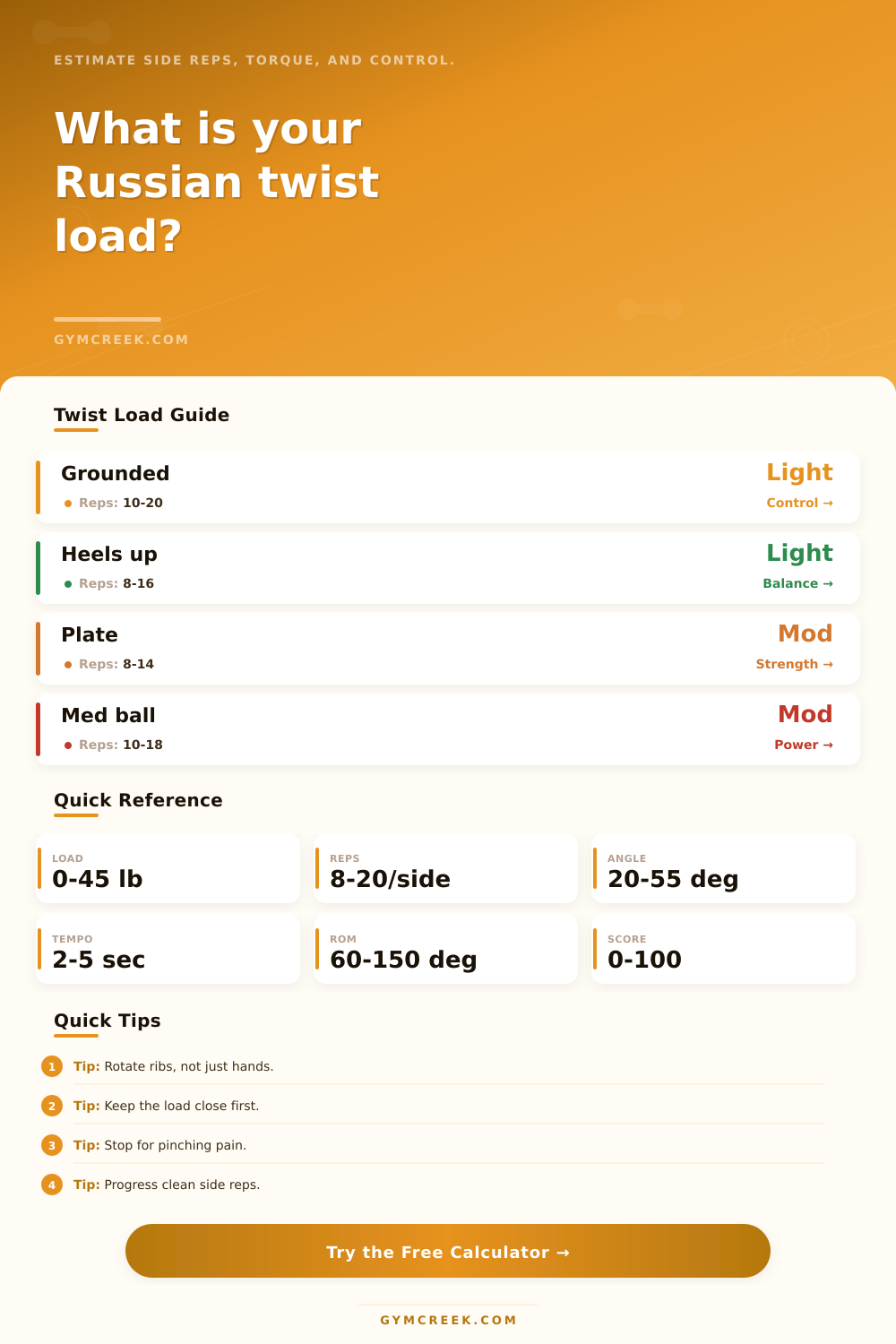
Russian Twist Load Calculator
Estimate med ball or plate twist workload, reps per side, torso angle stress, feet-position demand, tempo strain, ROM torque, and anti-rotation control.
📌Presets
Each preset uses a real Russian twist setup, then recalculates load, control score, and safety status instantly.
⚙Calculator
Russian twist snapshot
Enter a load, reps per side, torso angle, feet position, tempo, and ROM to calculate.
📊Metrics Grid
📑Reference Tables
| Implement | Loading Feel | Typical Use | Calculator Factor |
|---|---|---|---|
| Medicine ball | Balanced and easy to grip | Controlled reps or light power | 1.00 |
| Weight plate | Flat and slightly awkward | Strength-focused twists | 1.08 |
| Dumbbell or kettlebell | Dense load with more grip demand | Moderate reps, strict form | 1.12 |
| Cable or band handle | Resistance pulls through the arc | Constant-tension rotations | 1.18 |
| Feet Position | Stability | Load Choice | Control Note |
|---|---|---|---|
| Feet grounded | Highest | Best for learning load | Keep heels quiet |
| Heels light | Moderate | Use lighter loads | Brace before turning |
| Feet elevated | Low | Lower the load | Avoid rocking hips |
| Feet anchored | Artificially high | Can hide overloading | Do not yank from hip flexors |
| Single-leg hover | Very low | Use tiny loads | Prioritize still pelvis |
| ROM And Angle | Range | Stress Level | Best Fit |
|---|---|---|---|
| Short arc, upright | 60 deg, 20 deg lean | Low | Return to loading |
| Standard arc | 90 deg, 35 deg lean | Moderate | General training |
| Long arc | 120 deg, 45 deg lean | High | Advanced control |
| Wide arc, deep lean | 150 deg, 55 deg lean | Very high | Light-load only |
| Score Band | Meaning | Next Step | Safety Cue |
|---|---|---|---|
| 80-100 | Strong control | Add reps or small load | Keep same tempo |
| 60-79 | Usable control | Repeat or add reps | Watch hip sway |
| 40-59 | Borderline | Lower load or ROM | Rebuild bracing |
| 0-39 | Too much demand | Regress setup | Stop if pain appears |
💡Tips
You know what I’m talking about: the person who kicks their feet up into the air, holds a forty-five pound plate in their hands and attempts to spin around like a helicopter blade. It looks great on Instagram until you notice there lower back arching outward with each rotation. Most folks take that as a sign that Russian twists aren’t just core work (they’re a physics issue).
To help you train hard while staying intact, the calculator above run the numbers for you. Enter your bodyweight, load distance, and tempo to get an estimate of stress you’ll feel during your next set.
How to Do Russian Twists Safely
That’s the crux of it: leverage. If you hold a medicine ball up against your chest, you’re fine. Because the weight is relatively close to your center of rotation. Now you stretch your arms straight out in front of you and all of a sudden that same weight is double what it was. Why? Torque goes up with distance. And the tool accounts for this by allowing you to choose where on your body the load is positioned. When you have kettlebell tight to your ribs, there’s a lot less rotational drag than when you hold a plate with your arms fully extended. And that’s frequenly the reason someone can lift a heavy dumbbell but not a lighter plate. It’s not the weight; it’s the reach and handle.
This is why the way the movement work completely changes with feet positioning. With feet grounded you have a stable base from which you can focus on rotating through the ribs instead of simply swinging your hips. Either you lift your legs off the ground altogether, or you lift your heels, and the demand on your anterior chain spike immediately. This is why the calculus accounts for this deficit in stability. And if you opt for elevated leg position, it assumes you’ll offset this with lowering external load so you can keep control. Often if you don’t consider this tradeoff, momentum will take over. Instead of training abs, you end up training hip flexors.
The hidden factor between junk volume and effective training is tempo. When rotating quickly and bouncing the weight off your chest, your lower back and hamstrings store elastic energy and do the work. When you slow the turn and include a pause at the extremes, you’re forcing your obliques to engage under tension. The calculator accounts for how long you spend in each phase of the movement. Since you can’t use momentum to cheat, slowing down the cycle increase the anti-rotation score required. Slow it down to the point where you can’t maintain form, then you’re already maxed out on the current load.
Warning: Safety flags are not just warnings but necessary checks for joint health. Hard stops include sharp pains and pinches in your spine. This tool lets you know when you’re generating too much shear force against your lower back from the combo of rep, load, and lean angle. If you don’t have enough bracing and you go deep on a lean with a heavy load, that’s a recipe for disc irritation. You might be able to lift more weight then you can withstand the rotational stress caused by weight. Building up resilience is what we aim for, not pushing the limits of your spinal flexibility while loaded.
Begin within a comfortable range of motion. Keep your pelvis still while you rotate your ribs. Once you have some decent control, bump up the weight, or number of repetitions. For those unfamiliar with this exercise, the table on the page shows typical progression (based off implement) for control score. As control improves, you can add reps or slightly increase the load. If you are using a static weight, that’s easier than a constantly changing force like a cable. Select what works at your level and build into higher levels of difficulty.
But the key to it all lies in knowing what you’re measuring. The weight of the plate doesn’t matter and neither does how quickly you can spin it around. It is all about moving while keeping the structure intact.
If you find yourself feeling your oblique muscles instead of your lower back, congratulations… you’ve found your sweet spot. Stay tight, stay close and let the numbers dictate your growth. Respect the leverage, rotate those ribs and keep that pelvic area quiet. You should of respected the leverage, it’ll thank you for it later.