Running Stride Length Calculator by Height
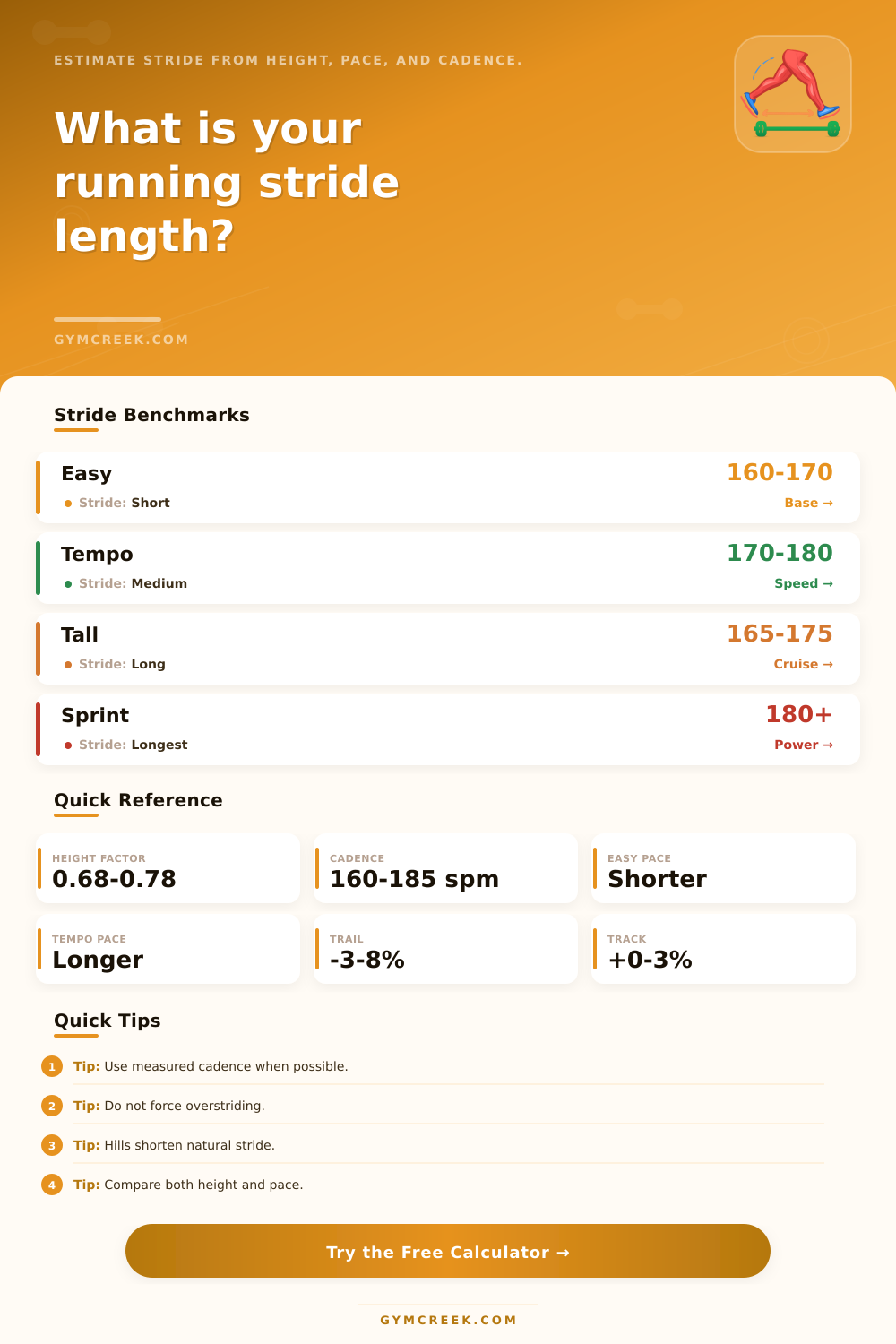
Estimate stride length from height, pace, cadence, terrain, and running style, then compare your height-based number with a pace-based stride.
📌Presets
Presets load complete height, cadence, pace, terrain, and measured-step examples, then calculate immediately.
⚙Calculator
Stride snapshot
Enter height, pace, and cadence to compare estimated and pace-derived stride length.
📊Metrics Comparison
📑Reference Tables
| Height | Easy Stride | Tempo Stride | Notes |
|---|---|---|---|
| 5 ft 2 in / 157 cm | 3.5-3.8 ft | 3.8-4.2 ft | Short lever |
| 5 ft 8 in / 173 cm | 3.9-4.3 ft | 4.3-4.8 ft | Common range |
| 6 ft 0 in / 183 cm | 4.2-4.6 ft | 4.6-5.1 ft | Tall runner |
| 6 ft 4 in / 193 cm | 4.4-4.9 ft | 4.9-5.4 ft | Long lever |
| Cadence | Typical Use | Stride Feel | Watch For |
|---|---|---|---|
| 150-160 spm | Easy jog | Longer | Overreach |
| 160-170 spm | Base runs | Moderate | Heavy contact |
| 170-180 spm | Tempo | Efficient | Forced rhythm |
| 180-195 spm | Fast reps | Quick | Too choppy |
| Terrain | Adjustment | Cadence Shift | Reason |
|---|---|---|---|
| Track | 0 to +3% | Steady | Even surface |
| Road | Baseline | Normal | Flat footing |
| Treadmill | -1 to +1% | Steady | Belt rhythm |
| Trail | -3 to -8% | Higher | Foot placement |
| Hills | -5 to -12% | Higher | Grade changes |
| Formula | Inputs | Best Use | Output |
|---|---|---|---|
| Height factor | Height x ratio | No GPS data | Estimate |
| Pace cadence | Speed / spm | Current run | Live stride |
| Measured steps | Distance / steps | Calibration | Best fit |
| Race count | Distance / step | Planning | Total steps |
💡Tips
We all know the myth: If you want to run efficiently, you must hit precisely one-hundred-and-eighty steps per minute. Over time, this magic number became gospel in running circles, but it ignores human anatomy.
Every runner isn’t built the same way. Some runners glides along with long, efficient strides; some churn out their legs quickly with short steps because they’re naturals. Height is a huge factor in whether you are better suited to a longer or shorter stride. Forcing yourself to hit a cadence that doesn’t align with your mechanics will not help you get faster it might hurt you.
Why You Should Not Force a Specific Cadence
This calculator will do the math for you, translating your physical measurements into useful stride data, with no trip to lab required. Your height determine the length of your levers and thus the distance you move with every step. The longer the runner’s leg length (typically found in taller runners), the more ground they will cover on a given stride length at any level of effort. Conversely, shorter runners depends more on higher turnover to cover the same amount of distance. That’s not a fault. Rather, it’s simply a matter of mechanics.
The tool estimates your starting stride length from your height by applying a ratio based off average body measurements. So you have a place to start, a benchmark, before tying your shoe strings. That allows you to ask yourself: Am I running efficiently for my body type? Or should I be thinking about shortening my stride to decrease braking forces?
Everything changes when you consider pace. Your running stride isn’t staying the same; it’s changing, increasing in length as your pace increases. If you’re running at a comfortable aerobic effort, your stride is going to be significantly shorter then it would be during a race effort or tempo run. The stride calculator considers this difference when you enter your desired target pace; it automatically calculates the corresponding expected stride length based on your own numbers.
This is important because so many runner attempt to use their long-run stride when doing speed work: they end up wasting energy, getting sloppy with form, and missing out on optimal mechanics. Comparing your pace-determined stride against the one you expect based solely on height lets you know whether you’re moving your body around in space properly or not.
Terrain is another factor in this flat-road science. Running on hills or trails will naturaly shorten your stride, your body is more focused on finding balance and stability rather than maximizing stride length per step. Your cadence will likely go up; stride length drop considerably. The calculator has settings for various surfaces (i.e., you need to input different things for a track workout versus a trail run).
If you don’t account for the environment, it can throw off your results and make you frustrated if you feel like you’re working harder but the numbers doesn’t reflect it. Before you start your run, know how to set it up based off the surface you’ll be running on rather than what you are wearing.
The other half of the equation is cadence, which refers to the frequency at which you take each step. Your stride length and cadence is inversely related (i.e., for a given speed, the faster your cadence, the shorter your stride). To prevent injuries, you want to find your sweet spot, your cadence must support your natural stride without leading to overstriding. When you overstride, your foot land ahead of your center of mass, placing extra stress on your hips and knees.
This is laid out clearly by the cadence table on the page, showing what different cadence ranges matches with typical running efforts and possible form issues. So in summary, run to learn your own running profile and don’t get fixated on the numbers. Think of the estimations as a learning tool to become more aware of yourself and adjust accordingally.
How does it feel after you’ve tweaked your stride according to what you learned? Does it feel easier, smoother, lighter with a higher cadence? Then you’re probably onto something. But if it feels choppy or forced, take a step back and just go with a pace/rhythm that feels comfortabley.
The rules are set by your anatomy. Your awareness is the game being played inside the rules. Let the data lead you, but be true to the comfort level which will shape your final self.