Running Recovery Time Calculator
Estimate how much recovery time to leave after a run using session duration, intensity, weekly mileage, sleep, soreness, heat, elevation, age, and the workout coming next.
📌Presets
Each preset loads a realistic runner profile, then recalculates the recovery window.
⚙Calculator
Recovery snapshot
Enter your run and readiness details to estimate recovery.
📊Fitness Metrics
📑Reference Tables
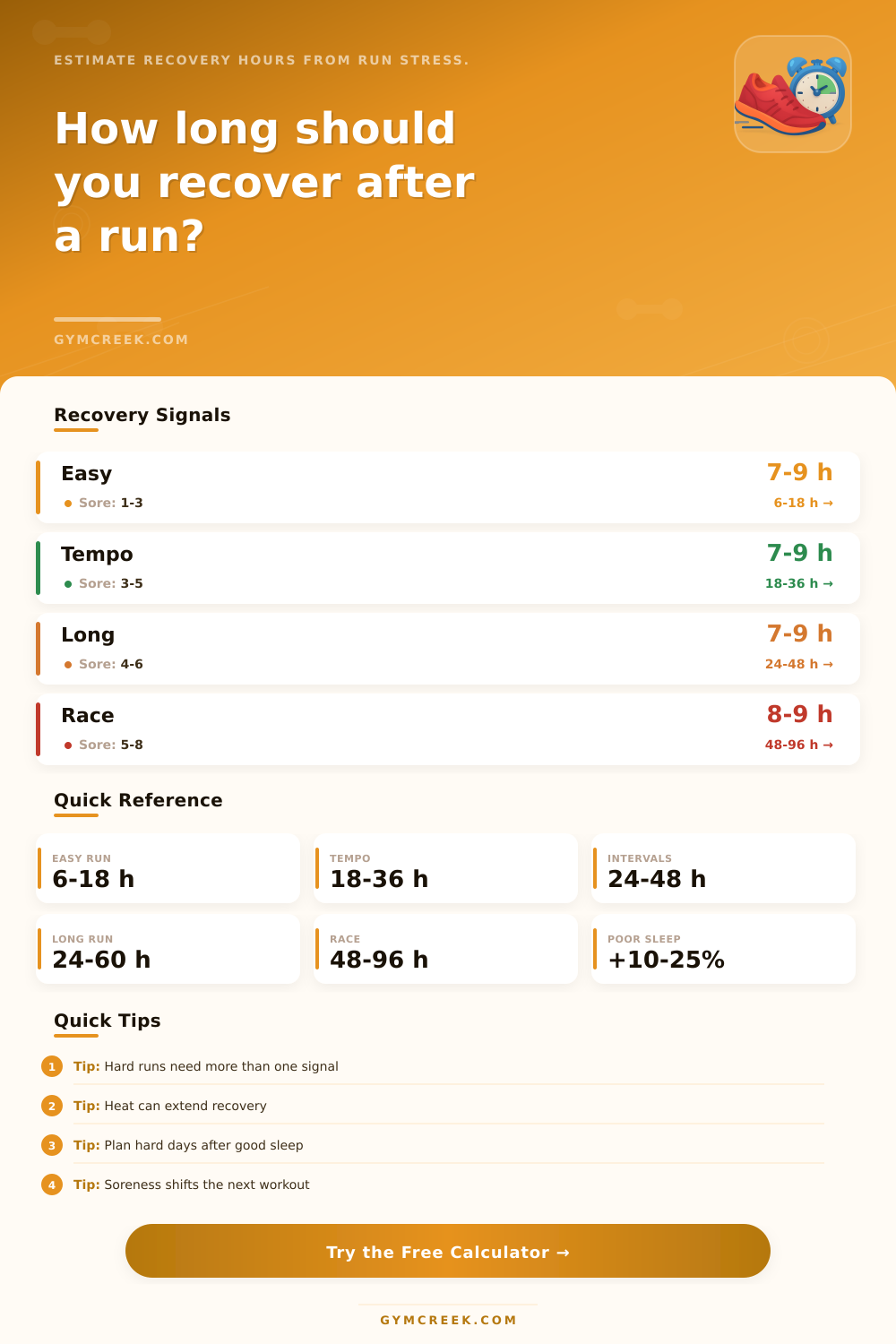
| Intensity | Stress cue | Typical recovery | Watch point |
|---|---|---|---|
| Recovery shuffle | Very low | 4-12 hours | Keep it short |
| Easy aerobic | Low | 6-18 hours | Fatigue fade |
| Steady moderate | Medium | 12-30 hours | Leg heaviness |
| Tempo or threshold | High | 18-42 hours | Sleep quality |
| Intervals or hills | Very high | 24-54 hours | Tendon feel |
| Race effort | Peak | 48-96 hours | Deep soreness |
| Next workout | Buffer effect | Best use | Change if sore |
|---|---|---|---|
| Rest or mobility | Shorter | Full reset | Keep it easy |
| Easy run | Base | Aerobic volume | Drop pace |
| Long run | Longer | Endurance | Trim distance |
| Quality day | Longest | Speed work | Move 24 h |
| Race or time trial | Longest | Performance | Prioritize sleep |
| Readiness sign | Green | Caution | Red flag |
|---|---|---|---|
| Sleep | 7-9 hours | 6-7 hours | Under 6 |
| Soreness | 1-3 | 4-6 | 7-10 |
| Heat stress | Cool | Warm | Extreme |
| Weekly load | Stable | Rising | Sharp jump |
| Scenario | Inputs that matter | Recovery bias | Planning move |
|---|---|---|---|
| Base run | Duration, mileage | Moderate | Easy next day |
| Hot run | Heat, sleep | Higher | Hydrate and rest |
| Hill run | Elevation, soreness | Higher | Watch calves |
| Race | Intensity, age | Highest | Delay quality |
💡Tips
Running recovery time is a factor that determines whether an individual will be consistent with there trainings or whether they will begin to miss their workouts. While many runners feel when there legs is becoming heavy with fatigue, they may not recognize that an amount of time that has passed between their last training session and the next causes this feeling. The gap between training sessions can be a time when the body adapt to the runner’s training, but it is also when any problems with running begin to evolve into bigger problems.
A recovery calculator allows runners to calculate the amount of time that they need to recover from their last training session to ensure that they dont have to guess as to how there body will feel with an upcoming training session. Several factors influences how the body adapts to a runner’s distance and how those adaptations can be accounted for in a recovery calculator. Factors to consider include the duration of the runner’s last training session, the intensity of that last training session, the number of miles that the runner typically covers during each week of training, the amount of sleep that the runner got the night prior to the last training session, the sensation of soreness within the muscles of the runner, the climate in which the runner experienced there last training session, the elevation gain that that runner covered while training, the age of the runner, and the type of upcoming training session.
How to Use a Running Recovery Calculator
These different factors will combine within the recovery calculator to determine the amount of time that is necessary for the body to recuperate from the previous training session. For example, if an individual ran for forty-five minutes and got eight hours of sleep the previous night while running on flat terrain and on cool weather temperatures, the body may recover within twelve hours. However, if the same individual ran at similar distances and speeds, but after sleeping for six hours while exposed to humid weather temperatures and after gaining elevation while running, the body may require more than thirty hours of recovery prior to attempting any other hard running efforts.
This recovery calculator will mathematically calculate these variable for the runner, saving the individual from having to guess as to there body’s recovery time. While the recovery calculator establishes a time period for when the body should rest, the recovery period does not mean that the individual is banned from all physical activity. Instead, individuals can still perform easy walking and stretching activities during the recommended recovery period.
The body needs to rest from the previous running effort, but it does not need to be banned from movement. Individuals often make the mistake of treating each training session for runners as the same. For example, runners that complete long runs on a Saturday may believe that they are ready to complete more intense training on a Monday.
However, the sensation of soreness often does not begin to develop until after Tuesday’s training sessions, indicating that the body adaptations began to compound. Moreover, many individuals ignore the effect of heat and humidity on the body. For instance, if an individual completed there running session in hot weather, there body will have required more energy to keep there body temperatures regulate; therefore, the body adapted to the training with more effort than if they were to run in cooler weather.
Such factors are accounted for in the calculator; more hours of recovery will be indicated for runners that train in heat and humidity. Moreover, if an individual selects either a race or a quality day in the calculator, the calculator will indicate more hours of recovery due to the fact that the body will have to feel fresh for these types of efforts. Sleep is one of the factors that most individuals are unaware of.
While cutting a sleep period by an hour or two does not seem like a dramatic difference to the individual, if sleep is skipped regularly, the body will require more time to recover from there running efforts. While the bodys muscles will recover from sleep skipped, the body requires more time to develop adequate adaptations to recover from running. If an individual selects less than seven and a half hours of sleep on the calculator, it will account for the decrease in the bodys ability to recover during sleep.
The same is true for the sensation of soreness; if an individual includes higher level of soreness in there training with the calculator, the body will require more recovery time to allow those muscles to adapt to there training. The tables located on the calculator provide the typical time ranges for runners of different levels and of different types of training. These tables are not rules to be followed by the runners, but they do help to provide individual an idea of how to incorporate the recovery time indicated by the calculator into there schedule.
For instance, if the calculator indicates that an individual requires twenty-eight hours of recovery, but the individuals schedule allows only for twenty hours of recovery, the individual must decide if they will move the workout, shorten the workout, or adjust the level of performance that they will feel during the workout. Such a decision ensures that the body is not forced to continue to adapt to there training without adequate rest periods. Often, training plans cannot remain perfect.
Individual lives may prevent adequate sleep for individuals, or weather may prevent individuals from having easy days of running. Moreover, if an individual ran a race, they may feel more soreness than they would normally during there run; the recovery calculator can be used to adjust for these types of factor. If an individual ran in excessively hot weather or had a poor amount of sleep the previous night, the recovery calculator can be used to adjust the bodys adaptation period to these types of factors.
Thus, the recovery calculator helps individuals to become aware of the signals that there body is sending. Thus, it allows individuals to recognize when there training may have cost them more than they should of. Recovery as a concept is not the same as a body that is not involved in any training.
Recovery is the part of training that the body adapts to the training that has occurred thus far. If an individual skips this portion of training, there body will begin to experience a slow decline in there ability to perform strenuous running efforts. Thus, while the running recovery calculator will not eliminate the need for runners to pay attention to there bodies, it will provide runners with another means of data to pay attention to there body in addition to the signals that there bodys legs are sending.
Thus, if both the signals from the body and the signals from the calculator begin to indicate that an individual should rest, they will have a better chance of completing the goal of the training plan to include the individual’s body for a number of training weeks. Thus, while the goal for runners to use this recovery calculator is not to develop the perfect training plan for there bodies, the goal is to establish the number of training efforts that an individual’s body can handle over the span of a number of months.