Running Power Calculator
Estimate running watts from pace, grade, wind, terrain, altitude, carried load, and your own threshold power.
📌Presets
Each preset loads a realistic running context and recalculates watts, W/kg, grade load, and threshold intensity.
⚙Calculator
Running power snapshot
Enter pace and terrain to estimate running watts.
📊Metrics Comparison
📑Reference Tables
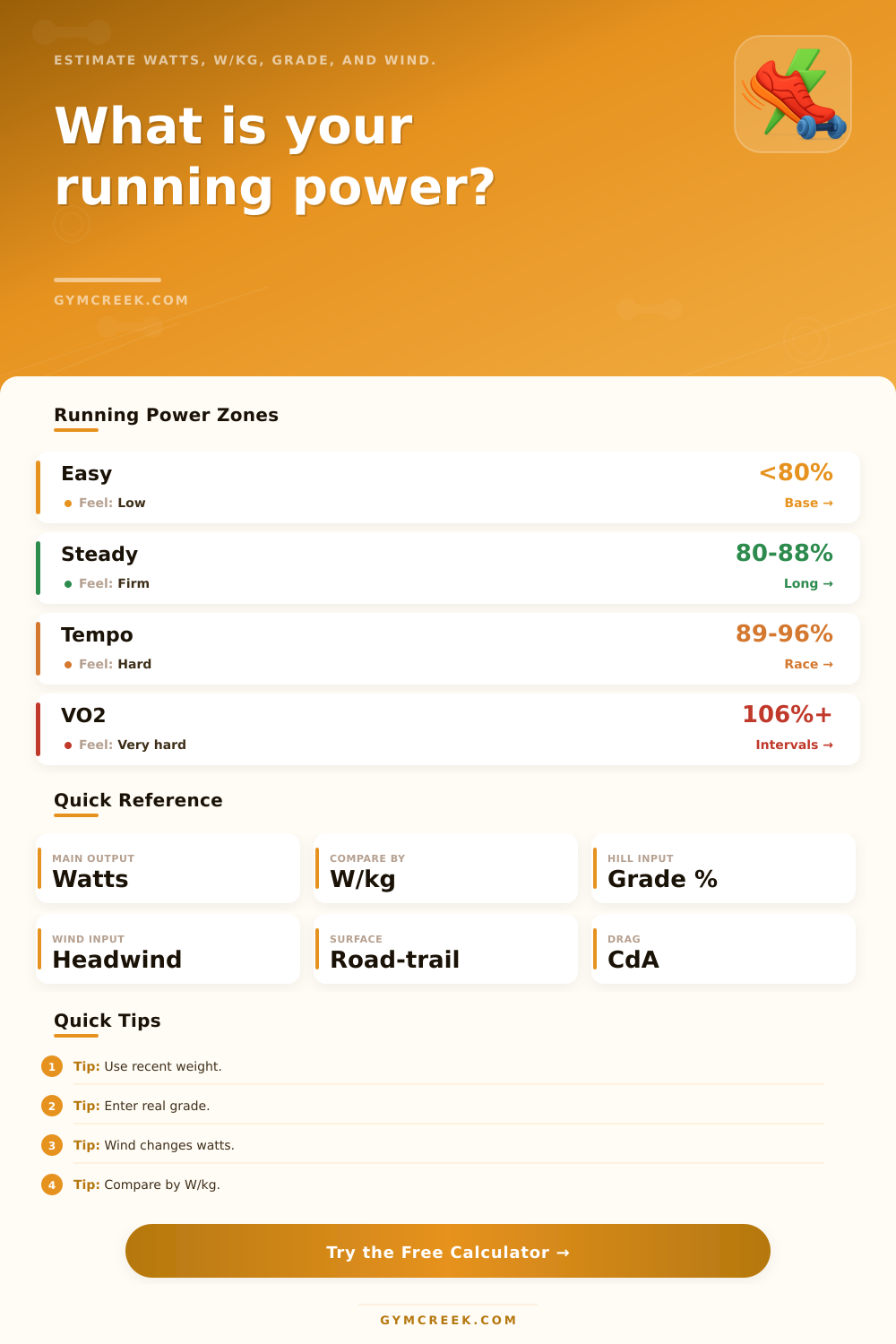
| Zone | % Threshold | Typical Feel | Common Use |
|---|---|---|---|
| Recovery | <70% | Very easy | Easy days |
| Endurance | 70-80% | Controlled | Base runs |
| Marathon | 81-88% | Steady | Long races |
| Threshold | 96-105% | Hard | Tempo work |
| Grade | Power Effect | Pacing Note | Best Use |
|---|---|---|---|
| -3% | Lower watts | Protect legs | Downhill |
| 0% | Baseline | Use pace | Flat road |
| 3% | Large rise | Hold watts | Rolling hill |
| 8%+ | Very high | Power hike ok | Steep climb |
| Surface | Factor | Why It Matters | Adjustment |
|---|---|---|---|
| Track | 1.00 | Firm return | Lowest loss |
| Road | 1.01 | Normal outdoor | Small loss |
| Trail | 1.08 | Footing varies | Higher watts |
| Sand | 1.18 | Soft contact | Big penalty |
| Variable | Formula Role | Unit | Impact |
|---|---|---|---|
| Pace | Speed input | m/s | Main driver |
| Weight | Mass input | kg | Scales watts |
| Grade | Gravity term | % | Hill load |
| Wind | Drag term | m/s | Air load |
💡Tips
Until you take out what throws things off kilter, pacing is subjective. Maybe you can run a seven-minute mile on a flat, windless track and feel like you are coasting. Then when you attempt the same pace up a hilly trail into the wind your heart races, your lungs burn, and you sweat like pig. The speed is the same. The effort is different than that. That’s why power matters. It isolates the work you do from conditions in which you do it.
The calculator (above) take this all in for you. That’s because it uses all those variables and converts pace, weight, grade, and wind into one thing: watts. To know what those watts represent, you have to look at inputs driving them.
Why Power Is Better Than Speed
Gravity doesn’t negotiate so weight is fairly straight-forward: Every pound you carry, whether you’re carrying gear for an ultra or wearing a hydration vest, costs energy; it doesn’t matter how flat the road appears. Enter weight here and tool will separate your body weight from load you’re carrying. This is important because being weighed down with extra weight changes your running economy. You may believe you’ll be able to run same pace as ever but moving that combined mass require significantly more power.
Then there is terrain. When you’re on a smooth track, its rolling resistance is low; nearly every bit of energy you put out go toward propulsion. You shift onto a technical trail/soft sand, and that surface factor shoot upward. Now you’re battling more than gravity, now you’re also battling the ground. And as that chart on the page demonstrates, various surfaces penalize your speed. It’s not simply a matter of comfort. It’s also a matter of efficiency. Even a small variation in footing can sap battery life at a greater rate then even a modestly increased distance ever would.
Consistency is affected by wind. Air resistance isn’t something most runners notice, as they don’t feel it directly, but physics doesn’t care how you perceive it. A stiff headwind is nothing more than a brake and the stronger the wind blows, the harder it becomes to overcome. Even though you may be maintaining your desired speed, in order to hold a target split against twenty-mile-an-hour gusts your power output go through the roof. On windy days, experienced racers monitor their power meters more intently then they look at their watches. The clock might show they are on pace, but if they are working harder than the split suggests, their legs will give out.
But what do those numbers mean? These numbers put threshold intensity into perspective. It’s nice knowing that you’re putting out three hundred watts. Knowing that this is ninety percent of your threshold power tell you whether you can hold it for five minutes or an hour. The comparison against your threshold will be given as a percentage. And that percentage help you make decisions on the fly. Ease up if it’s too high. You got fuel in the tank if it’s low.
Speed is something everyone notices; it’s visible. If I run a mile in 5 minutes, people notice that. But power tells the story behind the speed. How did you get up that hill? Did you have to fight wind? What was in your pack? Once we begin to train based off effort, not time, our workouts are honest. We no longer get rewarded or punished based on easy or hard conditions. The number isn’t a judgment of our ability anymore. Instead, it’s a measure of what we’re putting out.
But when you learn to manage the engine rather than chase the clock… That’s where the magic happens. Let the tool get you to a baseline on a flat, calm day. See what happens as you run into thick air or hit a steep part of road. Chances are, you’ll discover keeping steady power feels far more naturaly than rigidly trying to keep pace. And your legs will appreciate being allowed to relax and feel the effort. There is nothing about running well that has much to do with counting the seconds your foot hits the ground. It has everything to do with respecting amount of energy required to move forward at all.