🏃 Running Economy Calculator
Estimate oxygen cost per kilometer, pace efficiency, fuel demand, and normalized running economy from a steady field or treadmill effort.
Your Running Economy Results
Results appear after calculation.
| Economy Band | Oxygen Cost | Common Runner Profile | What It Usually Means |
|---|---|---|---|
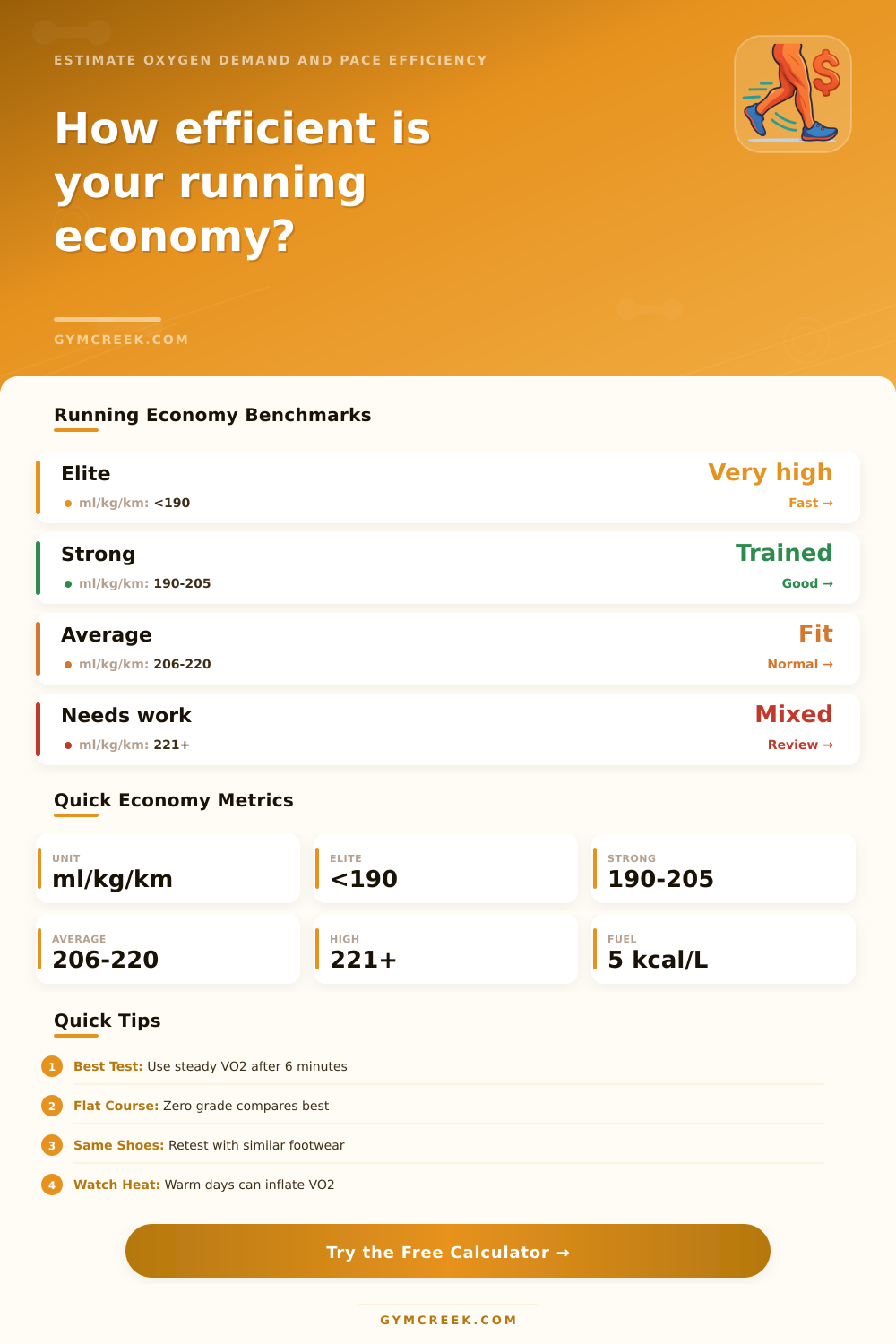
| Elite | Under 190 ml/kg/km | Highly trained distance runner | Very low oxygen demand at speed |
| Strong | 190–205 ml/kg/km | Competitive club runner | Efficient mechanics and good stiffness |
| Average trained | 206–220 ml/kg/km | Consistent recreational runner | Normal economy for regular training |
| High oxygen cost | 221–240 ml/kg/km | Newer runner or fatigued test | Review pacing, surface, or measurement setup |
| Very high cost | Over 240 ml/kg/km | Hilly, hot, soft, or unstable test | Retest under flatter, steadier conditions |
| Scenario | Example Data | Expected Result | Use This For |
|---|---|---|---|
| Lab treadmill | 0% grade, steady VO2 | Cleanest raw economy | Benchmarking between training blocks |
| Track repeat | Known distance and time | Good field comparison | Testing shoes or cadence changes |
| Road tempo | Flat road, light wind | Slightly noisier economy | Practical race-specific monitoring |
| Trail effort | Rolling grade and uneven surface | Higher adjusted oxygen demand | Estimating terrain penalty |
| Heat check | Same route in warm humidity | Inflated VO2 and kcal demand | Separating weather from fitness change |
| Metric | Formula | Variables | Interpretation |
|---|---|---|---|
| Running economy | VO2 / speed x 1000 | VO2 ml/kg/min, speed m/min | Lower ml/kg/km means better economy |
| Energy per km | RE x kg / 1000 x 5 | RE, body mass, 5 kcal/L O2 | Estimated kcal required for each km |
| Energy per hour | VO2 x kg / 1000 x 5 x 60 | VO2 and body mass | Fuel demand at this test intensity |
| MET estimate | VO2 / 3.5 | VO2 ml/kg/min | Exercise intensity relative to rest |
| Normalized economy | Raw RE / modifiers | Grade, surface, load, weather | Flat-condition comparison estimate |
| Factor | Low Modifier | High Modifier | Calculator Treatment |
|---|---|---|---|
| Grade | Flat 0% | Uphill or steep downhill | Positive grade adds oxygen demand; steep downhill also adds cost |
| Surface | Track or treadmill | Soft grass, sand, technical trail | Uneven or soft ground increases oxygen demand |
| Footwear or load | Light racing shoe | Pack or weighted vest | Extra distal mass raises the adjusted cost |
| Environment | Cool and dry | Hot, humid, or bulky cold clothing | Stress modifier helps separate weather from fitness |
Running economy are the measurement of the efficiency of the runners in relation to the amount of oxygen that they use to move their body forward when running. While running economy isnt to be confused with VO2 max value (which measure the amount of oxygen that a person can take into their lungs), running economy measures the amount of oxygen that a person use to maintain a specific pace. As such, individuals with high values of running economy will use less oxygen to maintain a specific pace than runners with low values of running economy; indicating that they are more efficient at running.
Factors that influence an individual’s running economy include their biomechanics, the stiffness of their muscle, and the type of equipment that they use while running. Individuals who waste energy while running will use more oxygen to move there bodies forward over a distance than runners who exhibit efficient movement. To calculate an individual’s running economy, it is necessary to use a steady state measurement to determine how much oxygen they use during running.
Running economy: what it means and how to improve
A steady state measurement is one that does not use measurements while an individual is sprinting or when their heart rate are climbing. These parameters will result in noisy data. Instead, the individual should be running at a steady pace and with even breathing so that a calculator can calculate their running economy.
After determining an individual’s steady state running economy, a calculator can determine how many milliliters of oxygen the individual consumes per kilogram of body weight when running a kilometer. This value is a measurement of the individual’s efficiency while running. An individual’s running economy will place them into different band in relation to other runners.
A low measurement of running economy indicates that the individual is an efficient runner, they waste less energy while running. A high number in these bands, however, does not necessarily mean that the individual has poor fitness. For instance, an individual may waste more energy when running on a sandy beach then on a paved road.
Or, an individual may use more energy when running in hot temperatures due to the bodys need to cool itself. These types of external factor will increase the oxygen consumption of an individual while running, but will not impact there actual economy. An individual’s running economy can be found by adjusting for different modifier of that economy.
For instance, an individual’s economy may be adjusted for the grade of the road that they were running on, the type of surface that they were running on, and the weight of their shoe. The economy can be calculated for even running on a flat and cool track. Additionally, an individual’s trail run economy can be compared with their economy while running on a treadmill by normalizing their data.
Without normalization, an individual may believe their fitness has worsened when they have simply changed the type of surface that they ran on. An individual’s economy can be influenced by the type of shoes that they use. For instance, an individual that use a pair of heavy shoes will use more energy than an individual that is using a pair of lightweight shoes.
Some moddern shoes are developed to improve the economy of an individual that runs in them, as a result of the use of carbon plate or specialized foams that store and return energy to the runner. Thus, when the shoes return some of the energy that was used to propel the individual forward, their economy increase. In order to improve their running economy, an individual can focus upon their running economy and their strength.
For instance, increasing cadence can reduce the amount of energy that an individual waste with vertical movements. Additionally, strength and plyometric exercises will lead to stronger tendons, which will allow the individual to prop themselves forward while using less oxygen. Over several month, an individual can measure there changes in running economy.
If an individual’s running economy increases while their pace remains the same, they have become more efficient at running. Furthermore, an understanding of an individual’s economy allows for them to understand the relationship between their effort and the distance that they output while running, knowledge that they can use to race with mathematical precision.