Ideal Running Cadence Calculator
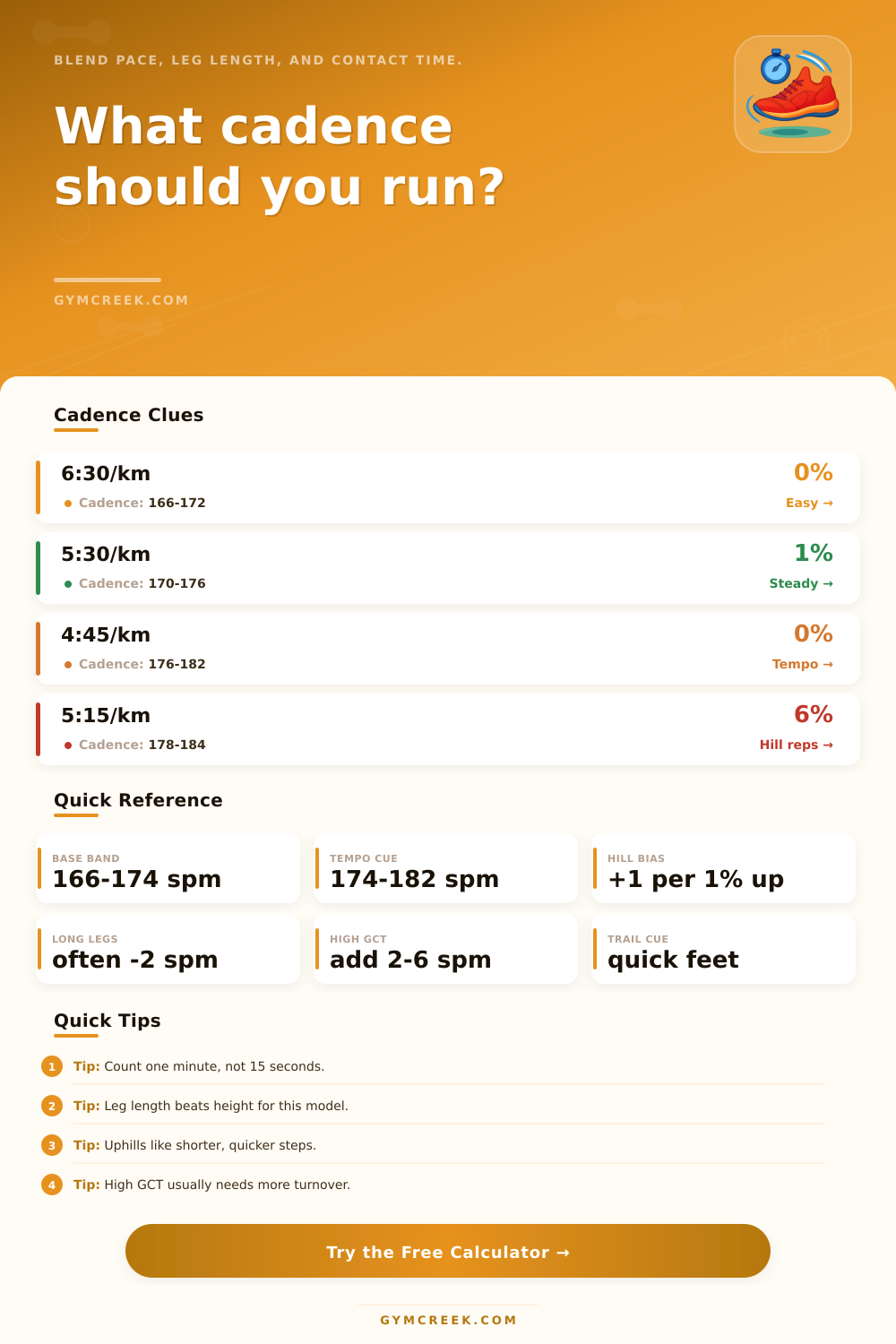
Estimate a smarter step rate by combining target pace, leg length, training status, incline, ground contact time, and surface so your cadence band fits the workout instead of chasing one universal number.
📌Runner Presets
These nine presets cover realistic running setups, from a comeback treadmill jog to hill repeats and faster track work, with pace, grade, leg length, and ground contact time already filled in.
⚙Cadence Inputs
Ideal running cadence
Enter valid pace and leg data to build a cadence target.
📊Cadence Metrics
📑Reference Tables
| Pace | Speed | Cadence band | Typical use |
|---|---|---|---|
| 6:30 per km | 9.2 km/h | 166-172 | Recovery miles |
| 5:45 per km | 10.4 km/h | 169-175 | Base training |
| 5:00 per km | 12.0 km/h | 173-179 | Steady run |
| 4:30 per km | 13.3 km/h | 176-182 | Tempo work |
| 4:00 per km | 15.0 km/h | 180-186 | Fast repeat |
| Leg length | Natural cue | Typical step | Read |
|---|---|---|---|
| 72 cm | 186 spm | 0.89 m | Shorter lever |
| 78 cm | 179 spm | 0.95 m | Compact stride |
| 84 cm | 175 spm | 1.00 m | Balanced |
| 90 cm | 169 spm | 1.06 m | Longer lever |
| 96 cm | 164 spm | 1.12 m | Tall runner |
| GCT | Cadence nudge | Read | Cue |
|---|---|---|---|
| 205 ms | -3 spm | Quick rebound | Do not force extra turnover |
| 220 ms | -1 spm | Efficient touch | Hold natural rhythm |
| 235 ms | 0 spm | Neutral | Stay relaxed |
| 250 ms | +2 spm | Long contact | Quicken the feet |
| 270 ms | +4 spm | Heavy loading | Shorten each step |
| Condition | Bias | Why | Best cue |
|---|---|---|---|
| Track at 0% | 0 spm | Clean rebound | Let rhythm settle |
| Road at 2% | +2 spm | Uphill shortens step | Keep knees quick |
| Treadmill at 1% | +2 spm | Controlled belt pace | Stay light |
| Trail at 4% | +5 spm | Footing changes often | Use nimble steps |
| Downhill at -3% | -1 spm | Stride opens slightly | Avoid overreaching |
💡Cadence Tips
Cadence is teh number of steps that an individual take in one minute while running. The cadence of an individual while running is one of the primary factors that determines there efficiency while running. While many runner strive to have a specific cadence for their running routine, there is no specific cadence that should be required of each runner.
A runner whose cadence does not correlate to their physical anatomy may experience issues with efficiency or even injuries to their physical body. One of the main variable that affects a runners cadence is their leg length. Short legged runners will naturaly have a higher cadence than individuals with longer legs.
What Changes Your Running Cadence
The distance from an individual hip to the floor is a way of measuring an individual’s leg length. An individual with a long leg length may have an efficient cadence of 165 steps per minute, while those with short legs may have an efficient cadence of 185 steps per minute. An individual’s pace can also impact their cadence.
Cadence and pace is mathematically linked to one another. When an individual sets a slower pace during a recovery jog, their cadence will be lower compared to when they are running at a fast pace during a tempo run. Additionally, the amount of time that an individual’s foot is in contact with the ground during their run (ground contact time) can also have an impact on their cadence.
Contact times longer than 250 milliseconds indicate that an individual may need to increase their cadence to reduce the amount of time that their foot is in contact with the ground. The terrain that an individual runs on will also have an impact on their cadence. An uphill run will require an individual to have a higher cadence and shorter stride compared to a downhill run.
In downhill races, an individual will naturaly take longer strides and have a lower cadence. Additionally, the different type of surfaces will require different cadences from an individual runner. Trail runners will have a different cadence than those who run on a treadmill.
An individual’s training will also have an impact on their cadence requirements. Beginners to running may require a shorter cadence to accommodate their body in comparison to those with experience in running. Additionally, those who are of an older age or injured while running may benefit from increasing their cadence to reduce the impact on their joint.
The most accurate way to measure an individual’s cadence is to time an individual’s foot beat for one minute. Short periods of time will provide inaccurate measurement of cadence. Additionally, individual should never try to increase their cadence too quick.
An individual’s form while running may break down if they increase their cadence too quick. Instead, if an individual has a cadence that is lower than there target cadence, they should gradually even out the two over the course of several weeks to allow their ankle and hip to adapt to any change in cadence. A runner should of have a range of cadence values rather than a single cadence value.
An individual should use cadence to adjust their running to their pace, terrain and physical anatomy. By knowing an individual’s leg length and stride, as well as their running pace, an individual will experience increased efficiency in their running motion.