Rugby Calorie Calculator
Estimate rugby calories from position group, match and practice minutes, carries, tackles, sprint count, ruck share, contact load, rest ratio, and adjusted MET logic.
📌Presets
Each preset loads a realistic rugby profile and recalculates calories from playing role, contact actions, sprint exposure, ruck involvement, and rest time.
⚙Calculator
Rugby calorie snapshot
Enter match structure, contact actions, and sprint demand to estimate rugby calories.
📊Fitness Metrics
🧮Formula Cards
Calories per minute = MET x 3.5 x body weight in kg / 200. Match work, practice work, and rest are estimated separately.
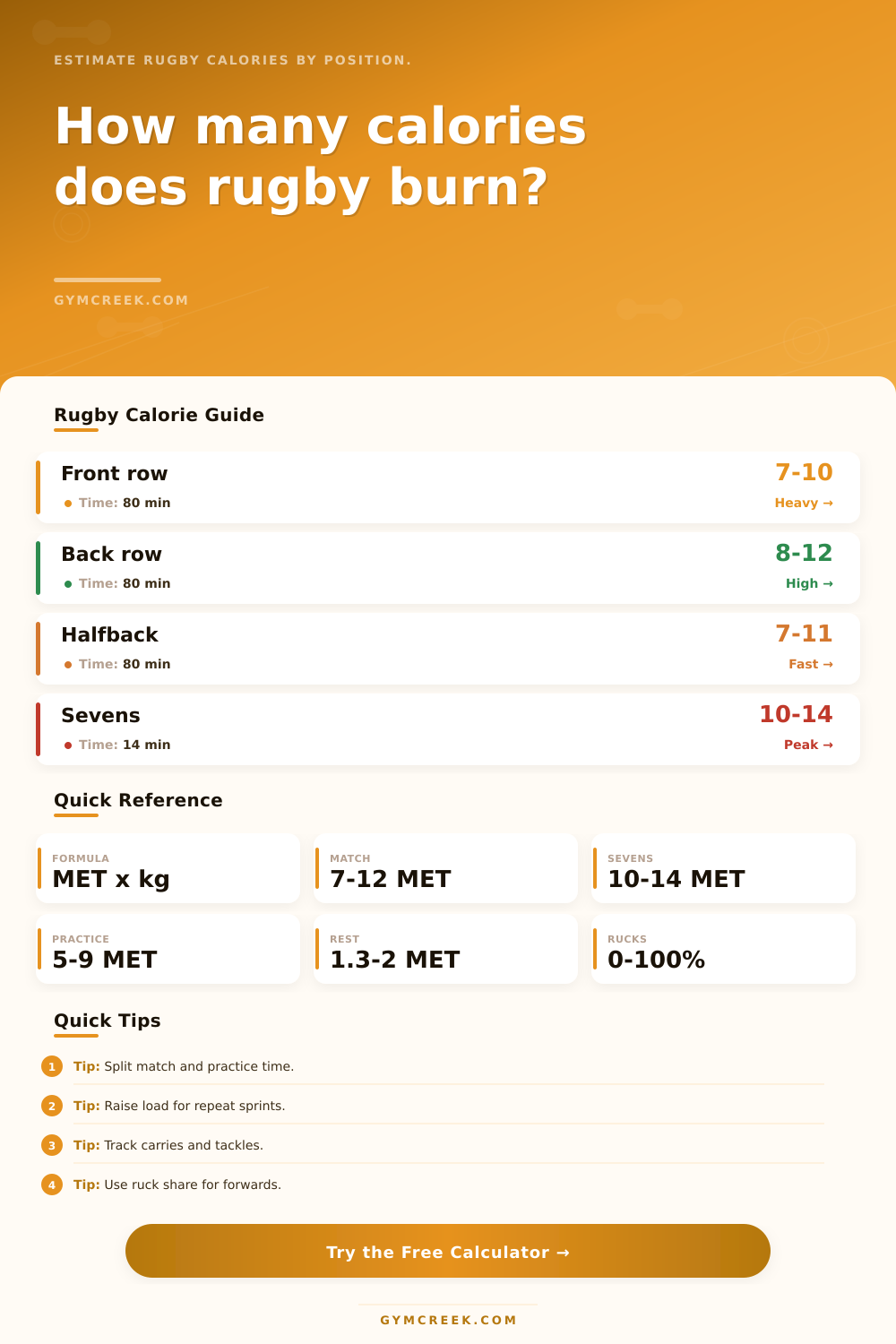
Front row, locks, back row, halves, centres, outside backs, sevens, and touch rugby use different base MET values for match and practice work.
Carries, tackles, ruck share, sprint count, sprint grade, pitch condition, and contact intensity raise or lower the adjusted rugby MET.
Mifflin-St Jeor estimates BMR from age, size, and gender, then activity multiplier estimates TDEE so the rugby session can be compared to a day.
📑Reference Tables
| Position Group | Match MET | Practice MET | Load Pattern |
|---|---|---|---|
| Front row | 8.0 to 10.5 | 5.8 to 8.4 | Scrum and ruck contact |
| Lock | 8.2 to 10.8 | 6.0 to 8.6 | Lineout, maul, repeat work |
| Back row | 8.8 to 11.8 | 6.4 to 9.2 | Ruck, tackle, carry volume |
| Halfback | 7.4 to 10.4 | 5.8 to 8.6 | Tempo, support, cover |
| Outside back | 7.0 to 11.0 | 5.5 to 8.4 | High-speed sprint exposure |
| Sevens | 10.5 to 14.0 | 7.5 to 11.5 | Repeat sprint and tackle load |
| Session Type | Common Time | Rest Ratio | Best Input |
|---|---|---|---|
| Full match | 70 to 90 min | 12 to 28% | Match minutes |
| Team practice | 75 to 120 min | 18 to 40% | Practice minutes |
| Contact practice | 45 to 90 min | 15 to 35% | Tackles and rucks |
| Conditioning | 25 to 60 min | 8 to 25% | Sprint count |
| Sevens tournament | 14 to 70 min | 20 to 55% | Repeated blocks |
| Action Load | Low | Moderate | High |
|---|---|---|---|
| Carries | 0 to 5 | 6 to 14 | 15 plus |
| Tackles | 0 to 6 | 7 to 16 | 17 plus |
| Sprints | 0 to 10 | 11 to 25 | 26 plus |
| Ruck share | 0 to 25% | 26 to 55% | 56% plus |
| Formula | Variables | Output | When Used |
|---|---|---|---|
| MET kcal | MET, kg, min | Calories | Main estimate |
| Action factor | Carry, tackle | MET lift | Contact work |
| Sprint factor | Sprints, grade | MET lift | Speed work |
| TDEE share | Calories, TDEE | Percent | Daily context |
💡Tips
Rugby isn’t a slow-burn activity: It’s an erratic blend of moments where your body is moving quick (sprinting), standing still (waiting for a break down), and suddenly getting pummeled. Because it’s stop-start, it’s hard to get idea of just how hard you’re working when training. Many players think they expend the same calories running to warm-up as they do plowing themselves into ruck; but they don’t. In rugby, calorie cost stems from spike in intensity rather than the overall time on field.
That’s where position comes into play big time. Locks is making lots of contact at slow speed, while a scrum-half are covering greater distance running around at faster speeds. The calculator adjusts these metabolic equivalent figures to take account of the role being performed and then runs math for you (see above). You can imagine that front row players will have fewer sprints but much heavier contact load. Then there are back rower who tend to be somewhere in between as they is involved in both rucking and pursuing lines. Outside backs cover space and kick chasing. So each player profile will have its own energy signature.
How to Count Your Rugby Calories
It’s important to consider what it is your body was actualy doing rather than how many minutes you spent on the field. Under the hood are contact actions. “Each tackle, each carry into resistance, each ruck contest makes your body create force against another human being,” he says. That’s very different from running around empty space.” Contact actions is the hidden fuel guzzlers that drive up the calorie cost.
With this tool, you can enter exact tackle or carry figures. That will alter base estimate upward. Log that you had fifteen tackles in one game? The system will know that was high-intensity defensive work. Players frequently overestimate offense (that ball I carried), while underestimating defense (the twenty collisions I made to prevent the other team).
The number of sprints also affects the equation. Repeated sprints will raise your heart rate and increase body’s need for oxygen. For this reason, the calculator has a setting to adjust grade of sprints. Accelerating for a few seconds doesn’t contribute significantly to overall effort, but longer chases burn more fuel. This becomes relevant if you’re racing on a wet, muddy field. Resistance goes up. The calculator factors in terrain conditions. Sliding across firm grass burns fewer calories different than running through the mud. It is a small detail, but it matters a lot over the course of an hour and twenty minutes.
That’s why rest periods are not wasted time; they’re part of the game. There are natural pauses in rugby. Injury time, scrum time, and conversions all cause downtime. The calculator assumes a rest period to allow for this. If your rest percentage is high, then that will reduce average burn per minute.
That’s why it helps if you can split out your practice time from match time. Rest during a game is different than rest during a structured drill session. They blend together into one number which skews the result. What you want to know is the cost of the type of effort you’ve done. So, it will spit out an adjusted metabolic rate and the overall calorie count for that session. Then it breaks it down into the sprint contribution and the contact load.
So you can see where energy was spent. If there’s a lot of contact load then you know it beat up on your muscles. If the sprint share is high then your cardiovascular system was working hard. That’s better information than just one number. Because it tells you what to do next.
The high contact days requires more sleep and maybe more protein. The high sprint days require more glycogen replenishment. Over time, you can track these numbers throughout a season and start to see patterns. Maybe you find you use less energy if you’re playing more conservatively. Perhaps you realize some of your training sessions are more challenging than match days.
This is laid out in the reference table on the page where you’ll see typical ranges for various activities. They is meant to be used as a starting place. Adjust from there based off your actual data. That’s what matters, getting it right. Getting it right helps you make smarter training decisions and makes sure you’re fueled properly.
Rugby asks every ounce from you. Understanding precisely how much you spent would of help you get it back. Those who manage their energy as well as their ball win the game.