Ruck Pace Calculator
Estimate ruck pace, flat-ground equivalent pace, load ratio, effort score, and training output from route, time, load, terrain, climb, and weather details.
📌Presets
Each preset loads a realistic route, load, time, terrain, and elevation profile, then recalculates the outputs.
⚙Calculator
Ruck pace snapshot
Enter route, time, load, and terrain to estimate ruck pace and route-adjusted effort.
📊Ruck Metrics
📑Reference Tables
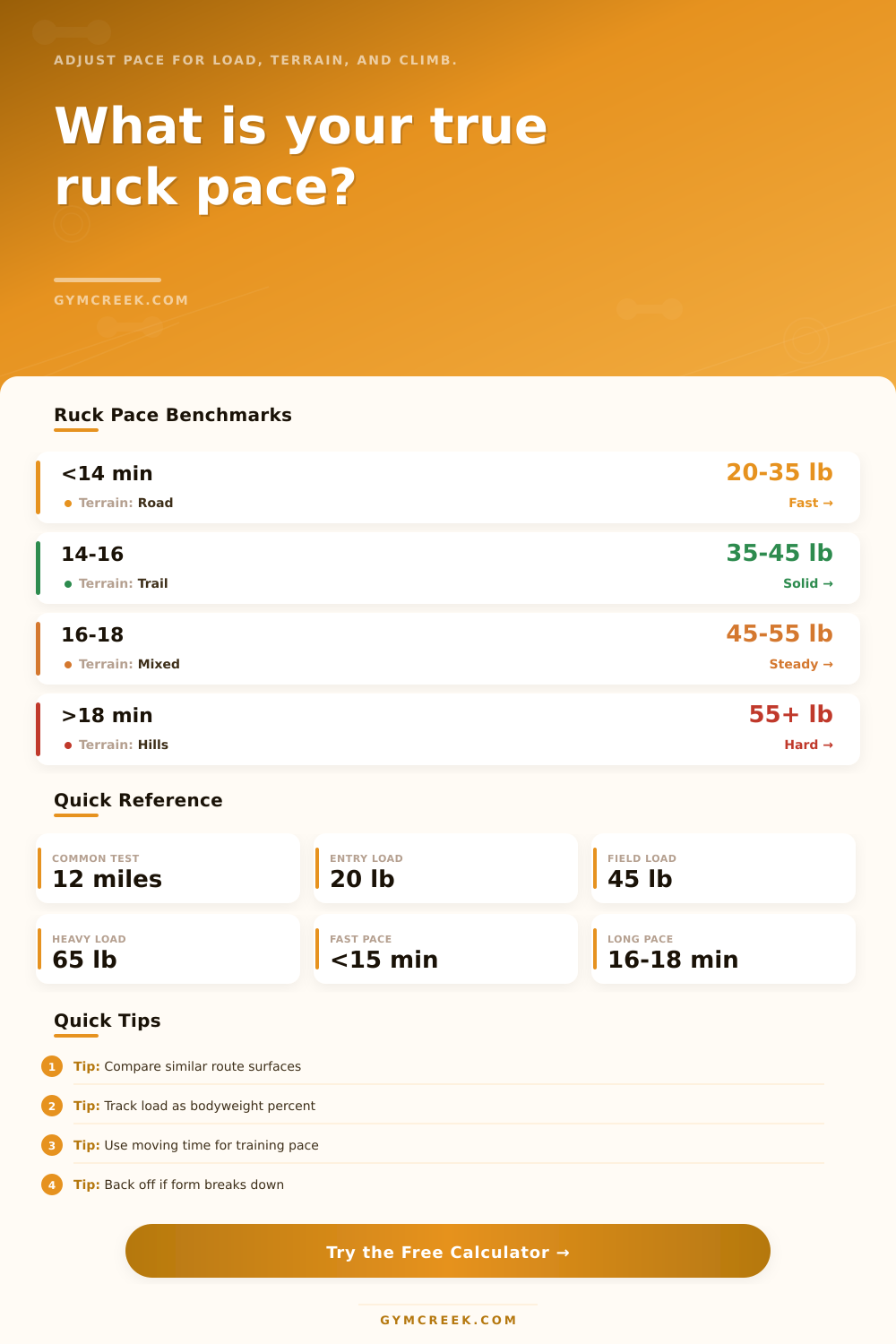
| Pace band | Road feel | Loaded feel | Use case |
|---|---|---|---|
| Under 14 min/mi | Very fast | High output | Short test |
| 14 to 16 min/mi | Fast walk | Solid work | Timed ruck |
| 16 to 18 min/mi | Steady | Sustainable | Long route |
| 18 to 22 min/mi | Conservative | Heavy or rough | Base build |
| Over 22 min/mi | Slow | Very taxing | Recovery or terrain |
| Load ratio | Class | Typical load | Pace effect |
|---|---|---|---|
| Under 10% | Light | 10 to 20 lb | Small |
| 10 to 20% | Moderate | 20 to 40 lb | Noticeable |
| 20 to 30% | Heavy | 40 to 60 lb | Large |
| Over 30% | Very heavy | 60 lb plus | Major |
| Terrain | Factor | Why slower | Watch point |
|---|---|---|---|
| Flat road | 1.00 | Firm footing | Cadence |
| Gravel road | 1.10 | Loose push-off | Ankle fatigue |
| Rooty trail | 1.16 | Foot placement | Trip risk |
| Sand or mud | 1.24 | Energy loss | Heat stress |
| Technical hill | 1.32 | Climb and braking | Form breaks |
| Logic piece | Input used | Output | Purpose |
|---|---|---|---|
| Actual pace | Time / distance | Min per unit | Raw speed |
| Load ratio | Load / weight | Percent | Pack burden |
| Grade penalty | Climb / route | Factor | Hill context |
| Flat pace | Pace / factors | Adjusted pace | Route compare |
| Effort score | All modifiers | 0 to 100 | Stress screen |
💡Tips
When you begin, its a blank slate. You’re moving fast. Your breath is regular, your stride is crisp and you feel good.
Someone then puts forty pounds of steel on your back, shoves you up a muddy hill in the rain and tells you to keep going. All of a sudden, that same pace seem more like running through wet concrete. It becomes less about speed and more about negotiating terrain and managing your load. And slowly, fatigue builds. When you least expect it, it hits you.
Why This Calculator Helps You Ruck Better
Many folks will use an unloaded pace to gauge their loaded time, assuming they’ll be able to shave off a minute or two per mile. More often than not, they will be grossly mistaken. Carrying weight doesn’t just make your body work harder; it alters the way it move as well. The tool above makes nuanced tweaks so you don’t have to wing it.
Just entering distance, duration, and weight does more than just divide a few numbers. It accounts for weather conditions that add (or reduce) heat stress, elevation gain/loss, and the surface you’re covering. Simple: A flat road is straightforward math. But put that same run in mud or on a rooty trail, and energy cost goes up fast. Why? Because with each step, instead of just moving forward, your constantly stabilizing yourself. To account for this, calculator uses certain multipliers for each type of terrain to show what your pace would of been on a flat surface.
More importantly, this flat equivalent pace help you compare an easy day running on the pavement to a brutal hill session. This lets you know which route was actualy harder, even if you do not know the layout.
Another overlooked metric is load ratio. Absolute weight doesn’t matter to a beginner, ‘A forty-pound pack sounds heavy no matter whose back I put it on.’ But forty pounds is over twice your bodyweight if you’re a ninety-pound guy. Less than half if you weigh eighteen. That’s a huge difference in mechanical strain. When you track your pack weight in terms of its percentage of your body mass, you have a consistent way to compare load.
And it helps explain why it feels like some days your pack doesn’t seem so bad with the same amount of plate in it. Lose five pounds of fat? Same number of plates, higher ratio, tougher ruck. Small shift, but a big one if you’re prepping for selection standards or doing longer term training cycle where consistency matters.
And then there’s elevation. Elevation makes things even more complicated. Vertical movement take extra work, which doesn’t always correspond directly to losing horizontal speed. Going uphill might only increase my time by three minutes for every hundred feet climbed on flat ground. But go uphill over a technical, gnarly section and it can double my heart rate, triple my time spent there, etc…
The effort score that the calculator generates try to account for all these stresses. It weighs in everything from the climate (i.e. It combines heat, terrain difficulty, how much weight you are carrying, and pace into a single number from zero to one hundred. That lets you get a quick sanity check as to just how hard the effort realy was. If it’s in the eighties or nineties, you know you’ll need more recovery time than you would have with a normal run of equal duration.
Second, it’s common to underestimate calories burned on a ruck since it appears to be such a harmless activity (compared to running). But combine that with incline and added load, and metabolic demand soars. The calculation uses your bodyweight, age, and sex to give an estimate of how much energy you are using. This is good for making food decisions. You’ll know you’re eating enough to refuel from what might feel like a moderate walk. Physiologically, it look more like heavy interval training. It will help prevent burnout.
If all you have is the clock telling you how fast or slow you’re going, then you might push too hard when climbing a technical hill route. But you don’t realize its an elite pace in terms of terrain factor. Or you might coast on a flat day, thinking it’s easy. Low load ratio masks how much volume stress there is on your joints.
The point here is to build endurance smartly. You must progress without breaking down. Plan your recoveries based off the data. Adjust your expectations different than the data. Let changed paces be your guide as you progress.
Rucking isn’t just walking plus some extra steps. It’s a test of resilience under constraint. When you understand variables, you can control the outcome instead of hoping for the best. Respect the load ratios, start with accurate inputs, and let adjusted paces guide your progression. Know exactly what it costs you in miles and they’ll add up faster.