Ruck March Calorie Calculator
Estimate loaded ruck calories by blending body size, pack weight, distance, moving time, speed, terrain, grade, and temperature so you can compare easy base miles with event-prep marches.
📌Mission Templates
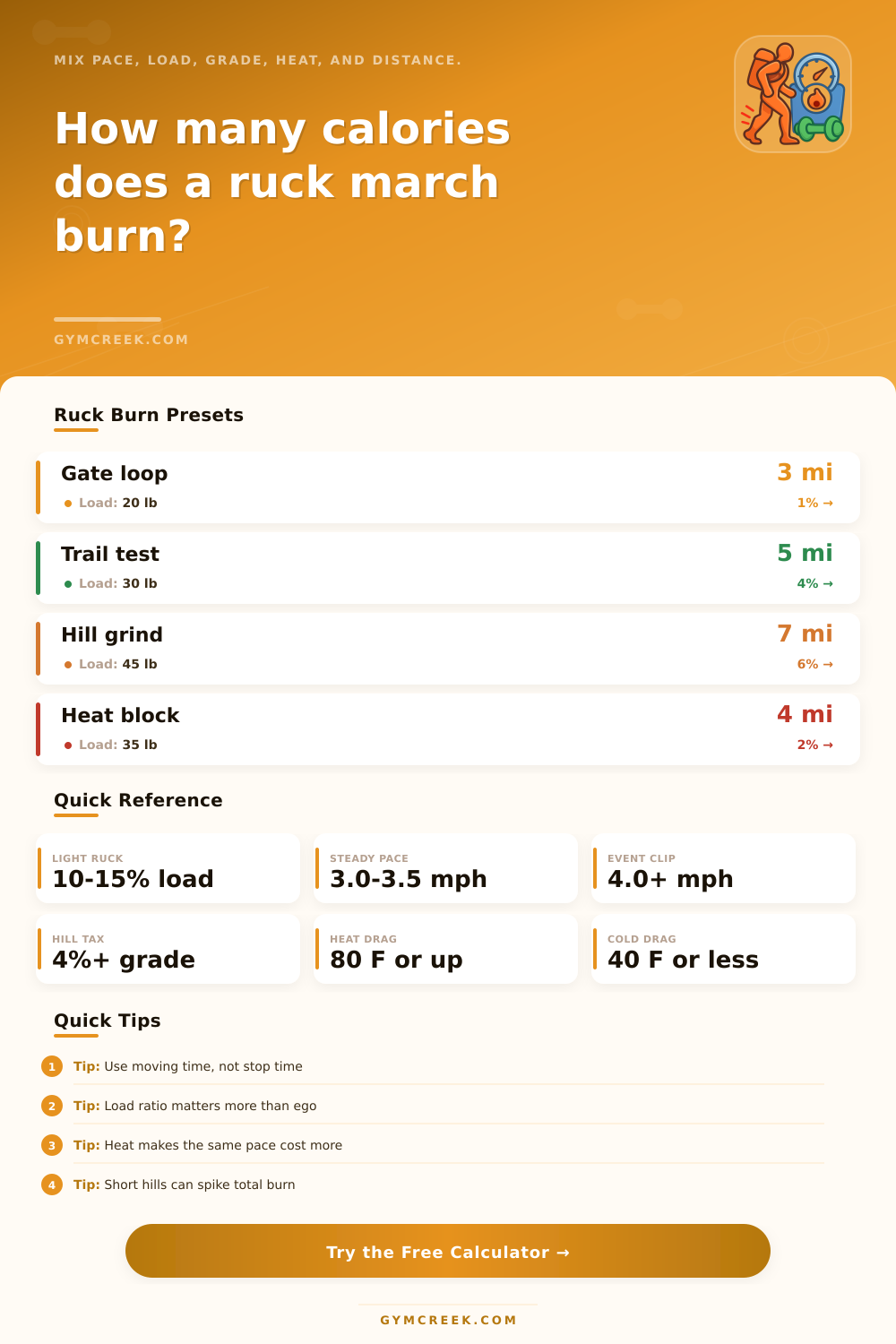
These nine preset marches cover flat recovery walks, hotter pace blocks, longer loaded grinds, and hilly efforts so you can compare common ruck conditions without rebuilding the form every time.
⚙March Setup
Ruck march calorie snapshot
Enter your march details to compare loaded and unloaded calorie burn.
📊Ruck Signals
📑Reference Tables
| Load % | Reading | Session feel | Typical use |
|---|---|---|---|
| Under 10% | Light | Small drag | Recovery miles |
| 10 to 15% | Moderate | Steady work | Base conditioning |
| 15 to 25% | Work set | Clear strain | Event prep |
| 25 to 35% | Heavy | Hard posture test | Short hard blocks |
| 35%+ | Very heavy | Technique fades | Advanced sessions |
| March speed | Grade | Read | Burn cue |
|---|---|---|---|
| 2.5 to 3.0 mph | 0 to 2% | Easy carry | Lowest burn band |
| 3.0 to 3.5 mph | 1 to 4% | Steady march | Most common base work |
| 3.5 to 4.0 mph | 3 to 6% | Harder clip | Noticeable cost jump |
| 4.0 mph+ | 5%+ | Event push | Large climb penalty |
| Condition | Temp band | Added tax | Why it rises |
|---|---|---|---|
| Cool sweet spot | 50 to 65 F | 0% | Best comfort window |
| Warm work | 66 to 80 F | 2 to 5% | More cooling demand |
| Heat stress | 81 F+ | 6 to 12% | Higher heart rate drift |
| Cold drag | 40 F or less | 3 to 7% | More insulation cost |
| Output | Method | Inputs used | Purpose |
|---|---|---|---|
| BMR | Mifflin-St Jeor | Sex, age, wt, ht | Resting energy context |
| Route MET | ACSM walking | Speed and grade | Base march demand |
| Load bonus | Load and terrain stack | Load, surface, grade | Added carriage cost |
| Distance floor | Cost per km blend | Distance and mass | Keeps route length in play |
| Climate tax | Temp factor | Air temp | Heat or cold adjustment |
💡March Notes
Rucking is the act of walking while carrying a weighted pack. A person will have to move there body and the weighted pack across different types of ground. Factors that affect the energy expenditure for a ruck march include the pace at which a person move, the terrain over which they march, and the air temperature during the march.
For example, a person may take steps at a rate of 3.5 miles per hour while walking on pavement, but may struggle to walk at the same rate on rocky trails or hills. The load ratio is the percentage of a persons body weight that is contained within the ruck; the higher the load ratio, the more work that the body must perform. A load ratio of 15% of a persons body weight may indicate a level of work that is considered moderate, but a load ratio of 35% of a persons body weight may be a test of a persons strength and grit.
What Makes Rucking Harder or Easier
To determine the effort that is required of a person for a ruck march, it is necessary for the person to track their body size, the weight of there ruck, the total distance to be marched, there moving time, there marching speed, the type of ground over which they will march, and the weather during the march. The weight of the rucksack is one of the primary factors that will impact a persons ruck march. The body weight of the person will indicate the baseline energy expenditure of that individual, but the weight of the ruck will impact the energy that must be expended during the march.
For example, a person may use a load that weighs 10-15% of a persons body weight to develop the strength of a person while allowing the body to avoid overexertion, but if the load increases to 25% of the body weight, or more, the person may experience difficulties in maintaining there proper marching technique. The load bonus is the number of calories that are burned during the march as a result of the body carrying the weight of the ruck; the load bonus is separate from the calories that would be burned by the individual while walking without the rucksack. Therefore, a person that weighs less and marches at a faster rate may burn more calories then a person that weighs more but marches at a slower rate.
Another of the factors that impacts the energy expenditure requirements for a ruck march is the pace at which a person marches. This pace is the speed that the person controls during the march, not the average speed for the entire route. Average route speeds may be misleading for a number of reasons, such as if the individual was descending a hill for part of the route.
For example, 3.5 miles per hour is a common rate for conditioning, but if the required pace is 4 miles per hour or faster, or if the grade of the terrain is 4% or more, the energy cost of marching will increase. Such an increased energy cost will result in a longer recovery period for the body after the march. Terrain is one of the factors that impacts the energy cost of a ruck march.
For example, pavement and smooth paths require the least amount of energy to march upon; therefore, the individual can maintain a higher rate of speed on these types of surfaces. If an individual marches upon trails or sand, the energy cost increases. Rocky hills can also increase the difficulty of a ruck march; rocky hills require the individual to take shorter steps and to use more of there muscles to march upon such terrain.
An average grade of the route that is to be marched is another terrain factor that impacts the energy cost of a ruck march. For example, a short hill with a high incline may spike the energy cost of marching, but the average grade of a route determines the total energy that is expended during the march. For example, a route with a three percent average grade may result in the individual feeling as if they are performing a long, slow march; three percent average grade increases the difficulty of marching with a loaded ruck.
Weather is another factor that can impact the energy cost of a ruck march. Warm temperatures above 80 degrees may increase the demands upon the body to perform activities like cooling the body; warm temperatures above 80 degrees may also increase the number of calories that an individual burns during a ruck march by six to twelve percent. Cold temperatures below 40 degrees may also increase the energy cost of a ruck march; the body must expend energy to keep itself warm.
However, if the air temperature remains within the range of 50 to 65 degrees, an individual may burn the least amount of calories during a march. The moving time for a march is the length of time that an individual is moving there body forward; moving time doesnt include the time spent on breaks for water or other objectives during the march. It is important for an individual to record the moving time that is spent during a march.
There are a number of different ways that the outcome of a ruck march can be measured. For example, the loaded burn is the total number of calories that are burned during the march; this metric is calculated by combining the metabolic equation for the energy expenditure of the body with the distance of the route. The net active burn rate is the amount of energy expended by an individual during a ruck march if the resting energy of the individual is subtracted from the total energy of the body; this energy is used to indicate the energy cost of the ruck march.
The number of calories that an individual burns per mile is another way to measure the efficiency of a ruck march; this number can be used to compare the efficiency of a persons ruck marches performed on different days. Additional measurements of a ruck march include loaded MET, cadence, calories per mile, and the heat tax; each of these metrics has a specific meaning related to the ruck march, and they can be used to explain why one ruck march may feel more difficult than another. Additionally, other factors, such as the load ratio and the effective pace at which an individual is marching, can be used to indicate if an individuals posture or speed while marching are slipping or hiding struggles.
A person can utilize preset marches to increase the efficiency with which they can march on the trail. Some of these preset marches may include marches with light loads that are used for recovery, or marches that include steeper grades than those undertaken during a typical ruck march. Additionally, preset marches can be established that allow an individual to mimic the types of weather conditions that are encountered during a ruck march; such marches could be used to benchmark that individuals performance.
References zones for energy expenditure may be established; for example, loads of 10% of body weight or less can be used for recovery, loads between 15% and 25% of body weight can be used for preparation for marches, and loads between 25% and 50% of body weight can be used as a test of strength. A number of other objectives can be established for preset marches, such as the pacing and grade that are to be maintained during the ruck march; for example, a preset march may be established to encourage an individual to march at a rate of 3.5 miles per hour on a grade between 3% and 6%. Additionally, temperature bands can be established during a preset march to quantify the effect that the weather will have upon that individual during the march.
While there are a number of the metrics that can be used to measure a ruck march, there are also a number of physical factors related to the body of an individual that will impact there march. For instance, if an individual places too much of there body weight onto there back, or onto one side of there body, there posture will be less balanced, and there body will burn calories at a rate that is different from individuals with more even body distributions. Additionally, the type of footwear in which an individual marches can have an impact upon the number of calories that are burned; for instance, heavy boots will increase the weight that must be carried by an individual.
Similarly, altitude may impact an individuals march; thin air may lead to increased feelings of fatigue. Additionally, the level of activity of the individual during the typical day may impact that individuals march; the more active an individual is during the typical day, the more context may exist for understanding the effects of the march. There are some mistakes that can be made during a ruck march.
For instance, individuals may load there ruck with too much weight; 50 pounds is a considerable amount of weight to be carried for a 12-mile march. Additionally, some individuals may race to set a distance for there march, rather than establishing a pace; racing to set a distance for the march may result in an individual carrying 50 pounds for 12 miles, but being unable to maintain there marching progress. Finally, some individuals may ignore there moving time; by ignoring there moving time, they may not be able to properly measure the efficiency of there ruck marches.
Recovery is an important part of the rucking process for individuals. For instance, age and gender have an impact upon the basal energy expenditures of individuals; the basal energy expenditure is used to calculate the net active burn of an individual during a ruck march. For instance, an 180 pound man that is 34 years of age may burn between 800 and 1200 calories during a six-mile ruck march; his net active burn may be 600 calories.
These numbers can be used to indicate the way that an individual should fuel there body; they should consume carbohydrates prior to a ruck march, and protein after the march to facilitate the rebuilding of the muscles of there shoulders. In addition to these recommendations, the body should also track the performance of these numbers over many weeks; base miles at a steady rate will build an individuals “engine,” as they refer to there bodys ability to perform ruck marches, and occasional heavy marches can test that “engine.” Finally, a number can be utilized to compare one type of ruck march to another; a comparison can help individuals to understand the changes in efficiency of there bodies.