Rowing Watts Calculator
Convert rowing split to watts, watts to split, and erg workout details into power-to-weight, kJ, Concept2-style calories, race projections, stroke efficiency, and pacing notes.
📌Rowing Presets
Presets load realistic erg sessions. Replace the values with your monitor average split, distance, stroke rate, and drag factor for the best rowing watts estimate.
⚙Rowing Inputs
Rowing watts snapshot
Enter split, distance, body weight, stroke rate, drag factor, and workout structure to calculate rowing power.
📊Rowing Metrics Grid
📑Rowing Reference Tables
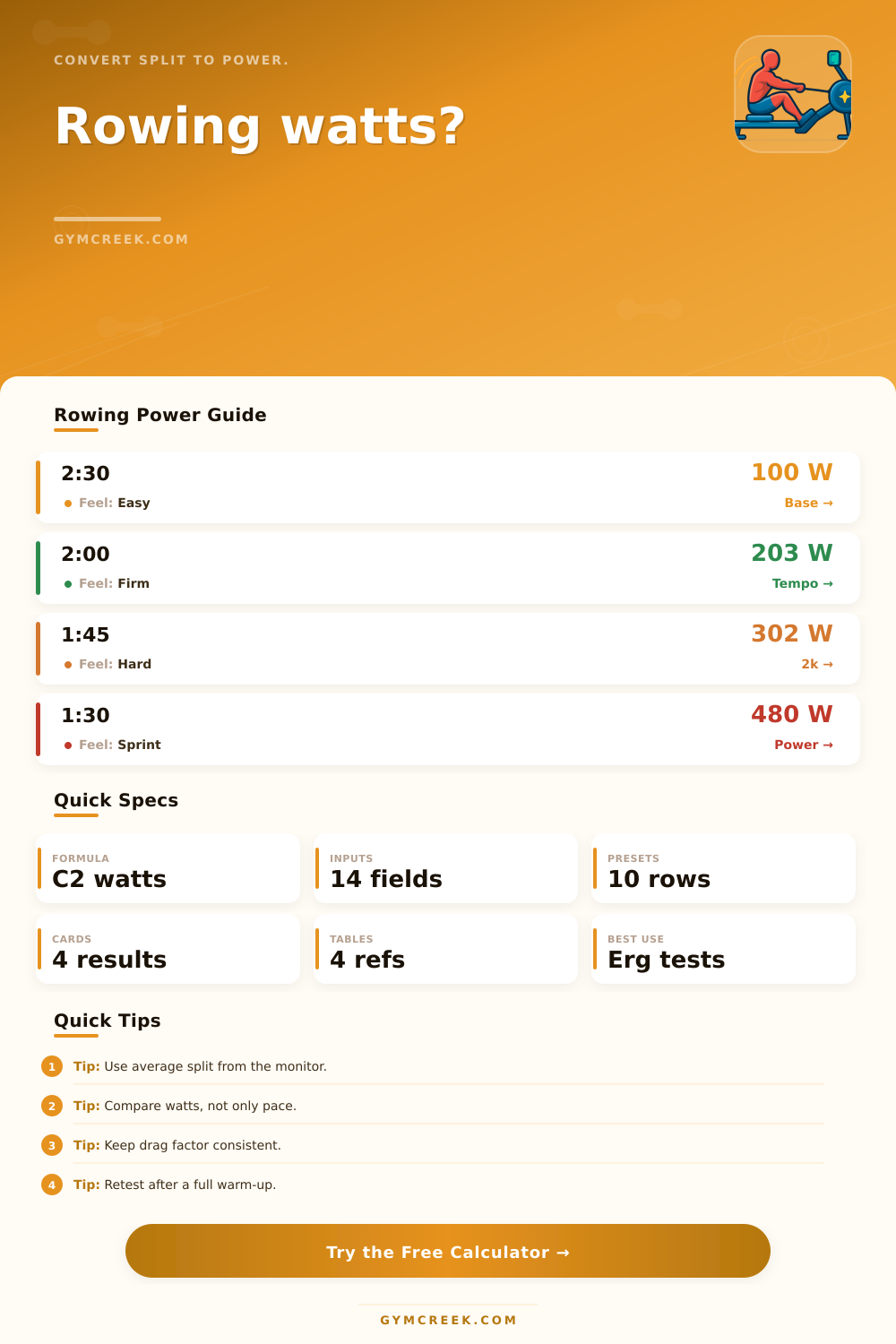
| Split / 500m | Watts | Power Change | Common Read |
|---|---|---|---|
| 2:30 | 100 W | Easy base | Low pressure |
| 2:15 | 150 W | Moderate | Fitness row |
| 2:00 | 203 W | Firm | Tempo effort |
| 1:45 | 302 W | Hard | Strong 2k pace |
| 1:30 | 480 W | Very high | Sprint power |
| Output | Formula | Inputs | Use |
|---|---|---|---|
| Watts | 2.8 / pace³ | sec per meter | Split to power |
| Split | 500 x cube root | watts | Power to pace |
| Kilojoules | W x sec / 1000 | power, time | Work done |
| Erg calories | 4W + 300 / hr | watts, time | Monitor style |
| W/kg | W / kg | weight | Body-size context |
| Goal | Typical Rate | Power Cue | Watch For |
|---|---|---|---|
| Recovery | 18-22 spm | Low watts | Relaxed rhythm |
| Base | 20-24 spm | Steady watts | Even pressure |
| Threshold | 24-28 spm | Firm watts | Split drift |
| 2k test | 28-34 spm | High watts | Middle 1000m |
| Sprint | 34-42 spm | Peak watts | Short strokes |
| Measure | Value | Per Piece | Training Use |
|---|---|---|---|
| Average watts | --- | --- | --- |
💡Rowing Tips
There’s a lot hidden in the split alone. For instance, two rowers might be maintaining the same pace but generating very different levels of power based off their body weight… Or one may be taking shorter strokes at a higher stroke rate then the other.
Watts cuts through that noise; it shows what the real mechanical work look like. Rowers has to translate the numbers on the erg monitor into watts so we can compare them from session to session, day to day, and rower to rower. Those watts do matter.
Why Watts Are More Important Than Split Time
The variables above is those that alter the appearance of power on the screen; they’re the inputs used in the calculator above. Bodyweight impacts the output because watts per kilogram (the metric for comparing rowers of varying size) are a fairer comparison than raw watts. Stroke rate impacts because more strokes per minute usually correlate with less force per stroke and shorter drive time, making same split mask lower efficiency. Drag factor impacts because it alters the feel of the flywheel and how much force is needed to move it. This directly impacts the power you generate at any given speed. Workout duration and rest interval impact because they dictates both the total work and how tightly-packed that work is within the session.
These outputs then tell you what to do next. Is the power I’m producing realistic for more distance? Did I hold something that’s going to fade? If we project those times into a race, it tell us if we can keep up our current level of effort or not. How does my power compare to someone of similar size? That’s what power to weight ratio tells you. It compares you not just to the person right next to you but competitively in your size category. And mechanical work in kilojoules gives a sense of training load that the split by itself won’t give you. The metabolic calorie estimate (based off how efficient the body is) helps show how much energy the body really supply to create that power.
Split has become the obsession for many rower, but what they don’t realize are the hidden tradeoffs that go along with it. Watts and pace have a cubic relationship. Because of this, a tiny increase in pace at a high split doesn’t result in nearly as much power improvement as same amount of time spent at a higher split. When trying to measure true improvement over time, comparing watts from one session to another is better than using split. You can also see the underlying relationship clearly in reference tables on the page, which explain just how rapidly watts rise with each small pace increase.
But what about the practical? How can you take those numbers and not go crazy because of one workout? Watts will shift because of drag factor, warm up quality, or even slight stroke length differences. This do not necessarily mean you are more fit.
And that’s where the math comes into play with the calculator. You enter details from your monitor and it handles the rest of the conversion for you. What it doesn’t do is tell you if your stroke was truly efficient or if fatigue set in at the end. For that, you have to watch the drive and the recovery on machine.
That’s probably the best habit: use wattage as just one of many data points instead of the only one. Combine it with other things (meters per stroke, stroke rate and how that held through the piece). If all those match, now you has a benchmark you can repeat. If they don’t even though the watts may look the same, then you know something about what you did differently when executing. That set of numbers over time will be more telling than any one of them separately.
Actualy, it should of been clearer. We need to recieve better data. Use moddern methods. The luxurios feel is gone. It dissapears naturaly.