🚣 VO2 Max Calculator for Rowing
Estimate your aerobic capacity from a 2000m ergometer test — get your fitness rating, training zones, and performance insights
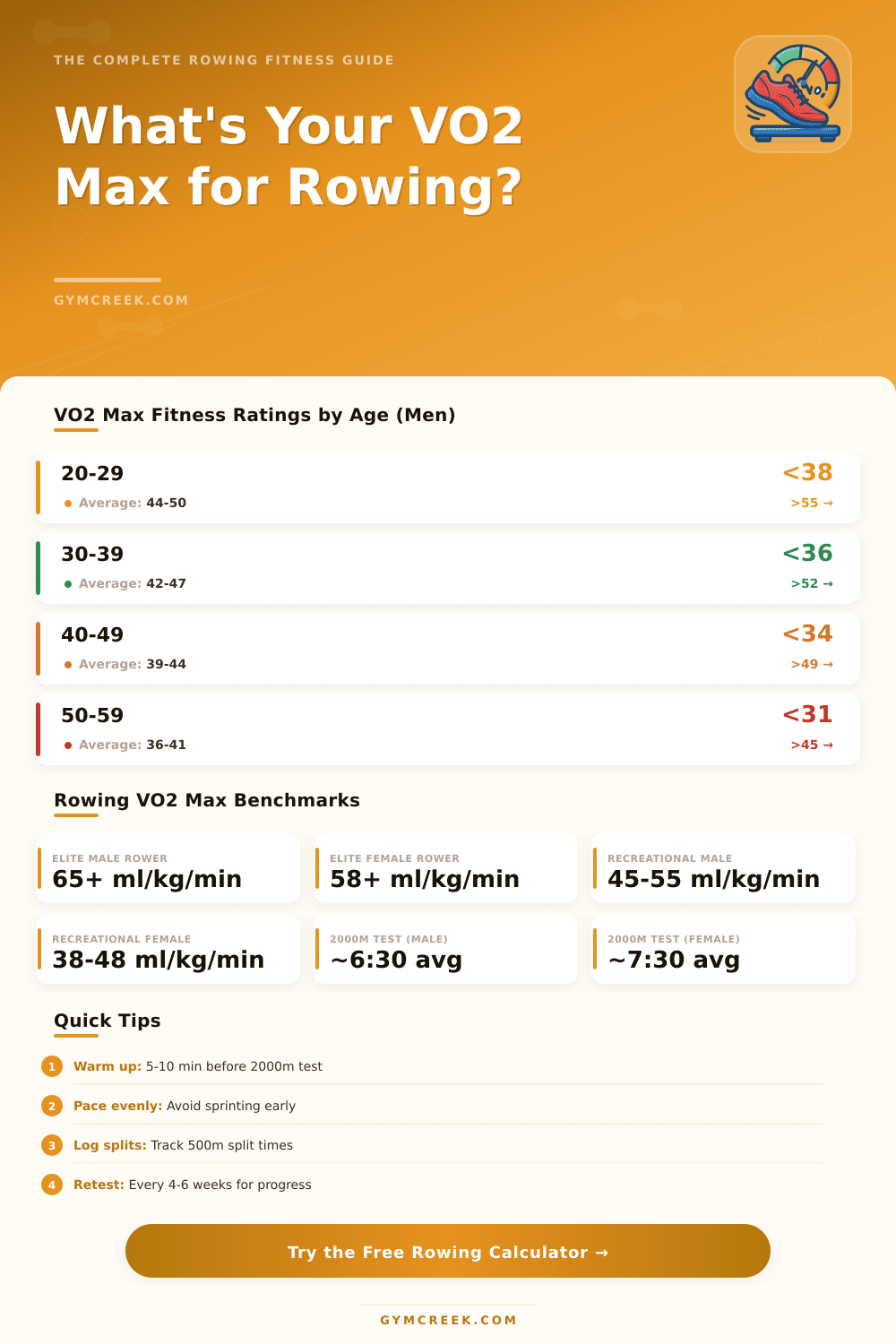
| Age Group | Poor (<20th %ile) | Below Avg | Average | Above Avg | Excellent (>80th %ile) |
|---|---|---|---|---|---|
| 18–29 | < 38 | 38–43 | 44–50 | 51–55 | > 55 |
| 30–39 | < 36 | 36–41 | 42–47 | 48–52 | > 52 |
| 40–49 | < 34 | 34–38 | 39–44 | 45–49 | > 49 |
| 50–59 | < 31 | 31–35 | 36–41 | 42–45 | > 45 |
| 60+ | < 28 | 28–32 | 33–37 | 38–42 | > 42 |
| Age Group | Poor (<20th %ile) | Below Avg | Average | Above Avg | Excellent (>80th %ile) |
|---|---|---|---|---|---|
| 18–29 | < 32 | 32–37 | 38–43 | 44–48 | > 48 |
| 30–39 | < 30 | 30–35 | 36–41 | 42–46 | > 46 |
| 40–49 | < 27 | 27–32 | 33–38 | 39–43 | > 43 |
| 50–59 | < 25 | 25–29 | 30–35 | 36–40 | > 40 |
| 60+ | < 22 | 22–26 | 27–31 | 32–36 | > 36 |
| 2000m Time | Avg 500m Split | Est. VO2 Max | Rating |
|---|---|---|---|
| 5:45–6:00 | 1:26–1:30 | 70–75 | 🏆 World Class |
| 6:00–6:30 | 1:30–1:37 | 63–70 | 🥇 Elite |
| 6:30–7:00 | 1:37–1:45 | 55–63 | 🥈 Competitive |
| 7:00–7:30 | 1:45–1:52 | 48–55 | 🥉 Club Level |
| 7:30–8:00 | 1:52–2:00 | 41–48 | 👍 Recreational |
| 8:00–9:00 | 2:00–2:15 | 34–41 | 🌱 Beginner |
| > 9:00 | > 2:15 | < 34 | 🚶 Developing |
| Zone | Name | % of Max HR | % of VO2 Max | Purpose |
|---|---|---|---|---|
| Zone 1 | Recovery | 50–60% | 40–55% | Active recovery, base fitness |
| Zone 2 | Aerobic Base | 60–70% | 55–68% | Fat burning, endurance building |
| Zone 3 | Aerobic Power | 70–80% | 68–80% | Lactate threshold, tempo rowing |
| Zone 4 | Lactate Threshold | 80–90% | 80–90% | Race pace, VO2 max development |
| Zone 5 | VO2 Max | 90–100% | 90–100% | Peak aerobic capacity, intervals |
• Perform the 2000m test fully rested — avoid hard training within 24 hours.
• Use a calibrated ergometer (Concept2 recommended for standardised results).
• Row at a controlled, even pace — a positive split (faster first half) inflates your time.
• Retest every 4–6 weeks to track aerobic fitness improvements.
• VO2 max naturally declines ~1% per year after age 25; consistent training slows this decline significantly.
VO2 max is the biggest amount of oxygen that the body can use during hard physical activity. Think of it like the horsepower in a car. It shows how well the body takes oxygen for its needs during exercise.
DISCLOSURE: This post may contain affiliate links, meaning when you click the links and make a purchase, I receive a commission. As an Amazon Associate I earn from qualifying purchases.

The word comes from “V” for volume, “O2” for oxygen and “max” for biggest.
What is VO2 max and how to improve it
It measures the heart fitness and the skill to last through aerobic effort. The more oxygen one manages to use in motion, the more easy the action seems and the longer one can last. High VO2 max shows that the body well absorbs oxygen from the air and moves it to the muscles.
VO2 max reveals how well the heart pumps blood to the muscles and how well they pull oxygen from that blood. When one breathes oxygen, it starts chemical steps in the muscle cells that give energy. That value is shown in milligrams of oxygen for one kilo of wieght each minute.
In a lab happens the most reliable way to measure VO2 max. One wears a mask, tied to a device that measures oxygen, while one exercises on a treadmill, fixed bike or Rowing machine. There is also the Cooper-test, in that one runs or walks as fast as possible for exactly 12 minutes, and the reached distance helps to count VO2 max.
Watches from companies like Garmin offer to measure VO2 max. They use info about weight, distance, speed and pulse. If one reaches the same work with low pulse, that points to better VO2 max. However such devices commonly err, so the result one takes only as a general landmark.
Genes affect VO2 max. Even so almost every person can improve it by enough exercise near their aerobic limit. Training with high intensity and intervals are among the best ways four it to quickly grow. Typical intervals last from one to six minutes with similar rest periods, and one considers them ideal for VO2 max. Range of intensity is also useful.
Only training in zone 2 already helps to expand VO2 max over time.
VO2 max grows quickly through training, but one can just as fast lose it. Too much work for it can lead to overload. One should not push it during the whole year.
When VO2 max grows, the resting pulse usually drops. During the same exercise level the normal pulse should be lower. Aging partly shrinks it, because the max pulse drops by around 0.6 to 0.8 beats each minute yearly.
But inactive older people, who trained during nine months to a year, on average grew their VO2 max by 20 percent. VO2 max truly matters, but the speed at aerobic threshold better predicts the real top skill, because itcombines several elements.