Rowing Power Calculator
Convert a 500m split into watts, W/kg, stroke power, duration energy, drag context, and rowing power zones from one erg workout snapshot.
📌Presets
Each preset loads a realistic rowing session and recalculates the split-to-watts output immediately.
⚙Calculator
Rowing power snapshot
Enter a 500m split to calculate erg watts and power-zone context.
📊Rowing Metrics Grid
📑Reference Tables
| 500m split | Watts | Use | Feel |
|---|---|---|---|
| 2:30 | 83 W | Recovery | Very easy |
| 2:15 | 113 W | Base | Steady |
| 2:00 | 203 W | Fitness | Firm |
| 1:45 | 302 W | Hard | Strong |
| 1:30 | 480 W | Sprint | Very hard |
| Zone | % anchor | Row cue | Session use |
|---|---|---|---|
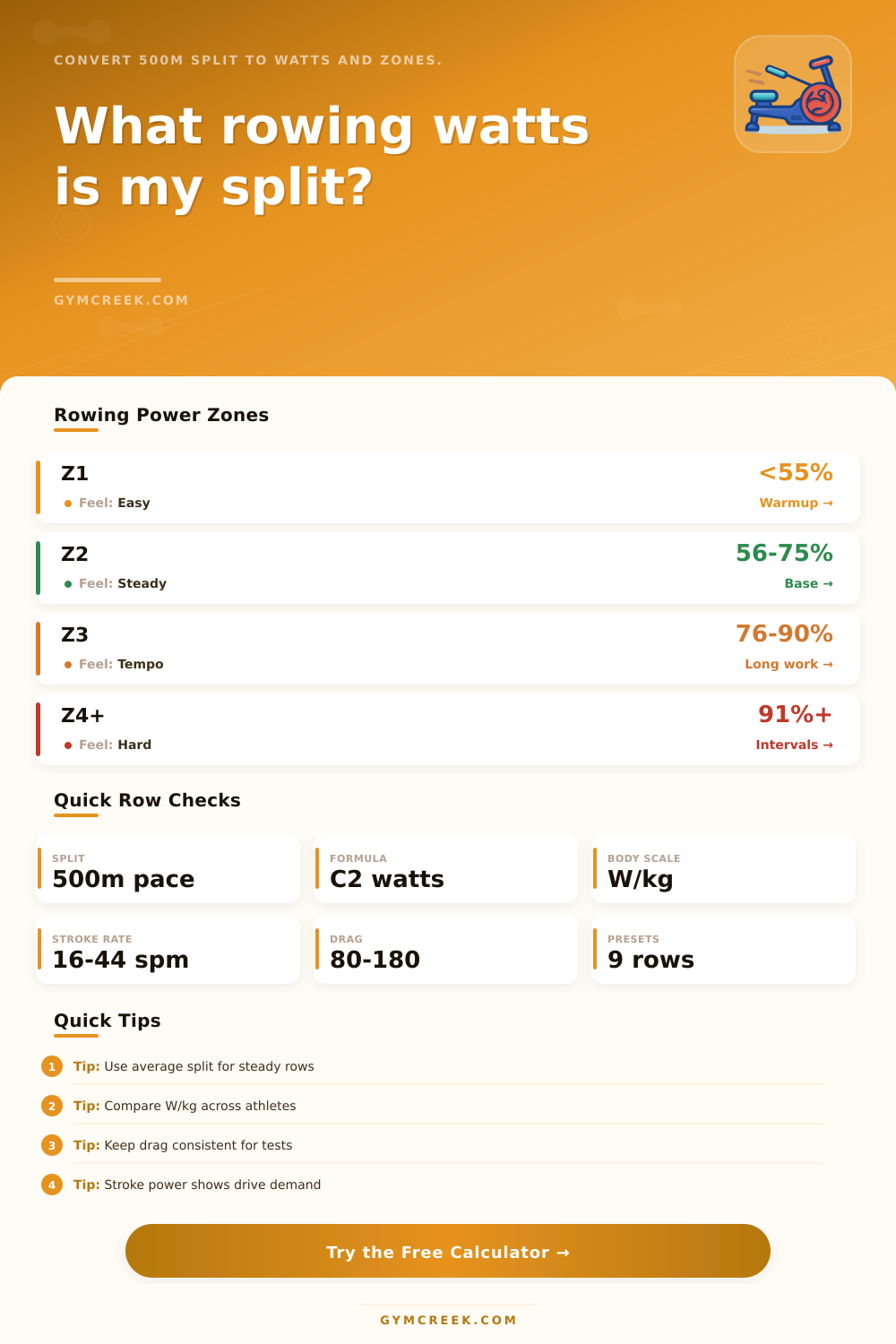
| Z1 Recovery | <55% | Relaxed | Warmup |
| Z2 Endurance | 56-75% | Conversational | Base |
| Z3 Tempo | 76-90% | Controlled | Long work |
| Z4 Threshold | 91-105% | Hard steady | Tests |
| Z5 Anaerobic | 106%+ | Aggressive | Sprints |
| Drag factor | Context | Common use | Watch |
|---|---|---|---|
| 80-105 | Light | Technique | Quick hands |
| 106-125 | Moderate | Base rows | Rhythm |
| 126-145 | Firm | Power rows | Back load |
| 146+ | Heavy | Strength feel | Rate loss |
| Formula | Variables | Output | Use |
|---|---|---|---|
| Watts | 500m split | Power | Main result |
| W/kg | Watts, kg | Relative | Compare rows |
| J/stroke | Watts, spm | Drive work | Rate context |
| kJ | Watts, time | Work | Load |
💡Tips
A rowing power calculator will take your 500 meter split and convert that measurement to watt. The reason for the split to watt calculation is that a 500 meter split is a pace number which hide the actual work that is being performed during a rowing session. By viewing the power that you are producing during a session, you are able to compare training sessions to each other.
Additionally, you can use the watts reading to compare your power to your body weight, as well as to determine if your training pieces belongs in your base training or high-intensity training. The 500 meter split is the most common reference for rowing training because the distance represent the middle distance for rowers. A 500 meter split will tell you how much power that your body is producing during each stroke cycle.
Turn Your 500m Split into Watts with a Rowing Power Calculator
To use a rowing power calculator, you will need to entering your 500 meter split, your body weight, your stroke rate, and the duration of your row. Each of these will change the information that you can view from the calculator. For instance, your body weight will allow for the calculation of your power in watts per kilogram, which you can use to compare your power to other individual with different body weights.
Your stroke rate will allow you determine whether you are producing your power with long stroke or with high cadence strokes. Finally, your duration will allow for the measurement of the total amount of work that you performed during your training session. Drag factor is one of the measurement that will change the way that your rowing machine feels when you are rowing.
However, drag factor does not necessarily change your fitness. At low drag factors, your flywheel will feel as if it can move freely. At higher drag factors, however, your legs will have to produce more force in order to move the flywheel.
It is important that you use the actual drag factor that is displayed on your rowing machine, not your damper setting. If you keep the drag factor the same for each training session, any changes in watts will indicate changes in your power, not in the design of your rowing machine. Power zones can be used to provide context for your raw watt measurement.
For instance, you can use a more recent 2K test, a 20 minute test, or you can use your split to establish an anchor point for your power zones. Any splits that you establish will allow you to determine whether your training was aerobic, tempo, or anaerobic based off where your splits fell within the zones. By establishing zones, you can give meaning to your training efforts, especially if you are coaching other rowers.
Without zones, rowers may all feel that they are producing a high amount of power, but they may actualy be meaning different things with that statement. Stroke power is measured in joules per stroke, and can help to reveal the amount of work that is required for each drive. At low stroke rates, the amount of joules per stroke will be higher.
At high stroke rates, joules per stroke will decrease unless the rower is striving to maintain their drive and the length of their strokes. This measurement is important for understanding how an individual rows at different rates, as any drop in joules per stroke at high rates indicates that the individual may be shortening their strokes or dropping them altogether from fatigue. Duration energy will display the total amount of kilojoules that were produced during the training session, as well as an estimated number of calories.
Energy is important to view because it can help to convey the total amount of work that you did during your training, regardless of how hard you may have rowed. For instance, it is possible to perform a session with high watts but low energy, or a session with low watts but high energy. By using the energy calculations of the rowing power calculator, you can more easily understand your training capacity and load.
Many rowers will make mistakes when they treat their 500 meter split as the only measurement of their performance on the rowing machine. A split of 1:55 at 18 strokes per minute is not the same as a 1:55 split at 32 strokes per minute. The 1:55 split at 18 strokes per minute may indicate economical rowing, while the same split at 32 strokes per minute may indicate a choppy stroke.
The rowing power calculator will display this difference in performance between the two rates. Another mistake that many rowers may make is to change their drag factor between tests. For instance, a rower may perform a test at 110 drag factor one month, and then perform the same test at 135 drag factor the following month.
In this case, the rower may appear to have increased their strength, even though their drag factor is the cause of their higher watt measurement. By keeping the drag factor the same between tests, any changes to the watts will be representative of any changes to the rowers performance. Aside from the measurements that the rowing machine itself collects, there are some factors to consider that the calculator cannot account for.
For instance, your technique, the way that you breathe while rowing, and your mental state can all have an impact on the power that is expressed. Two athletes may be able to produce the same amount of watts, but one may feel as if they are exerting more effort than the other. This factor is represented in the readiness selector for rowers.
However, this is a subjective measure, while the watt measurement is objective. Rowing power calculator allows rowers and coaches to change the way that training is planned over time. For instance, instead of planning training based upon desired splits, a coach can plan for certain ranges of watts and find out how the performance of the athletes changes according to those watts.
Additionally, coaches can use the calculator to compare training efforts between athletes, as they can read the amount of watts that each athlete produced during training. The rowing power calculator gains the most value when it is used as a log to record each training session. By entering the split, watts, rate, drag factor, and zone into the calculators log, coaches and rowers can view how each rower is developing over time.
For instance, it can be seen if an athletes base racing splits are developing, or if their high rate abilities are declining. Thus, while the 500 meter split is a useful measurement, the additional data provided by the rowing power calculator can make that split a signal to indicate how training efforts should of develop over time.