Rowing Pace to Watts Calculator
Convert rowing split pace into watts, W/kg, mechanical work, calories, stroke rhythm, 2K projection, and workout load for indoor erg planning.
📌Rowing Pace Presets
Presets fill realistic erg sessions with split pace, distance, time, stroke rate, drag factor, and body-size context.
⚙Pace and Rower Inputs
Split pace to watts
Enter a 500m split to estimate rowing power and workout load.
📊Rowing Metrics
📑Reference Tables
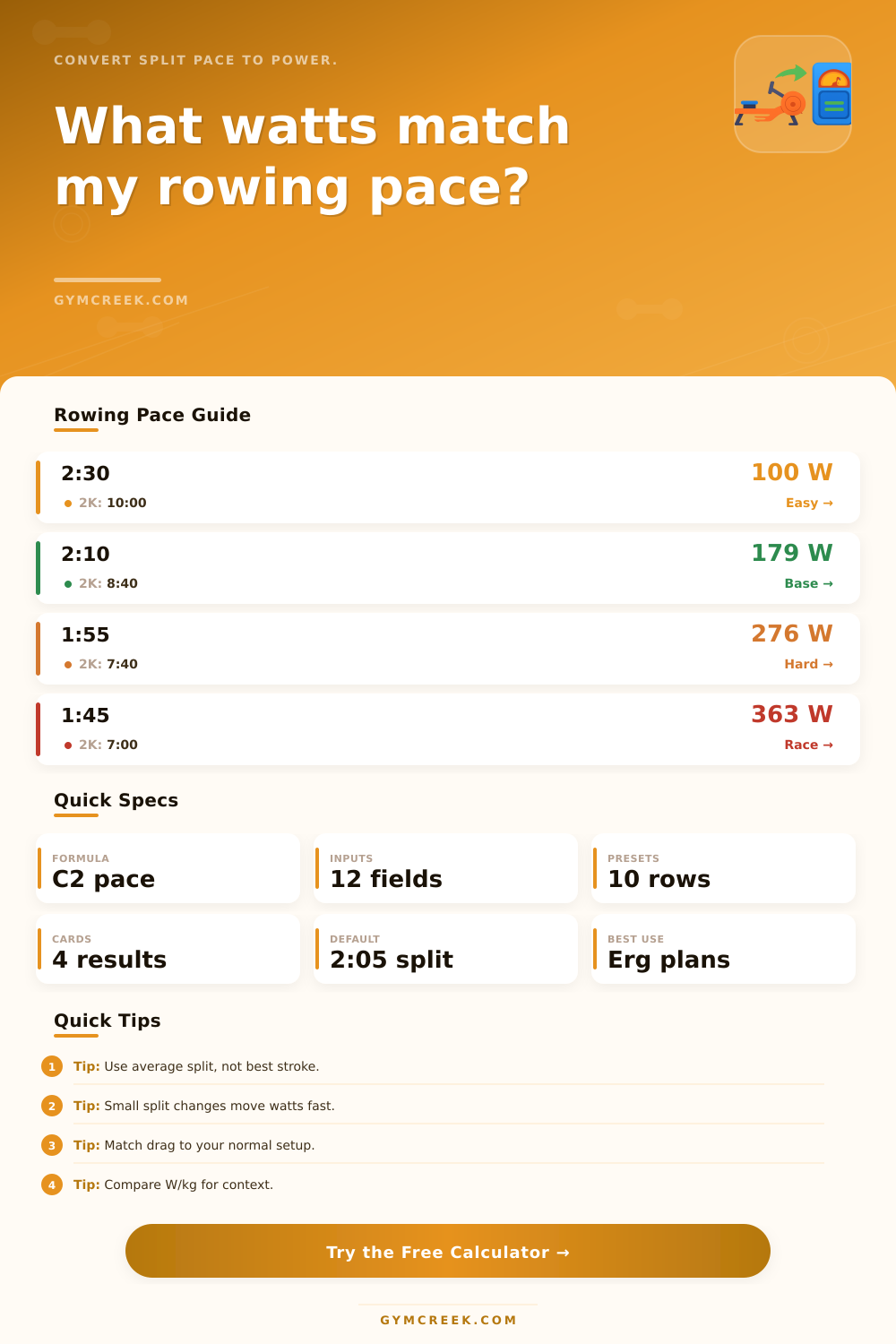
| 500m Split | Watts | 2K Pace | Use |
|---|---|---|---|
| 2:30 | 100 W | 10:00 | Easy technique |
| 2:15 | 151 W | 9:00 | Aerobic base |
| 2:00 | 203 W | 8:00 | Firm steady row |
| 1:50 | 284 W | 7:20 | Threshold or race prep |
| 1:40 | 350 W | 6:40 | Strong 2K pace |
| Rate | Power Feel | Best Use | Watch |
|---|---|---|---|
| 16-20 spm | Low rate | Technique and base | Connection |
| 21-26 spm | Steady | Aerobic rows | Relaxed recovery |
| 27-32 spm | Race rhythm | Intervals and 2K | Length loss |
| 33+ spm | Sprint rate | Starts and finishes | Control |
| Drag | Read | Typical Row | Note |
|---|---|---|---|
| 80-100 | Light | Small rowers, rate work | Fast spin |
| 101-120 | Balanced | Most steady training | Common default |
| 121-140 | Heavy | Power rows | Higher load |
| 141+ | Very heavy | Short power only | Use caution |
| Output | Formula | Inputs | Meaning |
|---|---|---|---|
| Watts | 2.8 / pace3 | sec per meter | Erg power |
| Split | 500 x cube root | Watts | Power to pace |
| Work | W x seconds / 1000 | Watts, time | Mechanical kJ |
| Calories | kJ / eff / 4.184 | Work, efficiency | Food kcal estimate |
💡Rowing Calculation Tips
Until you know how it works, the apparent relationship between rowing power and pace feel unfair. It takes a lot more effort to go a few seconds quicker on a 500 meter split than you think. The required power increase in a surprising way for many rowers. The relationship is actualy cubic, which means dropping the split even a modest amount can make the rower feel underpowered even though their strength hasn’t changed. The mathematics are responsible, not lack of motivation.
Each of those variables affect the way that math plays out in training. Why do we care about body weight? Watts per kilogram tell us whether our power is impressive for someone of our size, or whether it is merely average. Why do we care about drag factor? It affects resistance of machine against each stroke, and thus how much a particular split will cost you. Why do we care about stroke rate? Because the same number of watts feels differently at thirty two strokes per minute compared to say, twenty four.
Why Use a Rowing Calculator?
Those are all variables that the calculator takes into account, enabling you to make comparisons between seemingly different sessions. What you get from these are useful metrics to follow over time as your pace increase. The watts give you a reliable metric, unlike split time which varies based off distance. Your predicted 2K time lets you know if you’re training at a pace sustainable on race day. Calculating calories burned and mechanical work done lets you estimate the energy cost of a workout (good for managing training load) or the impact it had relative to others (to gauge how tired or energized it made you). They don’t replace feel; they take away the guessing game of “was this workout effective or am I just exhausted?”
Two common mistakes: One is treating every faster split as progress without noticing what changed to produce it. But was your stroke rate higher? Did your drag factor go up? Improvements might not seem quite so impressiv. And then there’s the tendency to overlook that slight adjustment of pace result in big shifts in power output. This is one lesson most folks would of learn the hard way following a few interval effort that were too ambitious. With the calculator, you’ll see those trade-offs before committing them to machine.
While it’s cool to have some nice numbers to show off, that’s not where the value lies. The value is in making more informed decisions based on the numbers. Knowing how many watts each of your splits cost allows you to push yourself while staying just below a devastatingly hard interval. You’ll be able to contrast a good day with another bad day and know whether it was due to lack of fitness or changes in workout structure. Or you might notice that a seemingly effortless row didn’t do much work at all, which is something easy to overlook if you only look at your split time.
None of this will alter the relationship between pace and power. Both will still be measured by rowing machines. It simply makes what that measurement mean clearer to you.