Rowing Oar Length Calculator
Estimate sculling or sweep oar length from inboard, span or spread, athlete profile, stroke rate, blade type, and the rigging load you want on the water.
📌Presets
Each preset loads a real rowing pattern and recalculates the suggested length, gearing, handle relation, and rig feel.
⚙Calculator
Oar length snapshot
Enter your rig and athlete data to estimate a practical oar length.
📊Oar Fit Metrics
📑Reference Tables
| Rig | Common length | Common inboard | Span or spread | Handle relation |
|---|---|---|---|---|
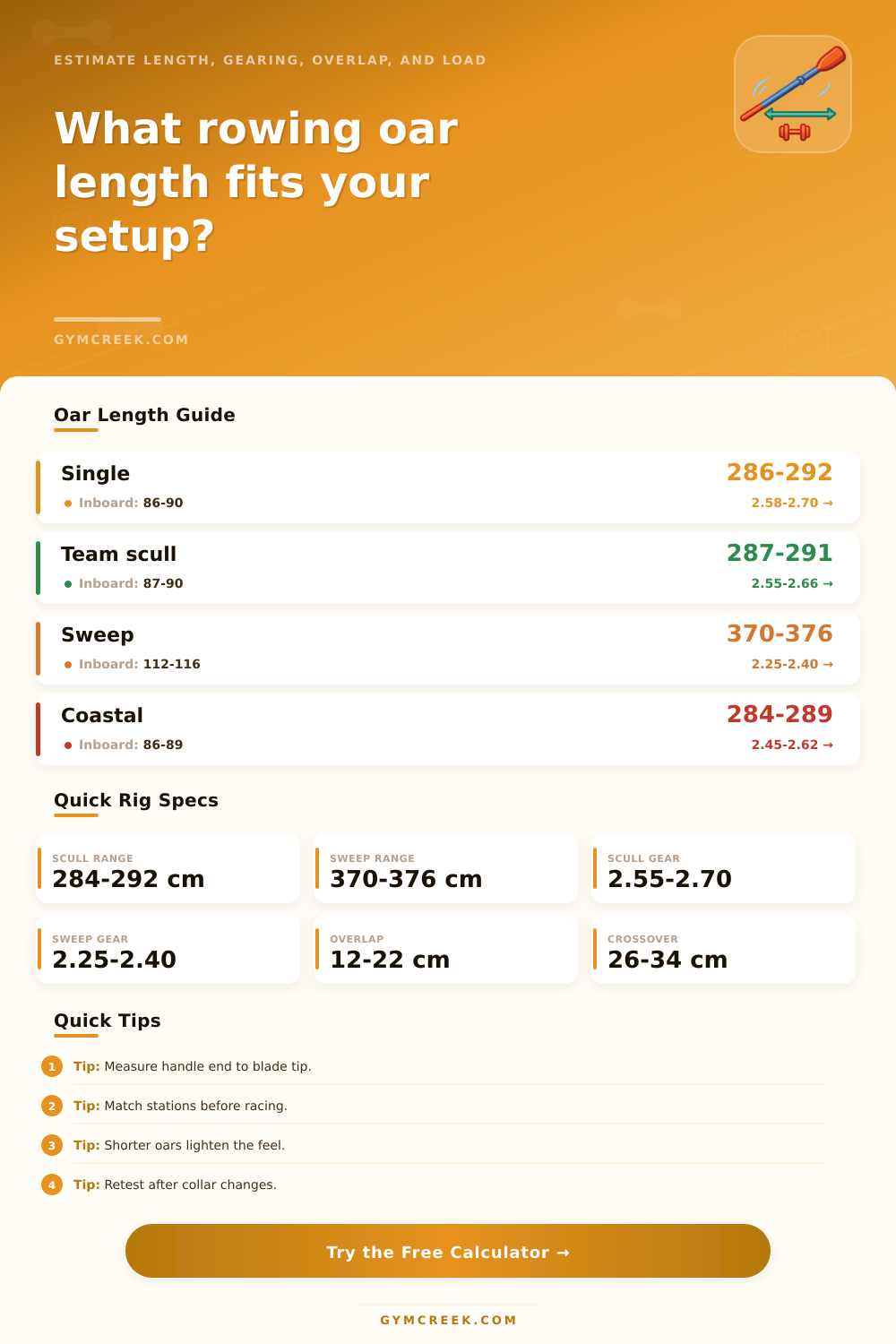
| Single scull | 286-292 cm | 86-90 cm | 157-161 cm span | 14-22 cm overlap |
| Double or quad scull | 287-291 cm | 87-90 cm | 158-162 cm span | 12-20 cm overlap |
| Sweep four or eight | 370-376 cm | 112-116 cm | 82-88 cm spread | 26-34 cm crossover |
| Coastal scull | 284-289 cm | 86-89 cm | 160-164 cm span | 10-18 cm overlap |
| Gear result | Likely feel | What a longer oar does | What a shorter oar does |
|---|---|---|---|
| Below range | Light and fast | Adds drive load | May feel too light |
| Low range | Technique friendly | Can add race bite | Useful for volume |
| Mid range | Balanced | Small gains matter | Small cuts matter |
| Above range | Firm or heavy | Can slow catches | Improves pickup |
| Output | Formula | Inputs | Use |
|---|---|---|---|
| Outboard | Inboard x gear | Inboard, target gear | Blade-side lever |
| Oar length | Inboard + outboard | Inboard, outboard | Main recommendation |
| Scull overlap | 2 x inboard - span | Inboard, span | Handle clearance |
| Sweep crossover | Inboard - spread | Inboard, spread | Past centerline |
| Mifflin BMR | 10W + 6.25H - 5A +/- sex | kg, cm, age | Fitness context |
| Signal | Likely cause | Length move | Retest cue |
|---|---|---|---|
| Stuck catch | Too much load | Shorten 1-2 cm | Cleaner pickup |
| Rushed finish | Light connection | Lengthen 1 cm | More stable finish |
| High-rate fade | Heavy gearing | Shorten 1 cm | Rate holds |
| Mixed crew feel | Uneven station load | Match gearing | Timing improves |
💡Tips
Selecting an correct length for a rower’s oars is an important task in rowing. Many rowers will use whatever rowing oars are locate within the rowing club where they is competing. However, using the wrong types of rowing oars can create issues for the rowers, such as making the stroke feel heavy or the boat feel slow when rowing.
The length of the oars can impact how difficult the catch is for a rower to perform or if the rower feel rushed at the finish of the stroke. Because the length of the oars impact the stroke that a rower performs, it is possible to utilize a calculator to determine the length of rowing oars that a rower should use. The calculator will require the rower to input several different factors related to the individual rower.
How to Pick the Right Oar Length
The height and weight of the rower are two factors that will impact the length of the rowing oars that the rower should use. Each rower’s age and level of activity will also impact the length of the rowing oars that they should utilize. For instance, older rowers may be able to better handle the gearing of rowing boats with lighter loads than younger rowers.
Additionally, the skill level of the rower and the reason for rowing will impact the length of the rowing oars that the individual should use. Novice rowers will have different rowing requirement than race rowers who compete in rowing regattas. The stroke rate at which a rower rows will also impact the length of rowing oars that the rower should use.
Rowers who row at high stroke rates may find that long rowing oars creates additional load on the rowers and cause them to fade during there stroke. The conditions of the water in which a rower competes and the experience level of a rower’s crew will impact the length of the rowing oars that they utilize. Additionally, the type of blades that a rower uses will impact the length of the rowing oars that they should use because large blades will create more load on the rower than small blades.
The calculator will use two specific measurements of the rowing boat to determine the length of rowing oars that each rower should use. The inboard measurement is the distance of the lever on the handle side of the boat. The span is the distance between the pin on the boat.
Using these two different measurements, the calculator will be able to determine if the sculling overlap (or the crossover for sweep rowing) for the boat is within an acceptable range. If the overlap is too small, the rowers’ handles may not clear the boat. If the overlap is too large, the rowers may experience resistance in the middle portion of their stroke.
The calculator will provide the rower with a starting point for the length of the rowing oars that should be used. However, the calculator does not account for the observations of a rowing coach. The calculator will include reference tables to allow each rower to compare their measurements to common ranges.
For example, there are common ranges of lengths for single scull, team sculls, sweep boats, and coastal boats. Thus, each rower can compare their current measurements to these common ranges. Another table within the calculator is the adjustment cues table.
This table relates the issues that a rower may experience with their stroke to the changes in length of their rowing oars. For instance, if a rower experiences issues with their catch and feels as if they are stuck with the boat when rowing, the adjustment cues table may indicate a certain direction to adjust the length of their rowing oars. It is important to understand that the length of rowing oars is only one of the ways to adjust the stroke that a rower will experience.
A rower can also adjust the collar setting for their rowing oars, the spread of their oars, or the blades that they use. Additionally, the calculator will provide indications of how the gearing for the boat will change based on the adjustments in load or water conditions. Rowers who wish to experience a firm stroke will have different suggested lengths for their rowing oars than rowers performing volume training.
While the calculator provides a suggestion for each rower for the length of their rowing oars, it doesnt provide a perfect number. Since there are many different variables for each boat and each crew of rowers, it is impossible for the calculator to account for all of these variables. For instance, the amount of bend that each rowing oar will exhibit when under load, the stroke rate of each member of a crew, or the response of the boat to changes in load are three different variables that the calculator cannot account for.
Because of these variables, the suggestion from the calculator should of be used to make a change to the current length of rowing oars that a rower use. After making the change that is suggested by the calculator, rowers should row some steady-state rowing pieces to see if the stroke feel better for the rowers. Additionally, it may be necessary to make additional small changes to the rowers oars after they change the collar or the composition of their crew.
Each rower should understand how to adjust their length for their rowing oars. Rowers should measure the length of each rowing oar from the handle end of the oar to the tip of the blade. Rowers should also keep notes about how their stroke change when they adjust the length of their rowing oars by only one centimeter.
Rowers should pay attention to these notes because they will be more valuable to the rower than the rowing oar length calculation itself. Thus, the calculator is a tool that can remove the guesswork from determining the length of rowing oars that a rower should use. Hence, it can assist a rower in finding the correct length for there rowing oars.