Rowing 500m Split Converter
Convert rowing split pace, watts, speed, target time, stroke length, and race projections for erg workouts built around the standard 500 meter split.
Results Snapshot
Your 500m split conversion updates watts, race projections, speed, stroke distance, and training load from one consistent pace model.
| Split band | 500m split | Watts | Typical use |
|---|---|---|---|
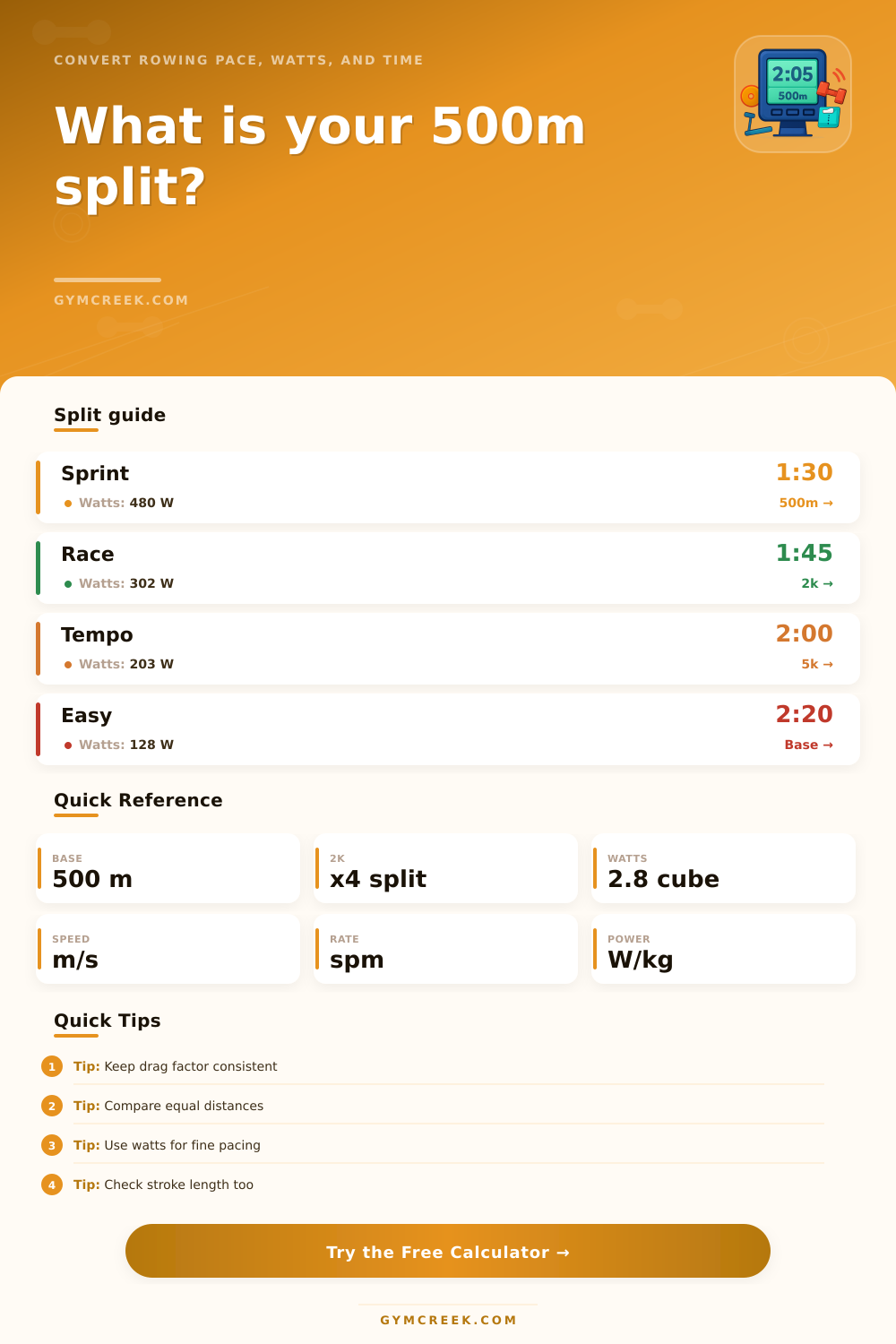
| Sprint | 1:25-1:39 | 360-640 W | Short power pieces and 500m tests |
| Race | 1:40-1:54 | 270-350 W | 2k race pace and hard intervals |
| Tempo | 1:55-2:09 | 164-263 W | 5k pace, threshold rows, steady pressure |
| Base | 2:10-2:29 | 105-157 W | Aerobic base, technique, longer rows |
| Recovery | 2:30+ | 104 W or less | Easy flush rows and low strain days |
| Split | 500m | 1k | 2k | 5k |
|---|---|---|---|---|
| 1:30 | 1:30 | 3:00 | 6:00 | 15:00 |
| 1:45 | 1:45 | 3:30 | 7:00 | 17:30 |
| 2:00 | 2:00 | 4:00 | 8:00 | 20:00 |
| 2:15 | 2:15 | 4:30 | 9:00 | 22:30 |
| 2:30 | 2:30 | 5:00 | 10:00 | 25:00 |
| Scenario | Input mode | Useful output | Best check |
|---|---|---|---|
| Race target | Target finish time | Required 500m split | Can you hold the stroke rate? |
| Erg workout log | Distance plus time | Average split and watts | Compare pieces equally |
| Power session | Known watts | Converted split pace | Keep drag factor stable |
| Base training | Known split | Projected distance per hour | Watch stroke length drift |
| Formula | Variables | Use | Output |
|---|---|---|---|
| Watts = 2.8 x (500 / split)^3 | Split seconds | Convert split to rowing power | Watts |
| Split = 500 x time / distance | Time, distance | Back-calculate log pace | Seconds per 500m |
| Time = distance x split / 500 | Target distance | Project finish time | Minutes and seconds |
| Stroke length = speed x 60 / rate | Speed, spm | Estimate distance per stroke | Meters per stroke |
Use this rowing 500m split converter to translate pace, watts, time, speed, and stroke metrics into one practical view for erg training and race planning.
Split: A split measure how long it takes you to cover 500 meters on your erg. And if you’re curious as to why every rower staring down an erg screen is asking herself this exact question, well, we all want to know what a split tell us about the upcoming work.
That middle part… The 500-meter split, reduce raw effort into one number you can use to compare against goals, days and distances. When you figure out what that number do, then the rest of the session begin to click in place rather than remain guesswork. This is because the split are a middle step that isn’t really a final score on its own.
Why Splits Matter for Your Rowing Workout
The split itself measure how long it takes to cover 500 meters at your current pace. Is this drifting towards recovery territory? Or grinding through a steady state? Holding race pace? I can tell from looking at the split. And it feeds into power calculations as well, which is why a lot of rower will switch to training by watts once they get their conversion down. The relationship isn’t intuitive by itself, but once you think about the split as common reference point, the math make sense and becomes consistant.
The point is that drag factor, stroke rate, and body mass don’t just look good; they also matter there. Body mass can tells you your relative power; important because it’s not always the raw wattage that counts when you’re comparing two athlete of different sizes. Stroke rate tell you if you’re hitting that split with longer, stronger strokes, or by turning over fast. And drag factor has to do with how much resistance the machine put up, and thus how the same split feels on another erg. This is why a planned session can feel unexpectedly brutally hard or deceptively easy; you adjusted one variable, but not the rest.
The projected finish time for the 2k or 5k distance give you an idea if your actual pace are realistic for a target race. The distance in half an hour or an hour let you know how much work you’re doing quickly without having to run it through another calculator. It helps you spot when stroke distance is being shortened because you’re fatigued, despite having the same split number. None of these replace coaching or feel, but they takes the math out of the equation and let you pay attention to what the numbers are actualy telling you about your workout.
A lot of the rowers we work with realize quickly: Consistency matter more than searching for that killer split. Comparing the same distance, using the same warm-up routine, and holding the drag setting constant during each test eliminate some noise from your results. Once you’ve got those habits down, it’s less about arguing over another variable and more about listening to what the split is telling you.
But how does it pay off? It’s easy. You type in what you know (a watt number, a target finish, a logged time) and let the conversion do the rest. Then look at the picture and see if what you thought would happen was consistant with what you are seeing now. Are you able to hold your stroke length? Is the workout plan appropriate for your current level of fitness? How much total energy does the session represent? All that precision makes fuzzy goals turn into workouts that you feel like doing and then improving upon.