Route Pump Time Calculator
Estimate how long a climbing route may take, where forearm pump is likely to appear, and whether rests are enough to keep grip fatigue manageable.
📌Route Presets
Presets load realistic climbing scenarios and recalculate route time, pump onset, recovery, and grip fatigue.
⚙Calculator
Route pump snapshot
Enter the route details and calculate your estimated pump profile.
📊Fitness Metrics Comparison
📑Reference Tables
| Pump Level | Forearm Feel | Movement Risk | Best Response |
|---|---|---|---|
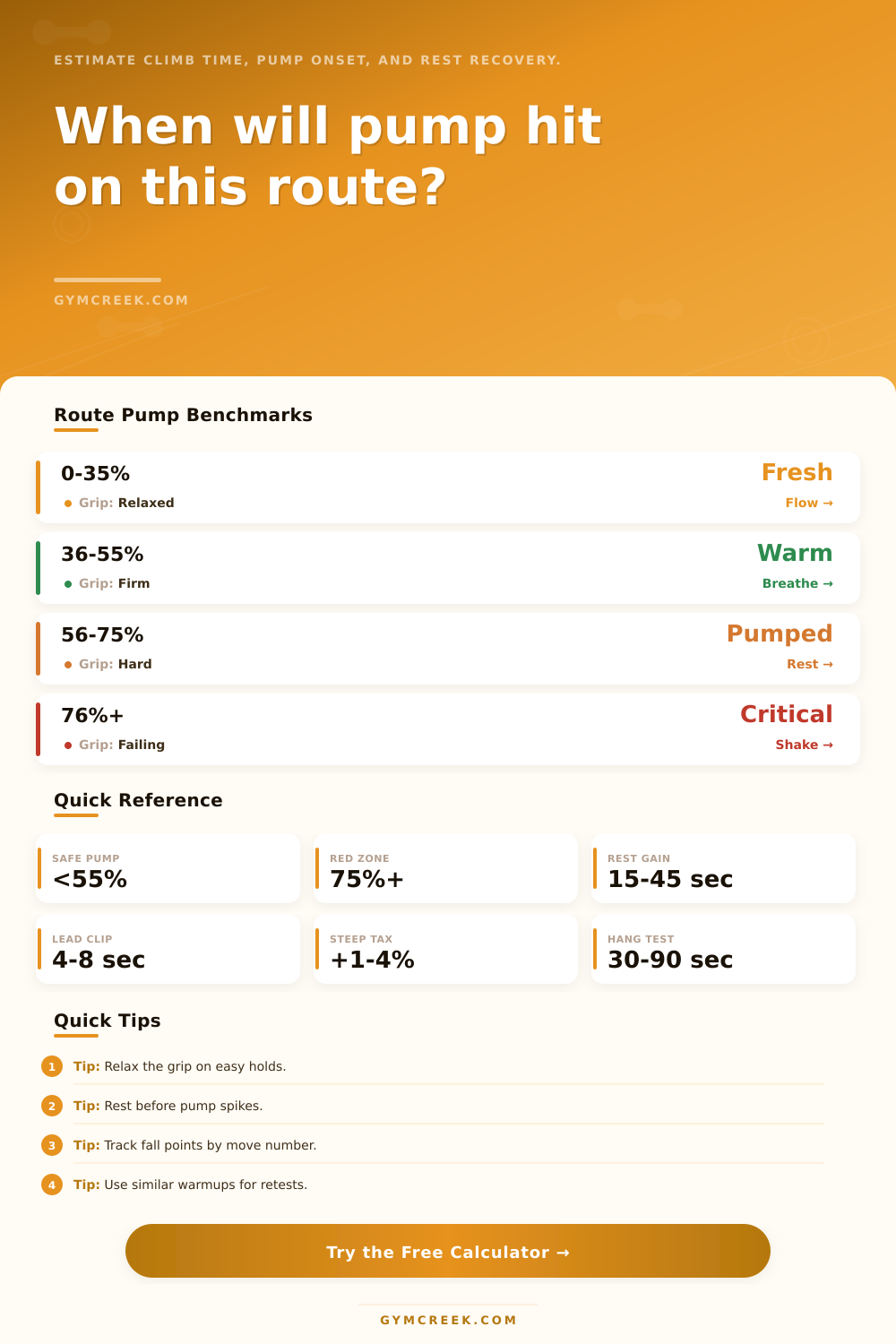
| 0-35% | Fresh | Low | Keep rhythm |
| 36-55% | Warm pump | Moderate | Relax grip |
| 56-75% | Hard pump | High | Use rests |
| 76-90% | Critical | Very high | Slow down |
| 90%+ | Failure zone | Fall likely | Recover first |
| Route Type | Typical Time | Grip Duty | Pump Pattern |
|---|---|---|---|
| Gym warmup | 2-4 min | 25-40% | Low and steady |
| Vertical sport | 4-8 min | 40-60% | Builds late |
| Steep sport | 3-7 min | 60-80% | Builds early |
| Long trad | 10-25 min | 35-65% | Rest dependent |
| Comp route | 5-7 min | 65-90% | Crux spikes |
| Rest Quality | Example | Recovery Rate | Notes |
|---|---|---|---|
| 0-20% | Bad shake | Minimal | Still tiring |
| 21-45% | Small edge | Modest | Breath focus |
| 46-70% | Good jug | Useful | Switch hands |
| 71-90% | Kneebar | Strong | Reset grip |
| 91-100% | No-hands | Best | Full pause |
| Formula | Variables | Output | Use |
|---|---|---|---|
| Time model | Moves, tempo | Route time | Pacing |
| Duty cycle | Grip, rests | Load index | Fatigue |
| Recovery curve | Rest quality | Pump drop | Rest value |
| Capacity ratio | Hang test | Onset time | Limit check |
| Age factor | Age, group | Endurance adj | Comparison |
💡Tips
It is that moment where you are inches away from the crux and it feels like your forearms weigh a ton. The pump starts creeping up into your wrists. It is not just because it hurts. Because there’s a physiological clock ticking toward zero and then failure.
Pump is something climbers often consider a natural consequence of climbing harder; it’s not. Pump’s a quantifiable factor: How hard do you grab? For how long? Do you let go between rests? Knowing the timer means you can manage the fire before the fire manages you.
How to Manage Your Climbing Pump
Plug in your pace, number of expected moves and distance for your route, and the calculator does the rest (above). Most folks estimate their climb time by assuming a couple minutes per pitch. Not true. When fresh, that 70 foot route with forty hand move will take longer then you think. By multiplying the number of movements you make by the number of seconds per movement, it calculate total time. Seems easy enough, except that you might pause between decisions on a trad route or add lead time if you’re clipping delays. Each additional second you stay still with your hands holding something increase your fatigue.
Grip intensity is one of the most difficult inputs to grasp. For long sections, it’s likely you’re working at sixty or seventy percent intensity, though you may believe yourself to be cranking with all your might. To build a pump different than using short bursts of max force, you need longer periods of sustained effort at lower levels. That’s why the calculator requests an average percent, this number is what the tool uses to predict the onset of screaming forearms.
Body weight and age also factor into the equation, tweaking the endurance model accordingly. Naturaly, heavier climbers requires more from their digits on steeper terrain, thus the system takes this added burden into account.
This is where projects usually fall apart: the quality of your rest. Having two stances on a route means nothing if you can’t lock down one hand to a tiny edge and let go with the other. The calculator use your rest quality as a percent. How much does that jug or kneebar reduce your pump? Not very much? It’s just psychological comfort. A lot? Good stuff. Rests are worth finding before you climb, not just after. That’s because the tool assume you’ll get some pump relief at a rest. It gives you an idea if those rests will be truly helpful or purely mental.
For some context on what those numbers mean, check out reference tables on the page. It breaks out the pump level by stage, from fresh all the way up to critical failure zones. Whatever pump your finish pump ends up being, you’re probably going to go over the next hard move no matter how skilled you are if it’s in high seventies or higher.
Which is the thing that trips people up with this the most. They blame their technique when they should of being blaming their pacing or lack of recovery. The other cool part about these tables is that they’ll show you typical times for various types of routes so you can adjust your inputs based off real world benchmarks.
Endurance training isn’t all about hanging off a board: it’s also about learning how to breathe while pumped, letting go of an easy hold and relaxing. A lot of climbers instinctively tighten their grips as soon as they encounter something hard, accelerating the rate at which they gets pumped. While the calculator doesn’t capture mental tension, it demonstrates the price you pay in terms of physical tension if you’re gripping things too tightly.
As you track fall points by move number, you’ll be able to pinpoint exactly where the system begins to break. Is it that one hard move? Or did you build up fatigue over previous 30 moves? Redpointing isn’t so much about being strong as it is being smart with your resources. There’s only so long you can keep working your forearms until blood flow starts to get cut off. If you know what that point is, you’ll be able to rest better, pace yourself accordingly, and save some energy for the business end.
You don’t need to be a physics major to grasp this concept. All you really need to do is stop guessing and start measuring. Next time you tackle something big, bring numbers, not hopes. A second or two more recovery or a slightly looser grip coming up can make all the difference between sending and falling.