Roller Skating Calorie Calculator
Estimate calories burned from rink laps, outdoor cruising, interval blocks, jam skating, dance moves, surface drag, speed, duration, and body weight.
📌Presets
Each preset loads a realistic roller skating session and recalculates the estimate.
⚙Calculator
Roller skating calorie snapshot
Enter skating mode, speed, surface, interval share, dance load, and duration to estimate calories.
📊Fitness Metrics
🧮Formula Cards
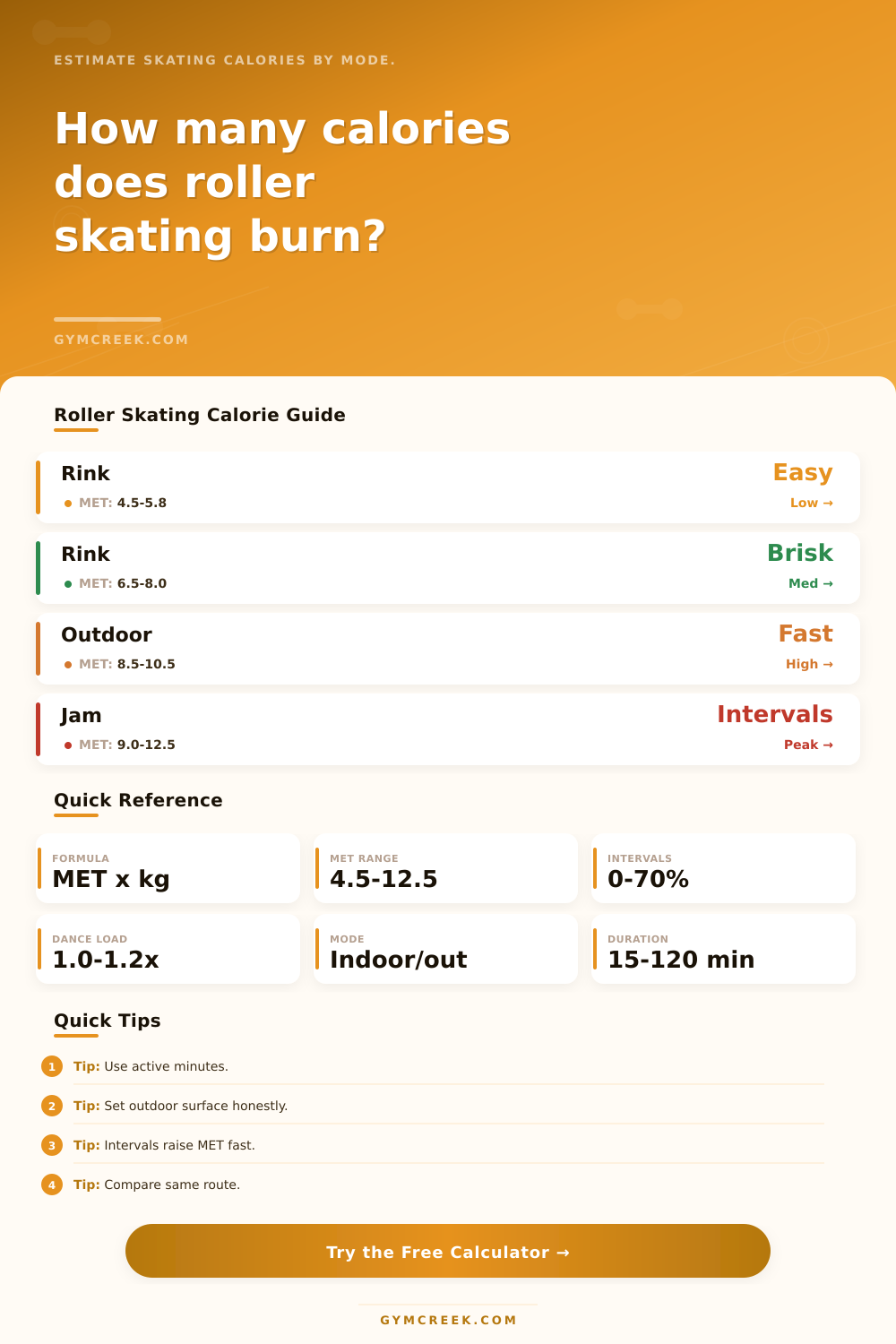
Calories per minute = MET x 3.5 x body weight in kg / 200. The calculator applies this to active skating minutes.
Mode and speed choose a base MET. Outdoor routes, trail skating, jam skating, and derby work start from higher mode-specific values.
Hard interval share blends steady MET with a harder burst MET, then dance or jam moves add footwork and upper-body load.
Surface drag and skating efficiency tune the estimate. Mifflin-St Jeor BMR gives a daily calorie burn comparison.
📑Reference Tables
| Mode | Easy | Steady | Fast |
|---|---|---|---|
| Indoor rink laps | 4.5 MET | 6.2 MET | 8.6 MET |
| Outdoor path skating | 5.0 MET | 6.8 MET | 9.2 MET |
| Trail or park route | 5.4 MET | 7.4 MET | 10.0 MET |
| Jam skating practice | 5.2 MET | 7.2 MET | 9.8 MET |
| Derby conditioning | 6.0 MET | 8.5 MET | 11.5 MET |
| Surface | Modifier | Typical Feel | Use Case |
|---|---|---|---|
| Polished indoor rink | 0.95x | Low drag | Lap skating |
| Sport court tile | 0.98x | Smooth grip | Drills |
| Smooth asphalt | 1.00x | Baseline | Paths |
| Rough asphalt | 1.12x | High drag | Street routes |
| Rolling trail | 1.18x | Uneven load | Outdoor cardio |
| Session Type | Duration | Interval Share | Expected Load |
|---|---|---|---|
| Beginner rink | 25-40 min | 0-5% | Light |
| Fitness cruise | 45-75 min | 5-20% | Moderate |
| Jam practice | 45-90 min | 10-25% | Mixed |
| Speed intervals | 30-60 min | 30-60% | Hard |
| Derby drills | 60-120 min | 20-50% | High |
| Formula | Variables | Output | When Used |
|---|---|---|---|
| MET kcal | MET, kg, min | Calories | Main estimate |
| Interval blend | Base, hard % | Work MET | Mixed pacing |
| Surface adjust | MET, surface | Adjusted MET | Route drag |
| Mifflin BMR | kg, cm, age | Baseline | Daily context |
💡Tips
There’s something unique about strapping on some inline blades or quad skates. There’s the rush. There’s the balancing act. And then, there’s all the work it do to the body.
Skating is a serious leg workout; it fire up your stabilizing muscles, your core and, well, your legs. And it gets your entire body moving in a way that most stationary cardio routine do not.
How Skating Burns Calories
With our calculator, we’ve done the math for you. We’ll take what you input and give you an actual calorie calculation so you can close that gap between “I know I worked hard” and “I know I burnt this many calories.”
The other thing folks tend to overlook: surface texture impact effort. A rougher surface generates more drag, which require greater muscle use to sustain your speed. You could be gliding across a slick indoor rink as fast as you skate down an uneven paved road, but your body isn’t expending equal amount of energy. That’s why there’s a surface modifier on the tool.
When you’re skating around town (on a boardwalk, say, or uneven pavement), the estimate goes up. It accounts for that extra weight. It’s a tiny touchpoint, yet crucial if you’re monitoring your progress. The page has a handy reference table spelling out those tweaks. Even a minor terrain difference can impact your burn rate.
Speed is another thing that plays tricks on your eyes. You might think that you’re cruising along at a comfortabley level and it seems fine. But cruising can keep you moving at a moderate heart rate for extended periods.
When you sprint? That’s dramatic and very much spike the metabolic equivalent. You can also plug in an interval share. What this does is blend intervals (high intensity bursts) with steady rolling. If you do derby conditioning or are a jam skater, this will be useful to you. There is no flat workout in either of these activities. Adjust that percent and you’ll find you’ve captured the reality of doing a burst based workout. It keeps from making the mistake of averaging out a hard workout as looking too easy on paper.
Dance also has complex footwork and other moves on top of this. That recruit additional muscle groups, like if you’re jumping, or spinning, or doing complex patterns. Your core is engaged much deeper as well different than just laps around the floor. All of these complexities add to what we call the load multiplier for dance.
And it’s not only speed. But it’s how technicaly difficult the movement is. Even if two people covers the same distance, the beginner gliding along in a circle will burn fewer calories then an advanced skater making sharp stops. And it’s not because they aren’t moving faster. It’s due to efficiency. Because the more advanced you become, the less energy you’ll expend for the same speed.
On the flip side though, if you’re drilling some new skill set then in the short term you’ll be burning more calories since learning something inefficiently burns more calories initially.
The two primary variables are body weight and duration. More body weight mean higher calories burned. The formula reflects this. Longer duration means greater overall accumulation.
Long pauses or standing around doesn’t factor into active burn nearly as much. Break time is broken off from active rolling time. You’ll have a better idea of how hard you really worked. This removes any confusion between how long you think you worked compared to reality. No time spent chatting or waiting will be counted. It would of been counted as active.
These aren’t numbers that are meant to be followed exactly. Rather, they is intended to serve as a guide. They give context to your own efforts.
What does it mean to get out there and skate? Do you want to train competitively? Do you want to train for fitness? Or do you just want to have fun on the trails? Knowing the factors gives you something to adjust wisely.
Maybe you want to up the ante by choosing a more gnarly route. Or maybe you’ve plateaued and need to increase intervals. The numbers show that it is time to get moving. They turn the hazy sensation of being tired into something real that you can act upon.
Consider your effort levels and how hard you push off the ground. That’s where the magic happens. Pay attention to them.