Rock Climbing Calories Burned Calculator
Estimate climbing calories from style, route length, rope work, grade difficulty, rests, falls, approach time, and body weight.
📌Climbing Presets
Presets load realistic climbing style, route volume, grade difficulty, rope handling, falls, rests, and approach context before calculating.
⚙Climbing Inputs
Climbing session snapshot
Enter your climbing style, route volume, rope work, and rest time to estimate calories.
📊Climbing Metrics Grid
📑Reference Tables
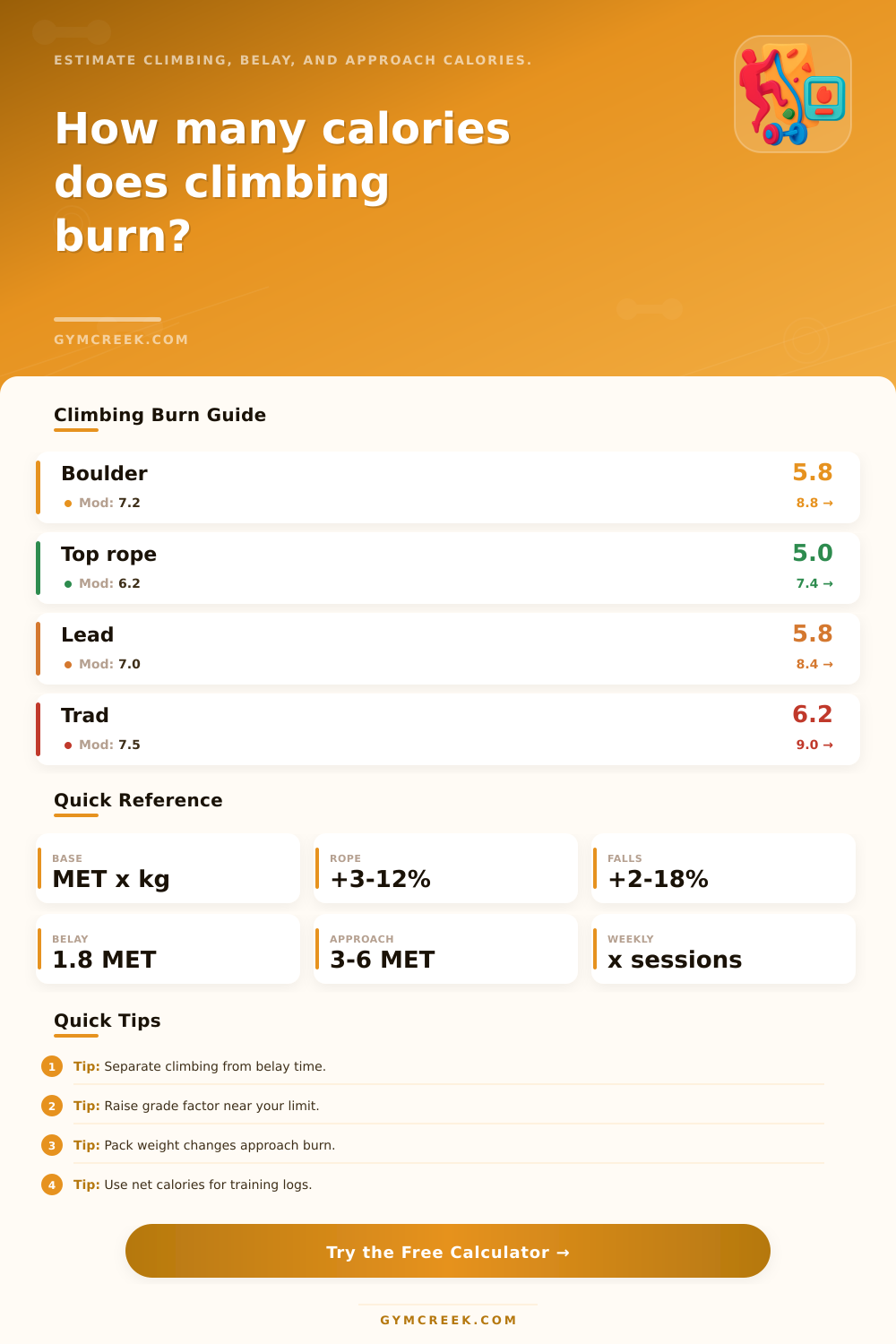
| Climbing Style | Base MET | Typical Use | Rope Demand |
|---|---|---|---|
| Bouldering | 6.5-8.8 | Short hard problems | None |
| Top rope | 5.2-7.4 | Gym or crag laps | Low to medium |
| Sport lead | 6.0-8.6 | Clipping routes | Medium |
| Trad climbing | 6.5-9.0 | Gear placements | High |
| Multi-pitch | 6.2-8.8 | Route systems | Very high |
| Difficulty Band | Factor | Example Feel | Calorie Effect |
|---|---|---|---|
| Easy mileage | 0.90 | Warm-up pace | Lower |
| Moderate routes | 1.00 | Steady climbing | Baseline |
| Hard onsight | 1.10 | Sustained effort | Higher |
| Project level | 1.20 | Repeat sections | High |
| Limit attempts | 1.32 | Max power | Highest |
| Rope Handling | Factor | Best Match | What It Adds |
|---|---|---|---|
| None | 0% | Bouldering | Pad moves only |
| Auto-belay | 3% | Gym laps | Clip-in checks |
| Top rope | 6% | Partner laps | Belay rhythm |
| Lead | 9% | Sport routes | Clips and catches |
| Trad or multi | 12-16% | Gear systems | Rack and anchors |
| Formula Piece | Variables | Use | Output |
|---|---|---|---|
| Climb kcal | MET x kg x hr | Wall time | Calories |
| Belay kcal | 1.8-2.4 MET | Rest and belay | Calories |
| Approach kcal | MET x load | Walk-in time | Calories |
| Net kcal | Total - rest | Training logs | Calories |
| Weekly kcal | Session x freq | Load planning | Calories |
💡Tips
The day starts with you standing at the bottom of a climb you don’t think you’re going to make. Your forearms feel acidic and your thoughts race as you recall half-forgotten moves from yesterday. Was it worth it? Did I give it all I had? In the past, we’ve guessed at the answer, depending on guesses about how much we sweated and checking our heart rate monitor. Guessing based off sweat isn’t very good; neither is monitoring heart rate, because it’s not steady state cardio when you climb.
Climbing are intermittent intervals of anaerobic power work broken up by long rests. To get an accurate number for calories burned, you need something to factor in the intensity of your moves, rather than just the time spent hanging out while doing nothing. That’s what the calculator does. It divide up real climbing work versus hanging around, which is where other trackers fail.
How the Calculator Works
Then there’s the style and grade: How difficult will the moves be? Is it something close to your limit, or a comfortable cruise? Depending on the hardness of the moves, top roping can feel like a long hike, whereas bouldering can feel like a sprint. The app asks if you’re going for limit attempts, moderate routes, or easy mileage. Why does this matter? Pushing against your maximum strength burns way more glycogen and recruits more muscle fiber over time. For example, you could climb an easy route for an hour and burn far fewer calories than burning through three limit boulder problems in twenty minutes.
If you choose limit attempts or project level, the calculation accounts for the higher energy cost. It’s not all about getting up the wall. You’re firing every fiber you’ve got for those critical sequences, and that spike in intensity drives calorie burn way more than duration alone.
And then there’s rope work. On the lead, you’re constantly moving the rope, managing slack, clipping quickdraws, and dealing with the psychological weight of falling free. There’s a physical layer to lead climbing that doesn’t exist when top roping. Managing a lead line or placing gear demands constant mental focus and micro-movement: all things that will raise your heart rate while off the move. These actions also don’t get accounted for by the calculator but should of been given a factor for rope handling.
For traditional climbing and multi-pitch routes, it gets even worse with anchor building and rack management, engaging your back and core muscles in a way that pure bouldering can ignore. Failing to account for this factor is an underestimate of overall energy used during a day outside when gear management is literally half the job.
Remember the approach: Carrying all that rock gear around on a hike to a crag will alter how your body use energy for the whole day. Getting a solid workout walking up-hill with two hundred pounds of rocks on your back. You’ll be able to enter the pack weight and approach time into the tool, and it will separate that from the climbing calorie burn to help you figure out how many calories you actualy expended.
That way, if you realize you burned more approaching the crag than you did on the wall, you know something isn’t right somewhere… Whether it’s about the efficiency of this trip, or maybe the routes you picked. Also, knowing how much you burned in total, including approach, matters when planning food for the trip, since your need for energy increases based on overall load, not necessarily time on the wall.
The other tricky piece is rest. Climbing involve a lot of movement. Sitting and watching your partner climb doesn’t burn as many calories as being active, but resting is still part of the workout. The calculator tells the difference between time spent actively climbing versus resting and belaying. So you don’t get in your head that every time you go climbing, you were really burning tons of calories because you assume those two hours were super intense exercise. That’s not always true. Maybe you are actually active for only about forty percent of the time. Knowing that breakdown allows you to better measure how much you’ve progressed. Are you getting fitter? Or are you just taking longer breaks?
And lastly: How does it project each week? Consistency matters more then intensity in an activity like climbing, it’s as much a sport of skill as it is a fitness activity. In other words, that one gut-wrenching weekend workout isn’t always better than burning the same amount of calories over three or four sessions. Based on how many times per week you work out, the tool will show you your total calorie burn that week. Knowing what all that “work” adds up to will help you prevent burning out and also know how much food to eat to match that load.
It’s not exact, yes, the numbers are approximations. But at least it gives you something to think about instead of just making a guess. Climbing is about more than just calories. It is a sport of physical grace and problem-solving. But if you bring a little quantitative awareness to your training, it helps you respect the work you put in. You’ll know, when you leave the wall, how much you gave it.
Climbing is a sport of physical grace and problem-solving. But if you bring a little data to your training, you’ll appreciate the sweat you’ve poured into it. You’ll know, when you leave the wall, how much you gave it.