Road Bike Crank Length Calculator
Estimate a road crank length from rider measurements, cadence style, hip clearance, knee comfort, bike fit goals, and standard crank sizes.
📌Presets
Presets load realistic road fit scenarios and calculate a recommended size, nearest standard crank, and setup changes.
⚙Rider And Fit Inputs
Road crank length recommendation
Enter rider dimensions and road fit goals to calculate a starting crank length.
📊Fit Metrics Grid
📑Reference Tables
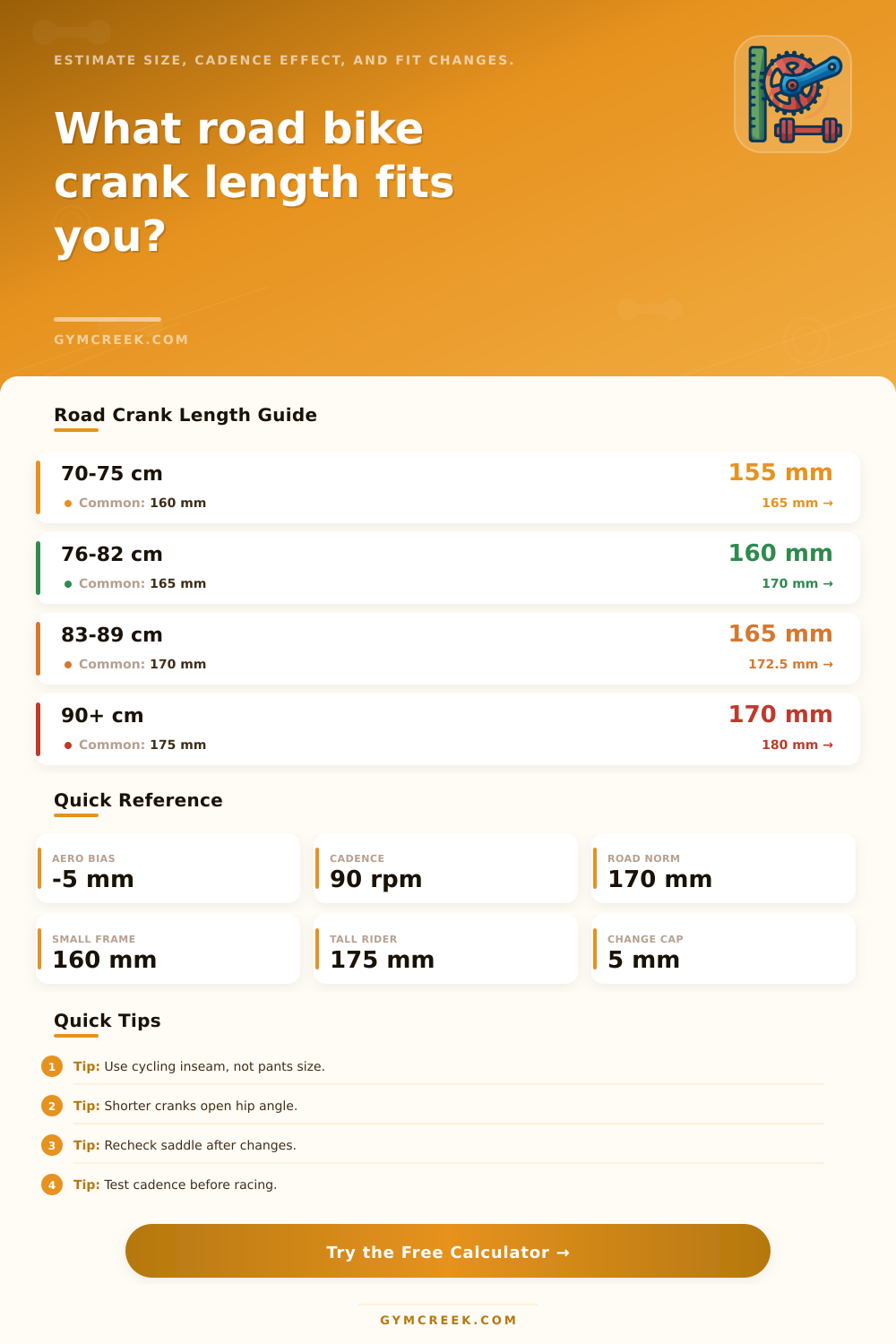
| Inseam | Short bias | Neutral | Long bias |
|---|---|---|---|
| 70-75 cm | 155-160 mm | 160-165 mm | 165 mm |
| 76-82 cm | 160-165 mm | 165-170 mm | 170 mm |
| 83-89 cm | 165-170 mm | 170-172.5 mm | 172.5-175 mm |
| 90-96 cm | 170-172.5 mm | 172.5-175 mm | 175-180 mm |
| Signal | Likely move | Why | Retest |
|---|---|---|---|
| Aero tuck | -2.5 to -7.5 | Opens hip | Power |
| High cadence | -2.5 to -5 | Less arc | Cadence |
| Front knee | -2.5 to -5 | Less peak bend | Comfort |
| Toe overlap | -2.5 | More clearance | Handling |
| Size | Common use | Frame clue | Notes |
|---|---|---|---|
| 155-160 | Small riders | XS road | High rpm |
| 165 | Small-medium | S road | Aero friendly |
| 170 | Medium | M road | Common stock |
| 172.5 | Medium-large | L road | Common stock |
| 175-180 | Tall riders | XL road | More leverage |
| Layer | Input | Adjustment | Purpose |
|---|---|---|---|
| Inseam | Leg length | 2.09x cm | Main size |
| Height | Stature | 9.5% | Proportion |
| Segments | Femur/tibia | Bias | Leverage |
| Fit goal | Use case | Shift | Clearance |
💡Tips
Crank length is a significant variable in a bicycle fit because crank length is a measurement that change the way that the human body interacts with the bicycle. While many peoples believe that the length of the crank is a fixed measurement that the manufacturer of the bicycle chooses, the length of the crank can be changed in order to alter the geometry of the bicycle that the rider uses. If the length of the cranks that a rider uses is too long, the rider may experience pinching sensation in there hips when they ride the bicycle.
In contrast, if the length of the cranks is too short for the individual that rides that bicycle, they may feel as if they dont have enough leverage when they ride. Thus, each of these issues indicate that it is necessary for each individual to find the correct length for the cranks on their bicycle in order to experience an efficient fit to there body. One of the primary measurements that is used to determine the length of the cranks that should be provided to an individual rider is the inseam of the rider.
How to Find the Right Crank Length for Your Bike
However, the inseam that is used for cycling is not the same than the inseam of an individuals pants. Instead, the inseam is a precise measurement of the distance from the floor of the body to the pubic bone. An individual can use the inseam along with their height to calculate the length of the cranks that should be supplied to each individual rider.
Thus, utilizing these calculations can help to remove the guesswork that each individual might otherwise have to use when determining the length of the cranks on their bicycle. In addition to the inseam of the individual, other factor to consider in the selection of the length of the cranks include the length of the femur and the length of the tibia of that individual. Each individual has different proportions to their legs.
Consequently, two individuals that possess the same inseam may have different needs with regard to their length of the cranks that they utilize to ride their bicycles. For instance, individuals who have long femurs may have an issue with their thighs hitting their torso when they are cycling with long crank lengths. Consequently, those individuals may be better utilizing shorter cranks to allow for their hips to open and for them to remain in an aerodynamic position without their legs repeatedly hitting their chest.
Other factors to consider in the selection of the length of the cranks that are provided to an individual rider to cycle includes the cadence at which they typically cycle. The length of the cranks will impact the circumference of the circle that an individuals foot travels when they are cycling. Short cranks will allow for the individual to travel a shorter distance with their feet, which may allow them to reach higher revolutions per minute (RPM) rates.
Consequently, many professional race cyclists use shorter cranks so that their legs do not fatigue during prolonged periods of cycling. However, longer cranks will provide more leverage for individuals that intend to cycle with higher level of torque with their pedals. Thus, each individual can balance between these two factors to find the best length of crank for themselves.
Another reason to consider the length of the cranks that will be supplied to an individual is in relation to the health of their knee. If an individual feels pressure on their knee when they are cycling, it is possible that their knee is flexing too deep when they cycle. Shortening the cranks that the individuals uses will help to reduce the flexion of their knees when they are cycling.
Consequently, this may provide some relief to the joint between the individuals knee bones. However, individuals may feel unstable with short cranks. Thus, individuals can use a focus setting to determine if they wish to emphasize their endurance, climbing, or power with their cycling efforts.
In addition to the factors mentioned above, individuals may need to adjust other components of the bicycle according to the length of the cranks that they choose to use. For instance, if an individual changes the length of their cranks to be shorter, their feet will be further from the bicycle saddle when their legs are dropped to the ground. Thus, they will need to adjust the height of their saddle.
Conversely, if an individual changes the length of the cranks that is used to longer lengths, the individual will need to lower their saddle to maintain the same length of extension of their legs. Thus, changing the length of the cranks will impact the height of the saddle that should be set to accommodate those changes in crank length. Finally, frame clearance is another consideration of an individual who is selecting the length of the cranks that will be supplied to their bicycle.
For individuals who have smaller bicycles, using long cranks may cause the individuals toes to begin to overlap with the front wheel of the bicycle. In this case, changing to a shorter crank will allow for more space between the individuals toes and the tire with which they ride. Finally, the goal of adjusting the length of the cranks that an individual uses is to ensure that the circle that the individuals feet make while cycling is of the correct length for their bodies.