Reverse Grip Bench Calculator
Estimate your reverse-grip bench 1RM, stable working load, grip readiness, and triceps demand from reverse-grip-specific setup factors.
📌Presets
Presets load complete reverse-grip scenarios: bench strength, reverse test set, supination angle, grip width, wrist control, elbow path, and stability.
⚙Calculator
Reverse-grip bench snapshot
Enter a test set and setup ratings to calculate your reverse-grip loading range.
📊Reverse-Grip Metrics
📑Reference Tables
| Setup factor | Green zone | Caution zone | Why it matters |
|---|---|---|---|
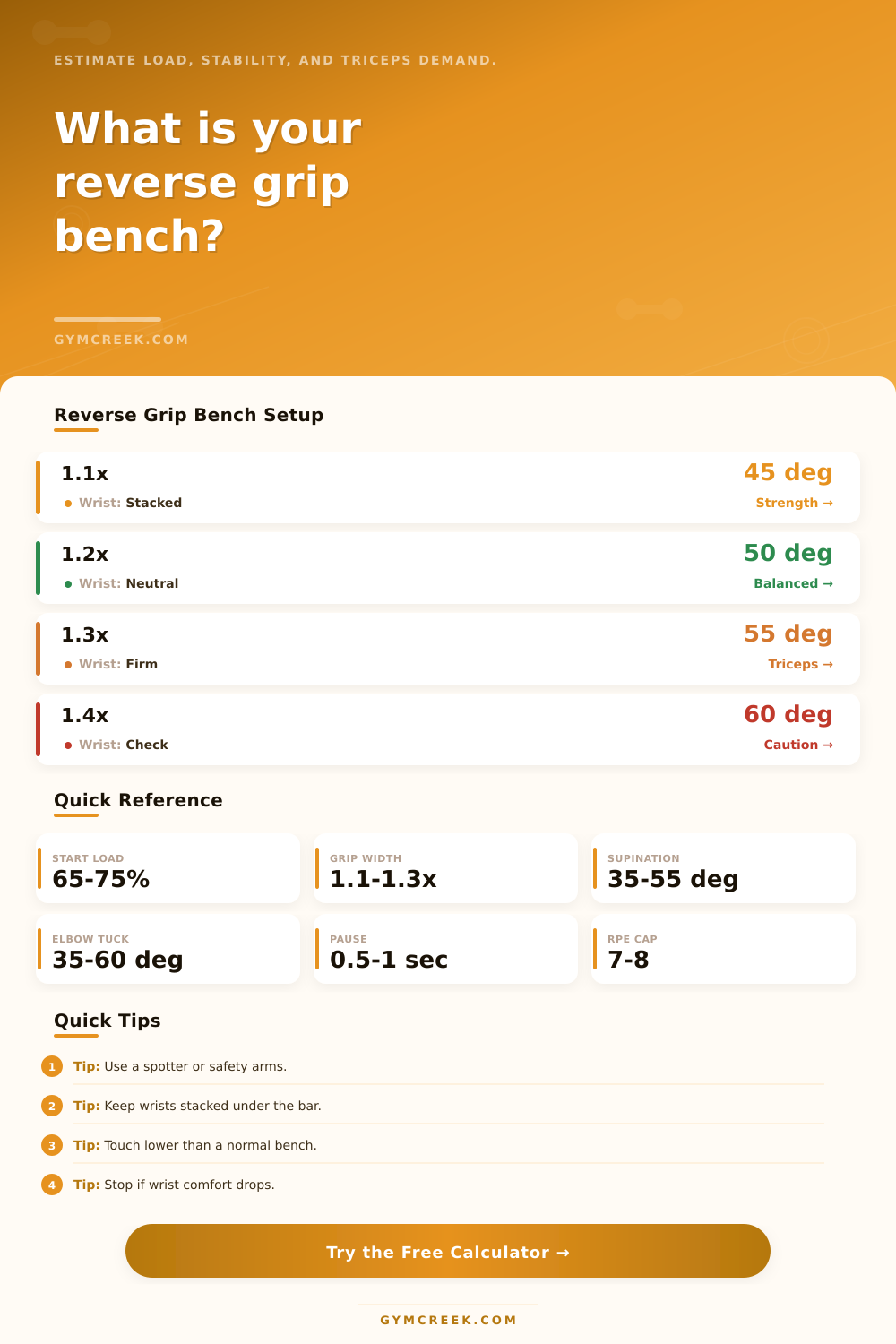
| Grip width | 1.10x-1.30x shoulders | Below 1.0x or above 1.45x | Controls forearm stack and bar drift. |
| Supination | 35-55 degrees | Below 25 or above 65 degrees | Too little becomes mixed grip; too much stresses wrists. |
| Wrist extension | 0-15 degrees | Above 25 degrees | Stacked wrists reduce roll-back risk. |
| Elbow tuck | 35-60 degrees | Very flared or pinned tight | Sets the press path and triceps leverage. |
| Experience | Bench carryover | Safety cap | Best first target |
|---|---|---|---|
| New | 68-74% | 78-82% | Technique sets of 6-8 |
| Learning | 72-80% | 80-85% | Paused sets of 5-6 |
| Practiced | 78-86% | 84-88% | Strength sets of 3-5 |
| Advanced | 82-90% | 86-90% | Heavy singles after warmups |
| Goal | Training max | Working range | Main watch point |
|---|---|---|---|
| Technique practice | 78% | 55-70% estimated 1RM | Repeatable touch point |
| Strength accessory | 85% | 70-82% estimated 1RM | Stable bar path |
| Triceps emphasis | 82% | 65-78% estimated 1RM | Lockout without hard flare |
| Heavy exposure | 88% | 80-90% estimated 1RM | Spotter and safety arms |
| Formula piece | Input used | Output | Purpose |
|---|---|---|---|
| Epley estimate | Test load and reps | Set-based 1RM | Projects strength from recent reps. |
| Bench carryover | Standard bench and skill | Anchor estimate | Prevents a single set from oversteering. |
| Technique index | Grip, wrist, elbow, comfort | 0-100 score | Adjusts load for position quality. |
| Training max | Goal and stability | Working load | Keeps reverse-grip sets conservative. |
💡Tips
A regular bench press is different from a reverse grip bench. The movement forces you to manage stability, your shoulders feel weirdly open, and it always seems like weight is more than what’s on the plates. People don’t do this exercise because it’s awkward. And that is why this movement is valuable. You’re forced to deal with stability in a way you would not on flat bench. Your front delts and triceps has to take up some of the slack. Your shoulder joint stay externally rotated, which is a safer position for the joint.
You can input specifics about your set-up and most recent test sets into the calculator above and it will do all the work for you. Instead of playing the guessing game, you might wonder if that last set was recklessly heavy. Or am I being careful enough? It puts forth a projected one-rep max and assesses stability index based off your grip width, elbow angle and wrist alignment. Why does this matter? Because how strong are you when the bar wants to shift towards your face during the lowering part of the lift? This handy tool guides you to the right balance between challenging your muscles while keeping yourself out of harm’s way.
Why Reverse Grip Bench Press is Good for You
First of all, let’s talk about the supination angle. That’s the amount you turn your palm underneath. Many lifters assume any reverse grip is equivalent. But a difference of only 15 degrees in wrist rotation change everything. If you rotate moderately, it will engage bicep during the lowering phase (aka a brake). Too far and you overload the wrist extensors. Too little and you get a confusing mixed grip. Your motor pattern gets confused. The reference table on the page clearly illustrates this. Here, you can see how slight rotations of hand move loads around.
The other thing that makes or breaks the lift is how you hold your wrists. You don’t want your wrists sticking way out with your hands like some sort of flailing octopus. You want them stacked right underneath the bar. Anything else… Such as bending them backwards toward your elbows, means that force leak out before it reaches your target muscles. This may seem like a small thing but over time, it really matters for your joint health. When you enter the workout, the calculator will ask for your wrist extension rating so it can estimate what kind of structural support you have. If you rate low on this one, then the system will recommend keeping your working load down. This is not because you’re weak, but because you have a shaky foundation.
Next is the touch point. A lot of lifters try to touch same place on their chest that they do when they bench normally. This is a mistake. When doing a reverse grip, you want to target a little lower, toward the top of your abs or just below your sternum. This puts the direction of force more in line with strength of your arms. If you like bouncing the bar off of your chest and moving more weight, then great; but again you forfeit all those stability benefits. By pausing, even briefly (half a second), you reveal any weaknesses in your set-up. Your pause style is included in calculator. Higher scores are given to those who shows good control.
And it’s all about experience here. Don’t expect to be chasing big numbers if you’re just starting out. There is no direct transfer from a regular bench. Maybe you can start at 70% of what you usually do. Or maybe you’ll hit 90+ as an experienced lifter. You shouldn’t of try and close that distance too soon. The safety buffers are set by the tool depending on what you tell it about your experience level. It will then suggest loads that fit within your brain’s comfort zone with the pattern.
To conclude. The bench is all about control as well as capacity. It forces you to press with precision and purpose. When your shoulders remains calm and you get a clear sense of tricep burn, you’re on the right track. And it’s never about how much weight you can move. It’s always about how much weight you can move safely. Begin lightly, believe in the process, and allow your stability to grow naturaly over time. Skill leads to strength.