Resting Metabolic Rate Calculator
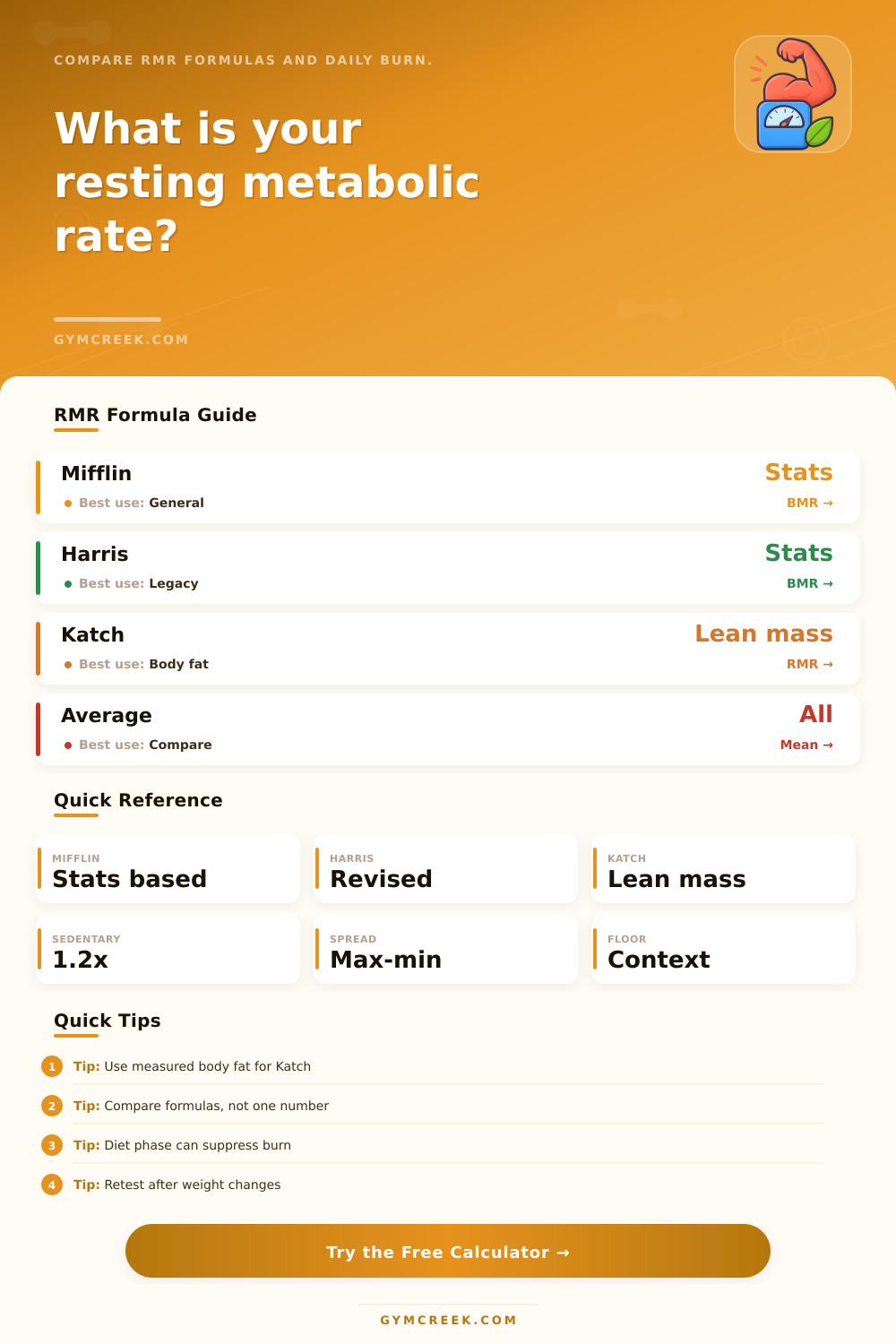
Estimate RMR with Mifflin-St Jeor, revised Harris-Benedict, and Katch-McArdle, then compare lean mass, daily burn range, formula spread, and calorie floor context.
📌RMR Presets
Each preset loads a realistic profile with formula choice, activity context, diet phase, and measurement method.
⚙Calculator Inputs
RMR snapshot
Enter your profile to compare resting metabolic rate formulas.
📊Metrics Grid
📑Formula and Reference Tables
| Formula | Equation | Needs | Best use |
|---|---|---|---|
| Mifflin-St Jeor | 10W + 6.25H - 5A + S | Age, sex, stats | General adults |
| Revised Harris | Sex-specific coefficients | Age, sex, stats | Legacy comparison |
| Katch-McArdle | 370 + 21.6 x LBM | Lean mass | Known body fat |
| Average | Mean of valid outputs | All valid formulas | Formula comparison |
| Activity context | Factor | Daily pattern | Use carefully |
|---|---|---|---|
| Sedentary | 1.20 | Desk, low steps | Low movement days |
| Light | 1.375 | Walks or light gym | 3-6k steps plus some training |
| Moderate | 1.55 | Training most weeks | Regular workouts |
| Very active | 1.725 | Hard training or active job | High step weeks |
| Athlete | 1.90 | Labor, sport, double sessions | High recovery demand |
| Diet phase | RMR context | Floor cue | Retest trigger |
|---|---|---|---|
| Maintenance | Most stable | Use chosen RMR | Weight change |
| Mild deficit | Small adaptation | Watch recovery | 2-4 weeks |
| Aggressive deficit | Higher risk | Avoid deep lows | 1-2 weeks |
| Post-diet | May be suppressed | Increase gradually | Weekly trend |
| Surplus | Often steady | Check gain rate | Monthly |
| Method | Confidence | Formula note | Typical spread |
|---|---|---|---|
| Home estimate | Low | Use Mifflin or average | Wide |
| Bioimpedance | Moderate | Katch can swing | Moderate |
| Skinfold | Moderate | Skill dependent | Moderate |
| DEXA/BodPod | Higher | Katch is useful | Narrower |
| Lab RMR | Highest | Use lab value when known | Lowest |
💡Tips
Your resting metabolic rate are the amount of energy that your body use to perform the basic function of life. The body includes energy used for functions like maintain the heartbeat and maintaining body temperature in the resting metabolic rate. Additionally, the body also uses the energy used for cellular work and rebuilding tissues in resting state.
Most individuals are unaware of there resting metabolic rate unless it change. Changes in the training or diet of an individual can lead to changes in the resting metabolic rate of that individual. There is several formula that can be used to estimate resting metabolic rate.
What is resting metabolic rate and how to calculate it
Each of the formula makes different assumptions about an individual’s body composition in comparison to other individuals of similar size. For instance, the Mifflin-St Jeor equation and the Harris-Benedict equation estimate resting metabolic rate based off the age, sex, height, and weight of the individual… Assuming that their body composition is average for individuals of their size.
The Katch-McArdle equation is different in that it require an estimate of body fat percentage. Because the Katch-McArdle equation calculates lean body mass, it is more accurate for individuals who have more or less muscle than the average individual. Each of these formulas can be calculated with a calculator included in this article.
An individual’s activity level can be incorporated into the resting metabolic rate to determine the total daily energy expenditure of that individual. Individuals who have more active jobs than others will have more higher total daily energy expenditure. Additionally, individuals who train more days each week will have higher total daily energy expenditure.
While the calculator calculate resting metabolic rate, it also allows for adjustments to activity level, which will reflect changes in total daily energy expenditure. An individual’s diet phase may influence the energy expenditure of that individual, though it isnt incorporated into the mathematical calculation of resting metabolic rate. Individuals who eat below their calculated total daily energy expenditure may find that their energy expenditure drop to the point below what the calculations indicate.
This drop in energy expenditure may last for some time after an individual begins dieting; the body remains in a low metabolism state until their weight and training volume returns to normal. During a maintenance diet phase, when no major changes are occurring in food intake, metabolism is stabilize. Such a phase is the most accurate in measuring energy expenditure.
These different diet phases can be compared within the calculator to determine energy expenditure during each diet phase. The method in which body fat percentage is calculated will impact the accuracy of the Katch-McArdle formula. Calculations of body fat at home may not be as accurate as calculations made in a health clinic.
An inaccurate measurement of body fat percentage will impact the calculation of lean body mass. An inaccurate lean body mass will impact the accuracy of resting metabolic rate calculations. More precise measurement of body fat, such as with a DEXA or BodPod measurement, will allow for more accurate calculations of resting metabolic rate.
The calculator allow for the individual to select the measurement method of body fat percentage, which will impact the daily-burn estimate that is projected. The reference tables on this page provide information regarding the activity factors, diet phases, and why there is a calorie floor for each individual. The calorie floor is determined by calculating a sex-based minimum calorie intake and size-based floor, then adjusting that floor according to the degree of ambition regarding dieting phase.
The calorie floor should never be dropped, as dropping calories intake below this level will negative impact the recovery and performance of that individual. While many believe that an individual’s resting metabolic rate is a fixed number, it isnt. An individual’s resting metabolic rate will change with changes in weight, muscle mass, or age.
Should any of these factors change for an individual, it is recommended to retest resting metabolic rate calculations to ensure accuracy in those calculation. While the mathematical formula are the same, the variables will change, thus altering the calculation of resting metabolic rate. One of the valuable features of this calculator is the ability to view how changes to one variable will impact the other variable.
For instance, changing an individual’s body fat percentage will impact the Katch-McArdle calculation of resting metabolic rate, but will have no impact on the Harris-Benedict and Mifflin-St Jeor calculations. Increasing an individual’s activity level will impact the daily-burn estimate of that individual, but will have no impact on resting metabolic rate. Through adjusting each variable individual, resting metabolic rate can be better understood.