🔥 Resting Metabolic Rate RMR Calculator
Estimate calories your body uses at rest, compare major formulas, and translate RMR into realistic daily calorie targets.
| Formula | Equation | Best For | Notes |
|---|---|---|---|
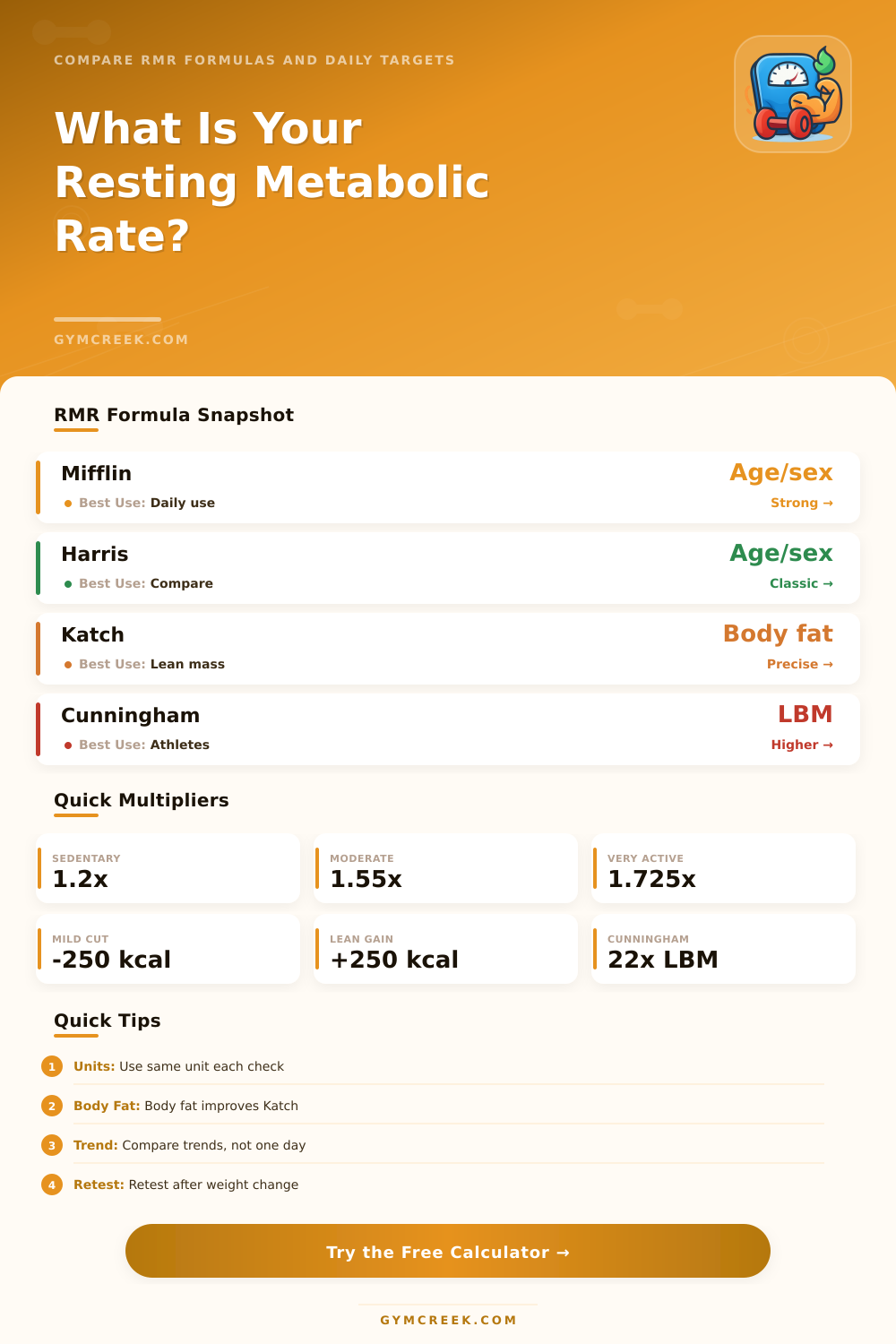
| Mifflin-St Jeor | 10W + 6.25H - 5A + sex | General adult estimates | Common default for calorie planning |
| Revised Harris-Benedict | Sex-specific W, H, A equation | Comparison estimate | Often a little higher than Mifflin |
| Katch-McArdle | 370 + 21.6 × lean kg | Known body fat percentage | Uses lean body mass instead of total weight |
| Cunningham RMR | 500 + 22 × lean kg | Athletes and lean users | Usually higher when lean mass is high |
| Setting | Multiplier Or Adjustment | Use When | Example |
|---|---|---|---|
| Sedentary | 1.2× RMR | Little planned exercise | Desk job, low steps |
| Moderate | 1.55× RMR | Training 3-5 days per week | Regular lifting or cardio |
| Very Active | 1.725× RMR | Hard training most days | Sport practice plus gym |
| Mild Fat Loss | TDEE - 250 kcal | Conservative deficit | Better for performance retention |
| Lean Gain | TDEE + 250 kcal | Slow muscle gain | Limits excess fat gain |
| Profile | Typical Pattern | Calculator Focus | Useful Check |
|---|---|---|---|
| New lifter | Weight stable, lean mass rising | Katch or average formula | Recheck body fat monthly |
| Post-diet athlete | Estimated TDEE feels too high | Measured lab RMR comparison | Watch trend weight for 2 weeks |
| Endurance runner | High activity multiplier | Mifflin plus activity review | Separate easy and hard weeks |
| Masters trainee | Lower total mass or activity | Formula comparison | Adjust after body weight change |
Every day, first thing in the morning, your body burns a specific number of calories just so your lungs can expand and your heart can beat. This is called your resting metabolic rate. Calories are usually something you think about after you eat them but knowing your base energy requirement shifts how you approach food. It makes it into an equation you can solve.
Above, we uses a few equations to find the best fit for your base plus motion. There are many formulas because there is different versions of humans. The default for most adults is Mifflin-St Jeor, which takes into account weight, height, age, and sex. It is simple yet relatively accurate.
How to Calculate Your Daily Calorie Needs
The older Harris-Benedict will tend to be slightly higher. If you’re looking for a way to justify eating a little bit more, maybe this will give you permission. But if you know your body fat percentage, switching to Katch-McArdle or Cunningham changes the game entirely. Both use body composition as their primary variable and disregard total bodyweight. Fat tissue doesn’t burn as many calories as lean tissue. For people who lift weights, especially athletes, that makes all the difference.
Two person can have the exact same weight. One could be overweight and one underweight. They both has different fuel usage rates while sitting still. You must adjust for body composition when calculating your intake. If you do not, you may under-estimate or over-estimate your needs. This leads to stalls in progress.
Many people’s numbers fall apart on the activity multipliers. For example, when they’re tired from exercise or work, they think their activity level must be higher than normal. Then they look up the activity levels in the reference table. They see a sedentary person as someone who sits around all day without much activity. A moderate person is someone who exercises regularly several days per week. And a very active person trains really hard almost every day.
Of course, they want to pick the top category. But that’s not honest to yourself, which is actualy best for you here. If you spend 8 hours a day at a desk and take a 20 minute jog, then you’re probably either moderately active or slightly less, not very active. Overestimating this will cause you to gain extra weight or make slow progress. Underestimating it will leave you feeling hungry and drained. To find the correct multiplier, glance at your calendar based off how you feel.
Then goals adjust your total daily energy expenditure. Instead of a drastic cut, a moderate two-hundred-fifty calorie deficit is usually wiser. You’ll lose weight (fat) while retaining more muscle and remaining hungry. For lean gains, you’d add an equal surplus. These subtle tweaks succeed for a reason. They’re sustainable. Crash diets don’t fail due to mathematical error; rather, they requires so much willpower that it evaporates quickly. Consistency trumps intensity, each and every time.
The formulas are an estimate of your personal RMR based on a measurement obtained from a lab… If you’ve had your RMR tested by indirect calorimetry, use this figure instead. This takes into account factors like metabolic adaptation due to past dieting as well as genetic differences (thyroid function). Most folks should focus on tracking trends across several days/weeks rather than getting obsessed with one-day numbers. RMR vary depending on hormones, stress levels, sleep quality, etc.
You’ll learn more about yourself by seeing what happens when you track calculated targets against weight and energy intake. What’s important to remember? What are you measuring? Your resting metabolic rate (RMR) is the floor of your energy budget. Everything is built upon this floor. Knowing your floor helps you create a realistic ceiling whether your goal is muscle gain or fat loss. Your RMR gives you a starting number; adjust it to match reality and then let your body fine tune.
That metabolic process should of waited until you wake up in the morning.