Resting Heart Rate Calculator
Estimate your true resting heart rate from a pulse count, compare it with your baseline, and calculate heart rate reserve, training zones, and readiness context from age, body size, recovery, and measurement conditions.
📌Presets
Each preset loads a realistic pulse count, baseline, training load, recovery context, and body profile so the calculated RHR and zone outputs change in practical ways.
⚙Calculator
Resting heart rate snapshot
Enter a pulse reading and baseline to estimate your resting heart rate context.
📊Fitness Metrics Comparison
📑Reference Tables
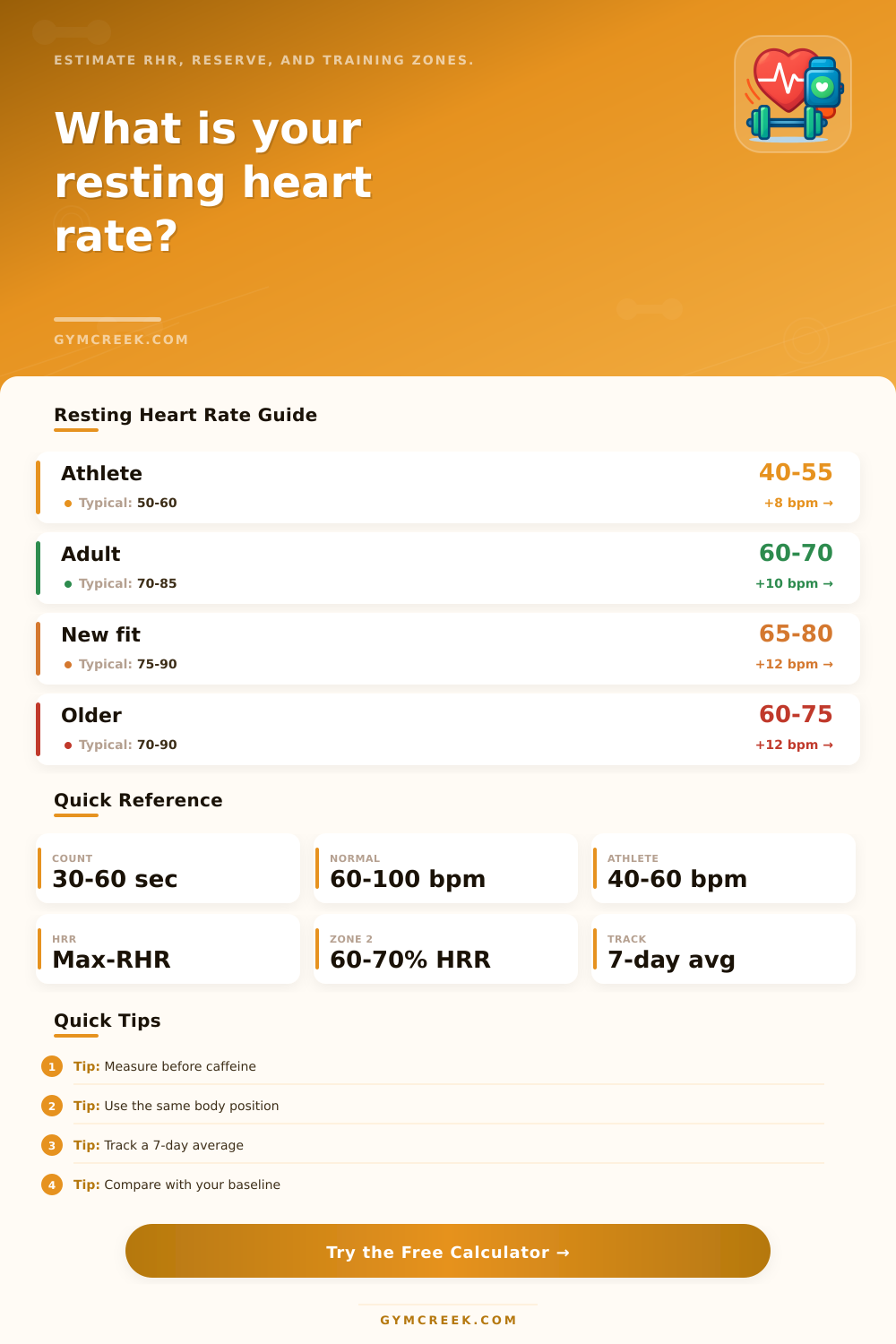
| Group | Typical range | Fitness signal | Tracking note |
|---|---|---|---|
| Endurance trained | 40 to 60 bpm | Often lower from stroke volume | Compare to personal baseline |
| Recreationally active | 55 to 75 bpm | Common fit adult range | Use a 7-day average |
| General adult | 60 to 100 bpm | Broad normal range | Watch changes over time |
| Elevated day | Baseline plus 8 to 12 bpm | May reflect stress or recovery load | Retest under same conditions |
| Method | Best use | Common error | Calculator treatment |
|---|---|---|---|
| 60-second pulse | Manual baseline | Counting mistakes | Highest manual confidence |
| 30-second pulse | Quick check | Small count doubled | Moderate confidence |
| Wearable average | Daily trend | Motion or fit issues | Good trend confidence |
| Overnight reading | Recovery trend | Algorithm differences | Best for consistency |
| Zone | Formula | Feel | Typical purpose |
|---|---|---|---|
| Zone 1 | RHR + 50-60% HRR | Very easy | Warm-up and recovery |
| Zone 2 | RHR + 60-70% HRR | Steady aerobic | Base endurance |
| Zone 3 | RHR + 70-80% HRR | Controlled hard | Tempo foundation |
| Zone 4 | RHR + 80-90% HRR | Hard | Threshold work |
| Scenario | Likely driver | What to compare | Useful action |
|---|---|---|---|
| Lower over months | Aerobic adaptation | Average RHR and pace | Keep conditions consistent |
| Higher after hard block | Recovery demand | Baseline gap and sleep | Use an easier session |
| Higher after caffeine | Stimulant timing | Morning no-caffeine reading | Retest before intake |
| Variable wearable data | Sensor placement | Same device trend | Check fit and timing |
💡Tips
Resting heart rate is a measurement that many peoples use to track the response of there body to the training loads that they place upon their bodies. Each individual are able to check their resting heart rate every morning without the need for any special equipment. Furthermore, each individuals resting heart rate is likely to change prior