Rest Time Calculator
Estimate how long to rest between sets from training goal, exercise type, load, reps, RIR, experience, fatigue, supersets, and session density.
📌Presets
Each preset loads a realistic training session and recalculates recommended set breaks, total rest budget, readiness, and density.
⚙Calculator
Rest time snapshot
Enter your training context to estimate a practical rest interval.
📊Rest Metrics
📑Reference Tables
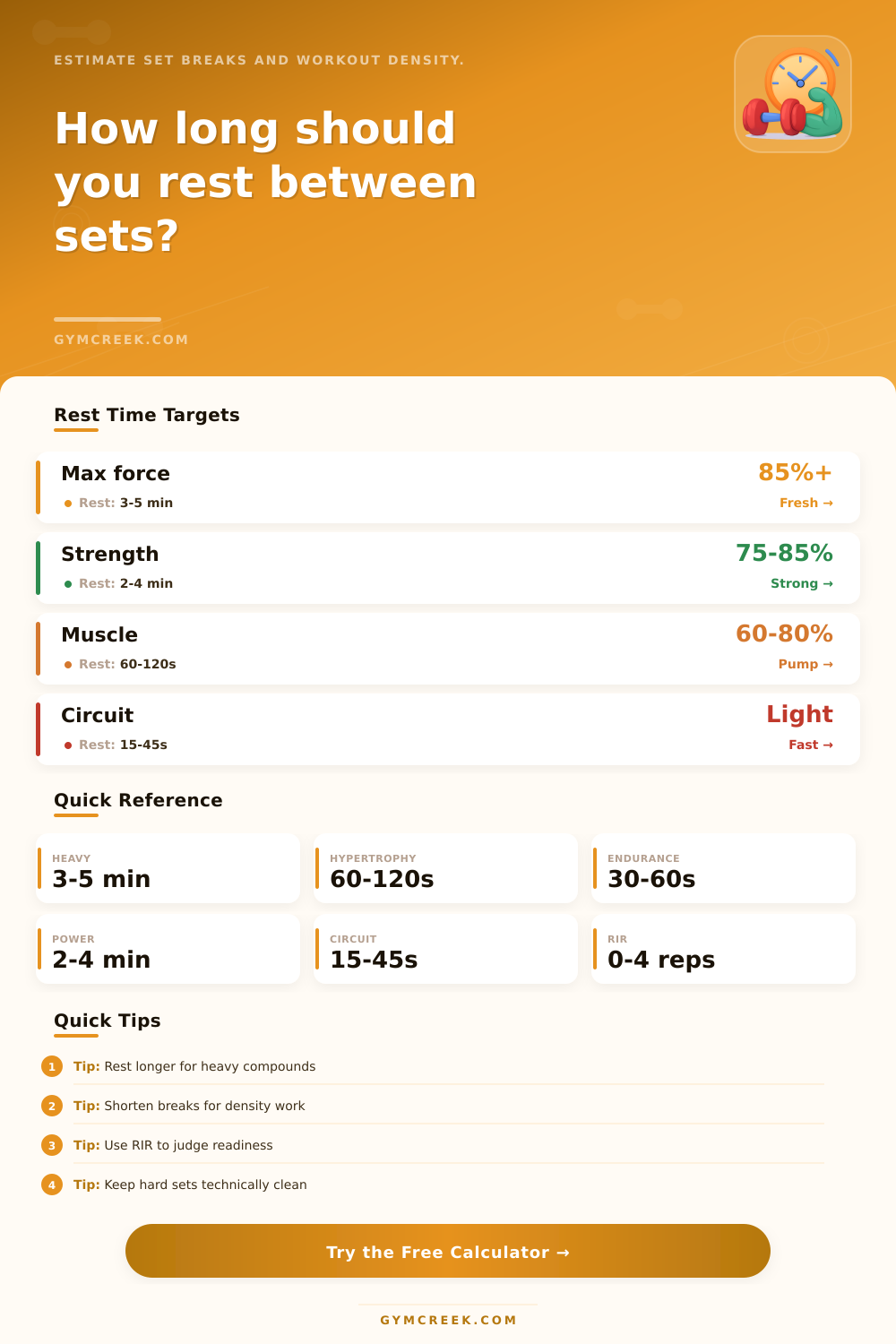
| Goal | Typical load | Rest range | Main priority |
|---|---|---|---|
| Max strength | 85% 1RM and up | 3 to 5 minutes | Force output and skill |
| Strength work | 75% to 85% 1RM | 2 to 4 minutes | Repeatable heavy sets |
| Hypertrophy | 60% to 80% 1RM | 60 to 120 seconds | Volume with quality reps |
| Endurance | Light to moderate | 30 to 60 seconds | Local fatigue tolerance |
| Conditioning | Mixed stations | 15 to 45 seconds | Density and breathing |
| Exercise type | Rest direction | Why it changes | Example |
|---|---|---|---|
| Heavy compound | Longer | High neural and bracing demand | Squat, deadlift |
| Olympic or power | Long quality rest | Speed must stay crisp | Clean, jump, throw |
| Compound accessory | Moderate | Systemic but less maximal | Row, press, lunge |
| Isolation | Shorter | Mostly local muscle fatigue | Curl, raise, extension |
| Circuit station | Shortest | Conditioning clock drives output | Sled, bike, carry |
| Cue | Green light | Yellow light | Red light |
|---|---|---|---|
| Technique | Bar path feels stable | Minor groove loss | Form breaks early |
| Breathing | Controlled nose or easy mouth breathing | Still elevated | Cannot brace or talk |
| Speed | Warm-up speed returns | Last rep slows | First rep is slow |
| RIR | Target reps remain | One rep under target | Failure risk rising |
| Output | Formula | Inputs | Use |
|---|---|---|---|
| Load percent | Working weight / 1RM | Load, 1RM | Intensity modifier |
| Set TUT | Reps x tempo seconds | Reps, tempo | Density estimate |
| Total rest | Rest x (sets - 1) | Sets, rest | Session planning |
| Readiness | 100 - fatigue penalties | RPE, RIR, rest | Next-set quality |
| Mifflin BMR | 10W + 6.25H - 5A +/- sex | kg, cm, age | Energy context |
💡Tips
Rest between sets is a topic that affects the quality of you workouts. Many people view the resting time between sets as time that is “dead.” The time between sets, however, can help you to reach your training goal. Taking too short of a break between sets will cause the quality of your workouts to drop.
Taking too long of a break between sets may also prevent you from feeling the stimulus from your workouts. Therefore, you must find the proper adjustment to the time between sets to allow your body to rest while still allowing you to reach your training goal. The amount of time to rest between sets need to change from workout to workout because not all exercises is the same.
How Long to Rest Between Sets
For instance, a back squat with heavy weights will take more recovery time than a set of bicep curls perform with dumb bells. This is due to the effect that the squat has on the nervous system of the body. The nervous system takes more time to recover than the muscles of the body.
Additionally, breathing pattern change with the type of workout performed so that breathing patterns after high repetitions of leg exercises may require a different amount of rest than breathing patterns after a power clean exercise. The calculator can determine the amount of time that you should take between sets once you have described your workouts. The calculator will first determine the training goal that you have established for yourself.
Based off the type of exercises that you will perform, the load that you will lift, and the amount of repetitions that you will perform, the calculator will determine the amount of time between sets. Furthermore, the calculator will also determine how much time you should allow for rest in relation to your schedule and your level of fatigue. In order to properly use the calculator, you must understand what each input mean.
Each workout has a goal, exercises of different types, loads to lift, number of repetitions, number of repetitions in reserve, level of effort, and experience level of the lifter. The two main outputs of the calculator will indicate the amount of time to rest between sets and the total amount of time that you will spend resting during your training session. Additionally, the readiness score and the density rating will allow you to understand whether your workouts will match the amount of time that you have to devote to training.
Many lifters may have developed their resting time between sets based upon the other lifters around them in the gym. These habits, however, may not be appropriate for your new training goal. For instance, if you are looking to build muscle, you may have rested for short period between sets.
For this same goal, however, short periods of rest may cause you to feel flat when performing a heavy deadlift. Therefore, the calculator helps to show lifters these different tradeoffs that they must make in order to reach their goal. Though the calculator takes into account your fatigue, your goal, and your schedule, there may be other factor to your training session that the calculator cannot take into account.
For instance, if your form or your speed with the lifting weights drop, it may be beneficial to take more rest time in order to allow your muscles to rest. Breathing recovery is another important factor in your workouts. Your breathing may be heavy after performing intense or high repetition exercises.
The breathing cue allow you to factor in breathing recovery in your time between sets. You may need to wait until breathing is returned to normal before beginning your next exercise or you may find that you can still complete your sets while working to return to normal breathing. The reference tables included in the calculator will provide you with an understanding of the workouts that may require more or less rest than others and the readiness cues that you can use before your workouts.
These tables are provided as a means of helping you to develop a feel for your workouts without having to constantly use the calculator. Instead of treating the amount of time between sets that the calculator calculates as a rule that you must follow, you can begin your workouts near the middle of that suggested time and adjust the rest periods as needed. If you can maintain your quality with the initial amount of time between sets, you can try to use the lower end of the time range for your next workout.
If your quality declines with the initial amount of time between sets, you may want to use the higher end of that calculated range to allow your body to rest enough to continue to perform at the same rate with which you began your workouts. Over several week you will begin to understand when you need to rest longer or shorter periods between sets. The same principle applies to your training schedule.
If you are on a more dense schedule, you may require a different amount of time between sets than if you were on a more relaxed schedule. By including your schedule in the calculation of the amount of time between sets, the calculator will allow you to adjust the time between sets so as to ensure that you have enough time to rest your muscles appropriately and your training schedule will still work with the time that you have available for training. In the article, you will find information that will allow you to manage the relationship between your workouts and the recovery of your muscles.
Therefore, the calculator allows you to manage the relationship between your workouts and your recovery so that you do not default to rest habits that do not work to help you achieve your goal.