Rest Pause Set Calculator
Plan an activation set, mini-set targets, rest intervals, volume load, density, and progression for one high-effort rest-pause cluster.
📌Rest-Pause Presets
Presets load practical rest-pause setups with different exercise risk, rest lengths, and progression rules.
⚙Calculator
Rest-pause set snapshot
Enter a load and mini-set plan to calculate the full cluster.
📊Fitness Metrics Comparison
📑Reference Tables
| Goal | Activation Set | Mini-Sets | Rest Target |
|---|---|---|---|
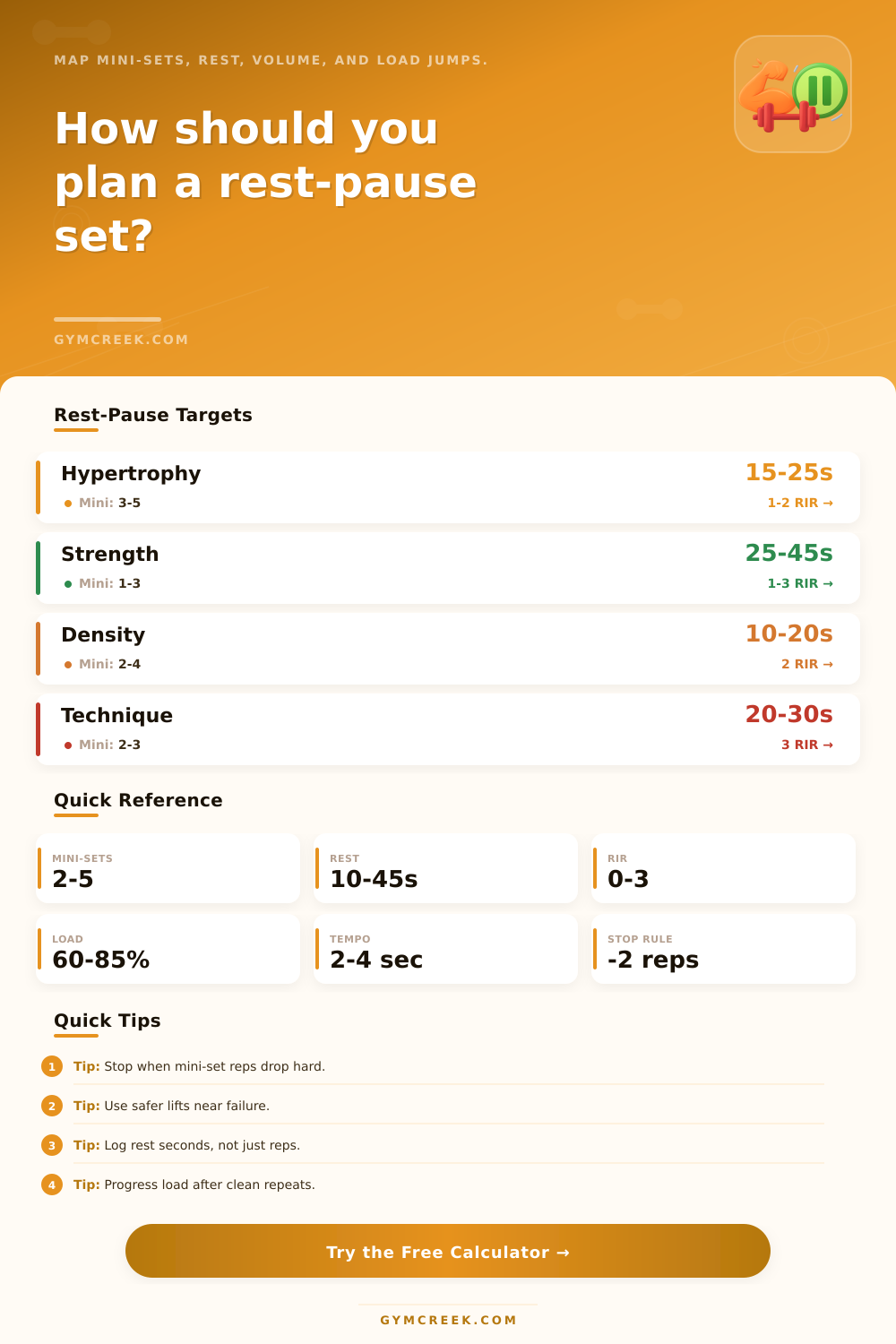
| Hypertrophy | 8-15 reps, 0-2 RIR | 2-5 x 3-5 reps | 15-25 sec |
| Strength practice | 4-8 reps, 1-3 RIR | 3-6 x 1-3 reps | 25-45 sec |
| Density challenge | 10-20 reps, 1-2 RIR | 3-6 x 2-4 reps | 10-20 sec |
| Technique retention | 6-10 reps, 2-3 RIR | 2-4 x 2-3 reps | 20-30 sec |
| Exercise Category | Best Fit | Risk Flag | Planning Note |
|---|---|---|---|
| Machine compound | Press, row, hack squat | Moderate | Good balance of effort and control. |
| Isolation | Raise, curl, pushdown | Low | Can tolerate shorter rests and higher reps. |
| Weighted bodyweight | Dip, chin-up | Moderate | Keep reps crisp; stop before form breaks. |
| Free-weight compound | Squat, bench, press | High | Use more RIR and fewer mini-sets. |
| Metric | How It Is Estimated | Useful Range | Watch For |
|---|---|---|---|
| Total reps | Activation + mini-set reps | 12-30 reps | Too much drop-off |
| Density | Total reps per minute | 6-14 reps/min | Rushing technique |
| Effective reps | Near-failure rep estimate | 8-20 reps | Failure on risky lifts |
| Fatigue score | Volume, rest, RIR, category | 40-85 | Poor recovery next session |
| Progress Rule | When To Use | Action | Example |
|---|---|---|---|
| Load jump | All reps clean at target RIR | Add planned jump | 185 to 190 lb |
| Rep match | Load feels heavy but stable | Repeat load, add 1 mini rep | 11+4+4+3 to 11+4+4+4 |
| Rest trim | Goal is density | Reduce rest 5 sec | 25 sec to 20 sec |
| Deload set | Form or recovery drops | Remove one mini-set | 4 mini-sets to 3 |
💡Tips
Rest-pause training involve performing an activation set of an exercise, performing bursts of additional repetition after periods of rest, and performing each of these mini-sets with short periods of rest. To perform rest-pause training, individuals must perform an initial set of the exercise to reach a high level of effort, take a period of rest to allow for the performance of additional sets of the exercise, and then perform each of those mini-sets with periods of rest in between each set. Rest-pause training allow for many sets of an exercise to be performed to the point of failure, but without having to perform one long set of the exercise.
For rest-pause training, an individual must decide how long to rest between mini-sets, how many mini-sets to perform, and when to stop performing rest-pause training session. In order to calculate the parameters of rest-pause training for an individual, mathematical calculation are performed with the information entered into the calculator. An individual must enter their working load, the number of activation set repetitions, the target number of mini-set repetitions, the number of mini-sets to be performed, and the rest interval between each mini-set.
How Rest-Pause Training Works and How to Use the Calculator
The length of the rest intervals will change the way in which the rest-pause training sessions are performed; short rest intervals will lead to density becoming the main focus of the sessions, while long rest intervals will lead to strength being the main focus. The number of mini-sets that the individual will perform will impact the amount of additional muscle group volume that will be load into the exercises. The drop-off rule will impact whether rest-pause training sessions will be stopped when the quality of the repetitions begin to decline or if the exercises begin to collapse.
Individuals can set the length of the rest intervals for rest-pause training according to how they feel after performing the exercise. However, setting rest intervals according to how an individual feel can lead to a lack of progress in their rest-pause training. Short rest intervals can lead to insufficient performance of the mini-sets in later sessions, while long rest intervals can lead to excessive training time without providing enough stimulus to the muscles to increase their size.
The calculator allow individuals to view the density in repetitions per minute that the individual will perform, as well as the total volume of the exercise. These parameters allow individuals to determine if the rest-pause training sessions will meet their specific training goal. The type of exercise that will be performed will impact the design of rest-pause training session.
For example, free weight compound exercises can be more likely to lead to injuries for individuals that are performing the exercises near failure, thus causing those types of exercise to have fewer mini-sets performed with a higher Reps in Reserve target. Isolation exercises and machine exercises have more stable forms for the exercises, thus allowing for shorter rest intervals between mini-sets. The calculator adjusts for the different types of exercise category in order to provide an estimate for whether rest-pause training is realistic for the exercise that the individual chooses.
Rest-pause training sessions incorporate the concept of progression, but often individuals ignore the rules for progression until they are no longer improving with the exercise. For instance, the calculator will only suggest a target weight for rest-pause training after the individual has successfully performed the rest-pause training with the set Reps in Reserve. If the individual begins to notice that the mini-sets are dropping off in quality during rest-pause training sessions, the calculator will suggest adding one to the number of repetitions for that exercise rather than increase the weight.
The calculator cannot account for variables in training sessions other than those suggested to the individual. For instance, the calculator does not account for the sleep of the individual performing the exercise, the pain of those individuals in performing the exercise, or the length of warm-ups for the individual. Thus, the estimates provided by the calculator are only targets for the individual to aim for during their rest-pause training sessions, and may differ from the actual sessions that the individuals perform.
One suggested habit for performing rest-pause training is to keep the load, rest interval, and number of repetitions for mini-sets to be the same for two or three sessions. By using this type of consistency in rest-pause training, the estimates provided by the calculator can be more reliable over time. If the estimates that are provided by the calculator match how the individual feels during their rest-pause training sessions, the individual will be able to determine how to progress.
If the estimates provided by the calculator do not match how the individual feels during their rest-pause training sessions, the difference between the estimate and the individual will reveal to the individual which aspect of their rest-pause training need to be changed.