Resistance Band Weight Calculator
Estimate effective resistance from band rating, stretch length, anchor setup, pull angle, reps, and body stats for cleaner band training logs.
📌Presets
Presets load common band setups and calculate immediately. For best accuracy, measure the band at the hardest point of the rep.
⚙Calculator
Band resistance estimate
Enter band rating and stretch length to estimate effective load.
📊Band Metrics
📑Reference Tables
| Stretch ratio | Meaning | Load note | Check |
|---|---|---|---|
| 1.0-1.25x | Near slack | Very light tension | May underload |
| 1.5x | Moderate stretch | About half of 2x rating | Good warm-up |
| 2.0x | Common rating point | Near listed resistance | Best baseline |
| 2.5-3.0x | High stretch | Fast rising tension | Inspect band |
| Setup | Path factor | Why it changes | Logging note |
|---|---|---|---|
| Single strand | 1x | One band section pulls | Use for handles |
| Doubled band | 2x | Two sections share load | Common door setup |
| Two bands | 2x | Parallel resistance | Add ratings |
| Folded loop | 4x | Four loaded sections | Very steep curve |
| Formula | Use | Equation | Limit |
|---|---|---|---|
| Hooke model | Band tension | Rating x stretch fraction | Approximate |
| Angle factor | Useful load | Load x sin(angle) | Needs same path |
| Epley estimate | Rep max context | Load x (1 + reps / 30) | Best under 15 reps |
| Mifflin BMR | Body context | Weight, height, age | Not a load formula |
| Exercise | Measure peak at | Angle target | Rep note |
|---|---|---|---|
| Row | Elbows back | 70-90 degrees | Pause peak |
| Press | Lockout | 75-90 degrees | Control return |
| Curl | Top third | 60-85 degrees | Avoid swing |
| Squat | Standing tall | 80-90 degrees | Track foot setup |
💡Tips
Resistance bands are training tools that may seem simple. However, resistance bands can create tension that is difficult to measure. Resistance bands will have a weight rating print on teh label.
However, the resistance that you apply will depend on how much you stretch the resistance band and on how you anchor it. Since how much the resistance band is stretched will determine the amount of tension created by a resistance band, the printed weight may not be the same as the actual weight that you are applying during your exercise. The tension created by resistance bands have a specific relationship with how much resistance bands are stretched.
How to find the real weight of your resistance band
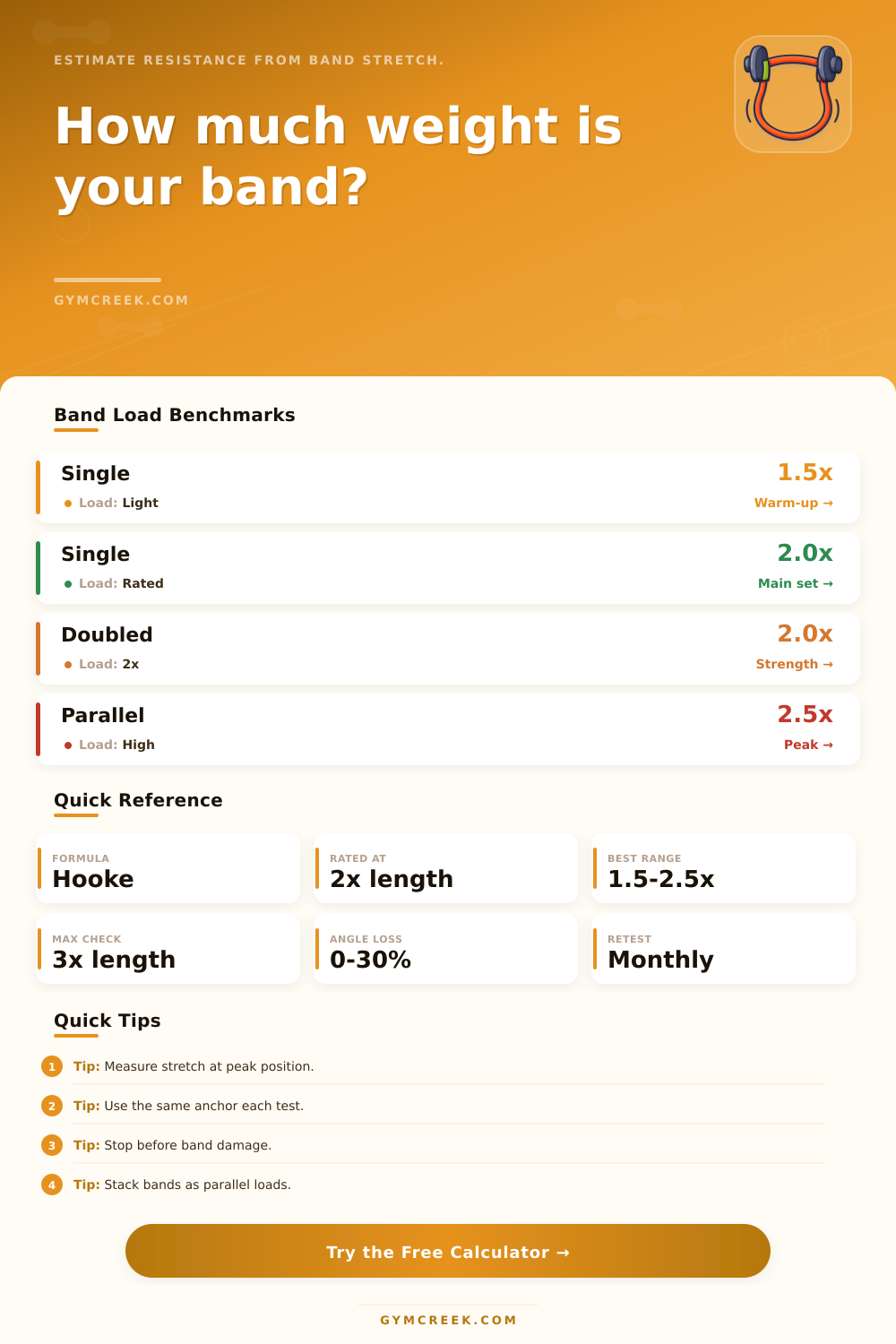
The weights that is printed on the resistance bands are based on a specific reference stretch for the resistance band. This reference stretch will be double the resting length of the resistance band. If you use the resistance band at one and a half times the resting length of the resistance band, you will be using less resistance than printed on the resistance band.
However, if you use the resistance band at two and a half times its resting length, you will be using more resistance than the rating printed on the resistance band. Thus, the weight that is printed on the resistance band will not be the same as the actual weight that you will feel from the resistance band. Your specific setup for the resistance band will also change the way that the resistance band function for you.
Using a single resistance band will allow you to anchor the resistance band on an object. Using a resistance band doubled around a door will allow for different tension than the single resistance band. Using multiple resistance bands will create the loads of each resistance band.
However, if they are stretched at an angle, you will lose some of the tension created by that resistance band. For example, if you apply the resistance band at a seventy-five-degree angle, you will lose some of the tension of that resistance band. The calculator included on this page will allow you to input the rating for your resistance band, the resting length of the resistance band, the stretch length of the resistance band, your specific tension setup with the resistance band, and the angle at which your resistance band is applied.
This will calculate for you the peak and average loads that you are applying into your exercise using the resistance band. The average load is a more important number to track than the peak load. This is because resistance bands create a resistance curve for you that allows for more resistance when you stretch the bands.
Thus, if your peak load is forty-two pounds, you are not applying the same resistance as if you used forty-two pound dumbbells. Your body weight can also play a role in your use of resistance bands. The weight of your body may create other tension in your muscles, which plays a role in the effect that the resistance band will have on your muscles.
If you are using a resistance band, your body weight will have an effect on your muscles response to that load. The body weight that you input into the calculator will allow you to calculate the percentage of your body weight that the load of the resistance band represents. This can be important for certain exercises so understanding the percentage of your body weight that the resistance band will represent can allow you to adjust your training for the best results for your body.
Another factor in the calculation of the tension created by a resistance band includes the temperature of the resistance band and its age. If the resistance band is very cold, it will create more tension when you stretch it than if the resistance band is warm. Additionally, if you use the same resistance band for multiple training sessions, that resistance band may lose some of its elasticity.
If you use resistance bands often, they will lose some of their elasticity with time. Thus, a resistance band may feel differently in July than it does in January due to age or temperature. Because resistance bands change over time, you should test your resistance band with the same object that you use to anchor the resistance band every few weeks.
Another mistake that many individuals make with resistance bands is that they will measure the resistance band at the wrong time. You may stretch the resistance band to your desired length and use it in your exercise. However, you may measure the length of the resistance band at the beginning of the exercise rather than at the point of peak stretch.
Thus, if you do not measure your resistance band correctly at the point of peak stretch, your calculations will not be accurate. The calculator also has features that will allow you to set the number of repetitions that you will perform in your exercise. For example, you may want to allow some repetitions in reserve to allow for proper resting of your muscles.
Thus, by adjusting this setting, you can adjust the peak load to reflect the actual experience that you had while performing your exercise. The same can be said for the setting that allows you to adjust the quality of your repetitions. The reference tables on this page will allow you to check your stretch ratios for your resistance band.
If your stretch ratio is below one point two five, you are using your resistance band near its resting length. If the stretch ratio is above two point five, you may be near the breaking point of the resistance band. The purpose of the calculator is to allow you to create a training record.
By using the same resistance band, with the same object of anchoring the resistance band, and with the same stretch for your resistance bands, you can ensure that the load that you are creating in your exercise is consistent. Using the same resistance band and stretch is more important than calculating the exact number of pounds that your resistance band applies. Resistance bands and barbells create different amounts of tension.
Thus, using your resistance band and setting its measurements at the beginning of your training block will allow for the best training record. Every few weeks, you can retest your resistance band to ensure that the tension that it creates remains the same. You should of used a more modern approach to this.
It’s important to note that many people dont understand how much tension they are actually applying. Using the wrong equipment can make it difficult to achieve goals. Most people finds it hard to be comfortabley consistent.
You might want to recieve more training tips on this. The results will be much better than before. Your going to see a difference.
Using the same equipment is better then switching every day. It helps to have a plan based off your previous sessions. You can use a single adult-sized sofa to anchor them if you need to, but be careful.
The furnitures in your home might get damaged. Just dont let it happen. Its a common mistake.