Reps From 1RM Calculator
Estimate likely reps from a known one-rep max, selected training load, formula choice, reps-in-reserve buffer, and fatigue setting.
📌Inverse Rep Presets
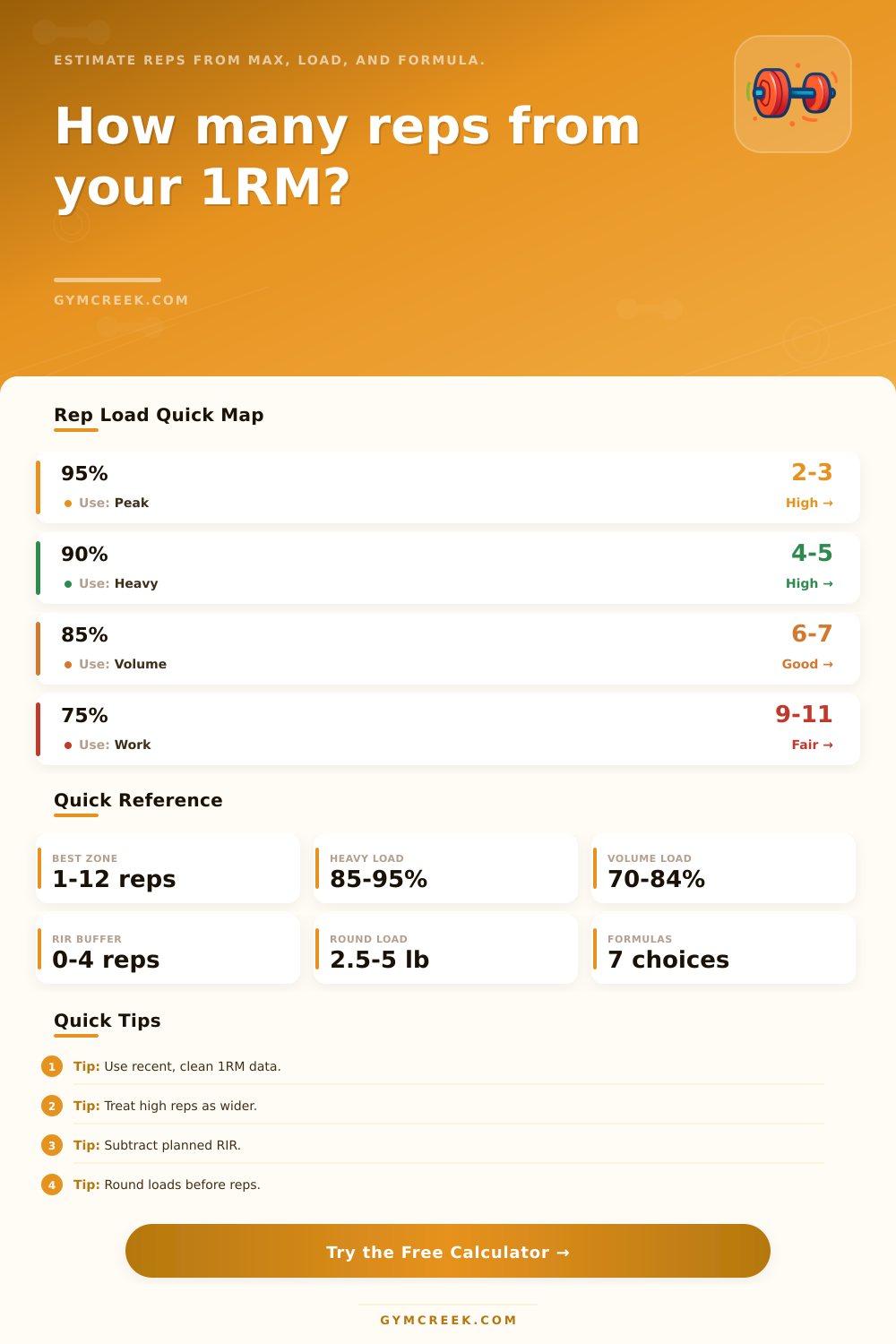
These presets start from a known max, then predict how many clean reps a selected load should produce after formula, readiness, and reserve adjustments.
⚙Calculator Inputs
Reps from 1RM snapshot
Enter a known max and chosen load to estimate likely clean reps.
📊Rep Estimate Metrics
📑Reference Tables
| Load percent | Typical reps | Best use | Reliability note |
|---|---|---|---|
| 97-100% | 1 rep | Max practice | Needs specific heavy skill |
| 92-96% | 2-3 reps | Heavy strength | High confidence if fresh |
| 86-91% | 4-6 reps | Top sets | Usually strong accuracy |
| 80-85% | 6-8 reps | Strength volume | Moderate fatigue effect |
| 70-79% | 8-12 reps | Volume work | Formula spread widens |
| 60-69% | 12-18 reps | Hypertrophy range | Endurance matters more |
| Formula | Inverse idea | Best range | Use when |
|---|---|---|---|
| Epley | 30 x (M/W - 1) | 2-10 reps | You want a common linear rule |
| Brzycki | 37 - 36W/M | 1-10 reps | You prefer conservative mid reps |
| Lander | (101.3 - 100W/M) / 2.67123 | 1-10 reps | You want a percent equation |
| Lombardi | (M/W) to the 10th power | 2-12 reps | You want a smooth power curve |
| Mayhew | Log based solve | 3-15 reps | You want higher-rep smoothing |
| Blend | Trimmed formula average | 2-12 reps | You want less formula noise |
| Adjustment | Effect | When applied | Planning note |
|---|---|---|---|
| RIR buffer | Subtracts planned reserve | Every estimate | Use 1-3 RIR for repeat sets |
| Fatigue setting | Adds or subtracts reps | After raw formula | Fresh days keep more reps |
| Lift context | Changes confidence | Large technical lifts | Deadlifts can vary more |
| Rep cap | Limits displayed reps | Light loads | Caps estimates past useful range |
| Rounding step | Changes target load | Before reps are solved | Small jumps matter near 90% |
| Scenario | Load style | Likely target | Why it matters |
|---|---|---|---|
| Bench 90% | Heavy percent | 4-5 reps | Good top-set planning |
| Squat 82% | Volume percent | 6-8 reps | Fatigue changes output |
| Deadlift triple | Very heavy | 2-3 reps | Confidence depends on skill |
| Metric bench | Exact kg load | Top set | Rounding shifts percent |
| Deload return | Lower load | Submax reps | Reserve keeps work repeatable |
💡Rep Planning Tips
A reps-from-1RM calculator are a tool that helps a person to determine how many repetitions a person can performs with a specific weight. The reps-from-1RM calculator require that the person input the one repetition maximum that a person can lift and the weight that a person desire to use during an exercise. Based off the one repetition maximum and the targeted load, the reps-from-1RM calculator can determine how many repetitions a person should be able to perform with that specific load.
The reps-from-1RM calculator provides a range of repetitions as a result because several different mathematical formula are utilized to calculate the number of repetitions that a person can perform. This range helps a person to understand the nature of the training session that they will perform. The accuracy of the reps-from-1RM calculator is dependent upon the accuracy of the one repetition maximum that is entered into the calculator.
How to use the reps-from-1RM calculator
A one repetition maximum that is performed long ago may not be accurate for the strength that a person has now. Thus, repetitions that is calculated based upon an outdated one repetition maximum will not necessarily match with the repetitions that a person can actualy perform. To avoid this discrepancy in the results, it is important for a person to ensure that the one repetition maximum that is entered into the reps-from-1RM calculator is both recent and specific to the exercise that the person intends to perform.
After a person has entered the one repetition maximum for an exercise, a person can select a target load for that exercise. A person can select a target load as a percentage of the one repetition maximum or it can be an exact weight. Due to the fact that a load may be rounded to the nearest plate increment for an exercise, the percentage of the one repetition maximum for that load may be slight changed.
The reps-from-1RM calculator account for this rounding of weights so that the predicted repetitions for that load will match the repetitions that a person is able to perform during that exercise. The reps-from-1RM calculator also provides a spread value for the calculations. The spread value indicates the difference between the various mathematical formulas that the reps-from-1RM calculator uses to calculate the number of repetitions that can be performed with a specific load.
A narrow spread between the various calculations indicates stability in the load that is being lifted. A wide spread between the calculations indicates that the number of repetitions for that load may change with changes in the readiness of the person to performs that exercise. Thus, a wide spread is useful in that it allows a person to know that the load that is to be performed is less stable than a load with a narrow spread between the mathematical calculations.
A person can adjust the number of repetitions that can be performed with a specific load by adjusting the number of repetitions in reserve and the fatigue level for that load. The number of repetitions in reserve is the number of repetitions that a person will perform without reaching total failure. By leaving repetitions in reserve, the number of repetitions that are performed will be less than the total possible repetitions for that load.
The level of fatigue for a given exercise can also impact the number of repetitions that can be performed. For example, if a person is well recovered, the fatigue level will be low for that exercise, and more repetitions may be performed. In contrast, if a person is tired, the fatigue level will be high, and fewer repetitions will be performed.
The reps-from-1RM calculator can produce different levels of accuracy with the target load. For example, loads that are closer to the one repetition maximum will have more accuracy than loads that are lighter than the one repetition maximum. For example, percentages of the one repetition maximum of 92% will produce more accurate repetitions than percentages of 70% of the one repetition maximum.
Thus, a person may find it easier to perform repetitions with loads that are more closer to the one repetition maximum than with loads that is lighter. Other factor to consider besides the reps-from-1RM calculator that can impact the repetitions that are performed are the body weight and experience level in performing the specific exercise. For instance, an athlete that has a great deal of experience may have the strength and readiness to perform the repetitions at the higher end of the reps-from-1RM calculator.
In contrast, a person returning from a layoff may have less strength in performing the exercise and may have to perform the repetitions at the lower end of the reps-from-1RM calculator. Thus, while the reps-from-1RM calculator does not change its mathematical calculation according to the experience level of the person entering the calculations, the experience level is a factor that should of be considered in the use of the calculator. Finally, the main purpose of using the reps-from-1RM calculator is to help a person to ensure that the load, repetitions in reserve and fatigue level are aligned with the strength and readiness of the individual.
If a person does not take the time to ensure that these factors are aligned with one another, the person may attempt to either perform a load that is too heavy or too light for the individuals strength. Thus, the reps-from-1RM calculator is a helpful tool for determining if a person is ready to perform the indicated load and for planning that training session.