REM Sleep Calculator
Estimate REM minutes, REM percentage, completed sleep cycles, REM deficit, and a recovery flag from your nightly sleep pattern.
📌REM Presets
Each preset fills total sleep, sleep latency, awakenings, age, stimulant flag, sleep timing, stress, and wake time, then calculates the REM estimate.
⚙Calculator
REM sleep estimate
Enter your night details to estimate REM amount, percentage, cycle count, deficit, and recovery status.
📊REM Metrics Grid
📑REM Reference Tables
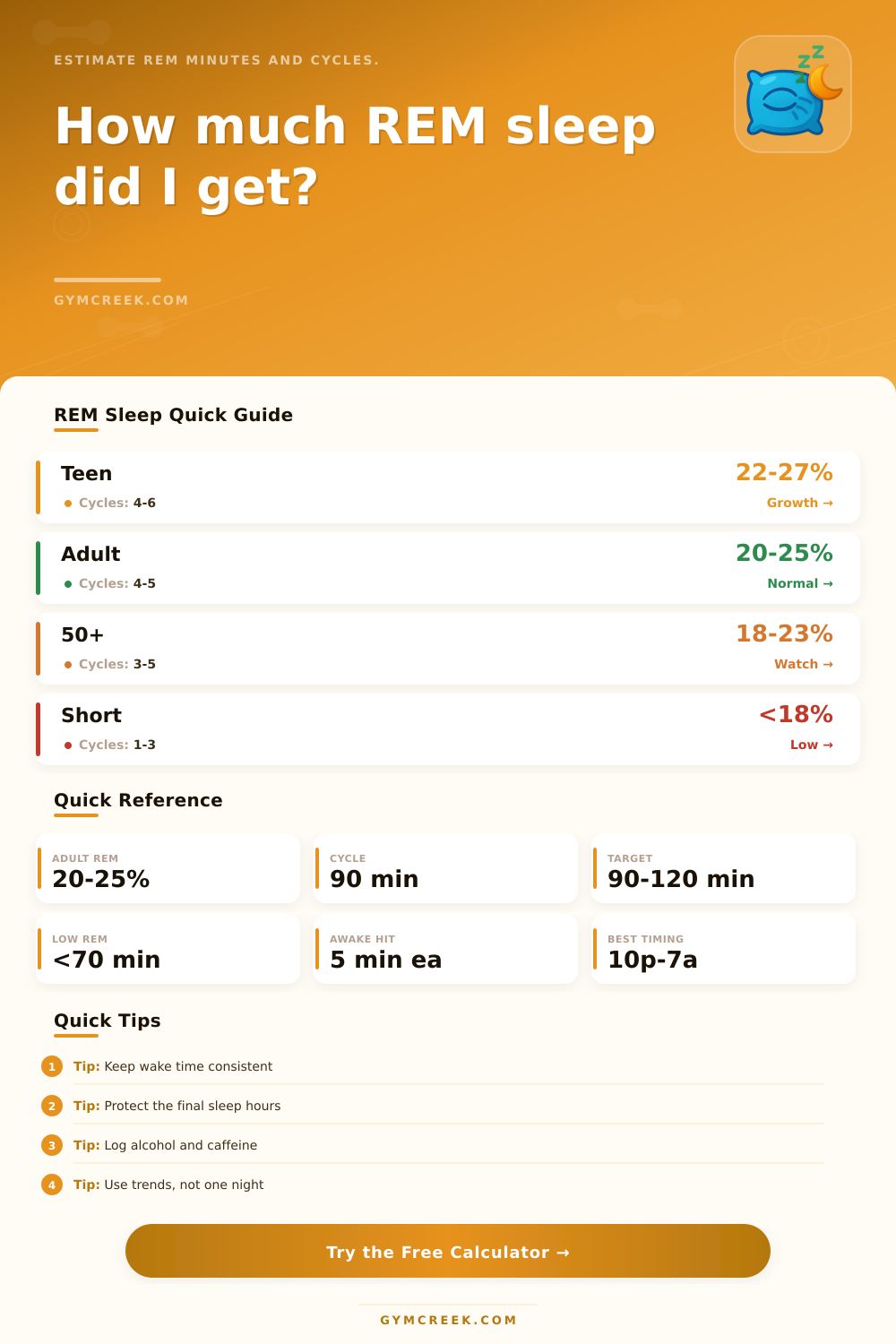
| Age group | Typical REM share | 7.5 hour target | Interpretation |
|---|---|---|---|
| Teen | 22% to 27% | 99 to 122 min | Growth and learning needs are often higher |
| Young adult | 21% to 26% | 95 to 117 min | Common high-normal REM range |
| Adult | 20% to 25% | 90 to 113 min | Most general adult estimates fall here |
| Older adult | 18% to 23% | 81 to 104 min | Lighter sleep and more wakes are common |
| Sleep factor | REM adjustment | Why it matters | Calculator use |
|---|---|---|---|
| Sleep latency | Subtracts wake time | Less true sleep leaves fewer REM opportunities | Latency is removed from total sleep |
| Awakenings | About 5 minutes each | Fragmentation can interrupt REM periods | Continuity penalty is applied |
| Alcohol | Moderate REM penalty | Evening alcohol can suppress or fragment REM | Flag reduces the REM estimate |
| Late caffeine | Mild to moderate penalty | Stimulants may delay sleep and increase arousal | Flag reduces the REM estimate |
| Timing pattern | Timing score | REM note | Typical flag |
|---|---|---|---|
| Aligned night sleep | 92 to 100 | Best chance to protect late REM | Good |
| Late bedtime | 78 to 90 | May shorten the final REM-rich window | Watch |
| Irregular schedule | 65 to 82 | Body clock mismatch can reduce quality | Caution |
| Shift or daytime sleep | 55 to 75 | Circadian mismatch may reduce REM efficiency | Caution |
| Recovery flag | REM deficit | REM percentage | Meaning |
|---|---|---|---|
| Recovered | 0 to 10 min | At target | REM estimate is close to nightly need |
| Monitor | 11 to 25 min | Slightly low | One night is not alarming, watch the trend |
| Rebuild | 26 to 45 min | Low | Prioritize longer, steadier sleep next night |
| High deficit | 46+ min | Very low | Consider stress, timing, substances, or illness |
💡REM Tips
REM sleep occur most frequently during the final third of a sleep period. During REM sleep is the stage of sleep that is most importance for memory consolidation and emotional processing. Because REM sleep occurs mostly during the final third of the sleep period, it is common for those who is mentally foggy upon waking to have had their sleep period cut short during those final hours of sleep.
The total amount of REM sleep that an individual receive is dependent on factors beyond sleep duration alone, such as when they begin to sleep, how often they are awakened during the night, and what substances they consumes while sleeping. The calculator provide a mathematical estimate of the amount of REM sleep that an adult should get based off the information that they provide to the calculator. Such information includes total sleep time, sleep latency, and the number of times that an individual awaken during the night.
How to Get Enough REM Sleep
Every minute that an individual takes to fall asleep represents a minute that their body does not get to enter REM sleep. The same is true for every time that they awaken during the night. Even five minute of sleeping awakenings may sound like a small amount of sleep, but if an individual awakens several times during the night, those minutes will begin to add up to a reduced amount of sleep cycle during which their REM sleep will occur.
Age is one of the factors that can impact the amount of REM sleep that an individual receives while sleeping; the calculator allow for individuals to select their age to ensure that the calculator adjusts the target amount of REM sleep that they should receive. Those between the ages of thirteen and twenty are likely to receive more REM sleep due to the learning connection that are being made in the brains of those young adults. However, adults receive less REM sleep than those younger adults, and the amount decreases with age.
Stress is another factor that can affect the amount of REM sleep that an individual gets; high levels of stress can cause individuals to receive more light sleep and to not experience sleep cycle that are as continuous as adults during sleep. Thus, seven hours of sleep for an individual with high level of stress may result in less REM sleep than would occur for an individual who is not stressed during the sleep period. Alcohol and caffeine are two substances that can alter the architecture of an individuals sleep period.
Alcohol may make it easier for an individual to fall asleep, but alcohol can reduce the amount of REM sleep that an individual has during the later portion of their sleep period. Caffeine has the same effect, even if those taking caffeine do not feel that the substance is keeping them awake during the night. The timing of the sleep period that an individual sleeps in is another factor that can affect REM sleep; if an individuals sleep period is irregular, they may not be able to experience sleep cycle during which they can acquire the required amount of REM sleep prior to waking up to their alarm.
These factor are combined in the calculator in order to provide an indication of how an individuals sleep cycle may impact their REM sleep. The calculator will indicate whether or not the sleep period that the individual entered has permitted them to receive enough REM sleep to meet the target amount for their age and their circumstance. If the result that is provided is close to the target amount for REM sleep, it indicates that their sleep schedule and routine is supporting their sleep need.
However, if there is a significant gap between their result and their target, it is likely that a factor in their sleep routine, such as stress, the consumption of stimulant, or sleep schedule is reducing their ability to experience enough REM sleep. The reference tables located on the calculator indicate the amount of REM sleep that individuals of different age group can receive and how different sleep disruptors can impact their sleep amounts; these table can help to indicate whether or not the individual needs to take any action according to the results of the calculator. One of the suggestion for improving an individuals REM sleep is to ensure that their wake time is consistent in the morning, even if their bedtime changes.
This is beneficial for protecting the later portion of an individuals sleep cycle, as it will permit their body to retain more REM sleep than if they attempted to add more sleep to the early portion of their sleeping period. While the calculator is not a replacement for the studies that could be performed on sleep or sleep trackers that could be used to monitor their sleep, the calculator does provide an indication of how their routine may impact their sleep. An individual should observe their sleep routine over several weeks to accurately determine whether or not their sleep schedule needs to be changed.
The sleep schedule for an individual over several weeks will help to indicate the cause of any shortfall in their REM sleep; the inputs that an individual provides to the calculator will indicate any potential cause of the shortfalls in their sleep. These cause may be related to the timing with which they consume alcohol, their management of stress in their lives, or when they begin to sleep. Although the calculator provides one data point regarding the amount of REM sleep that an individual may be getting, it is recommended that the individual use this data point in conjunction with information from the individual itself to provide an accurate indication of how well they is sleeping.