Relative Squat Calculator
Estimate a squat 1RM or enter a known max, then compare your squat-to-bodyweight ratio with practical standards that account for sex category, age range, experience, stance, and equipment.
📌Relative Squat Presets
Presets load real squat contexts, not generic strength profiles. Use them to see how a ratio changes when stance, equipment, age, and test style change.
⚙Calculator Inputs
Relative squat snapshot
Enter your bodyweight, squat load, reps or max, and testing context to compare your squat ratio.
📊Squat Metrics Grid
📑Reference Tables
| Band | Female ratio | Male ratio | Open ratio |
|---|---|---|---|
| Developing | Under 0.75x | Under 1.00x | Under 0.90x |
| Novice base | 0.75x to 1.05x | 1.00x to 1.35x | 0.90x to 1.20x |
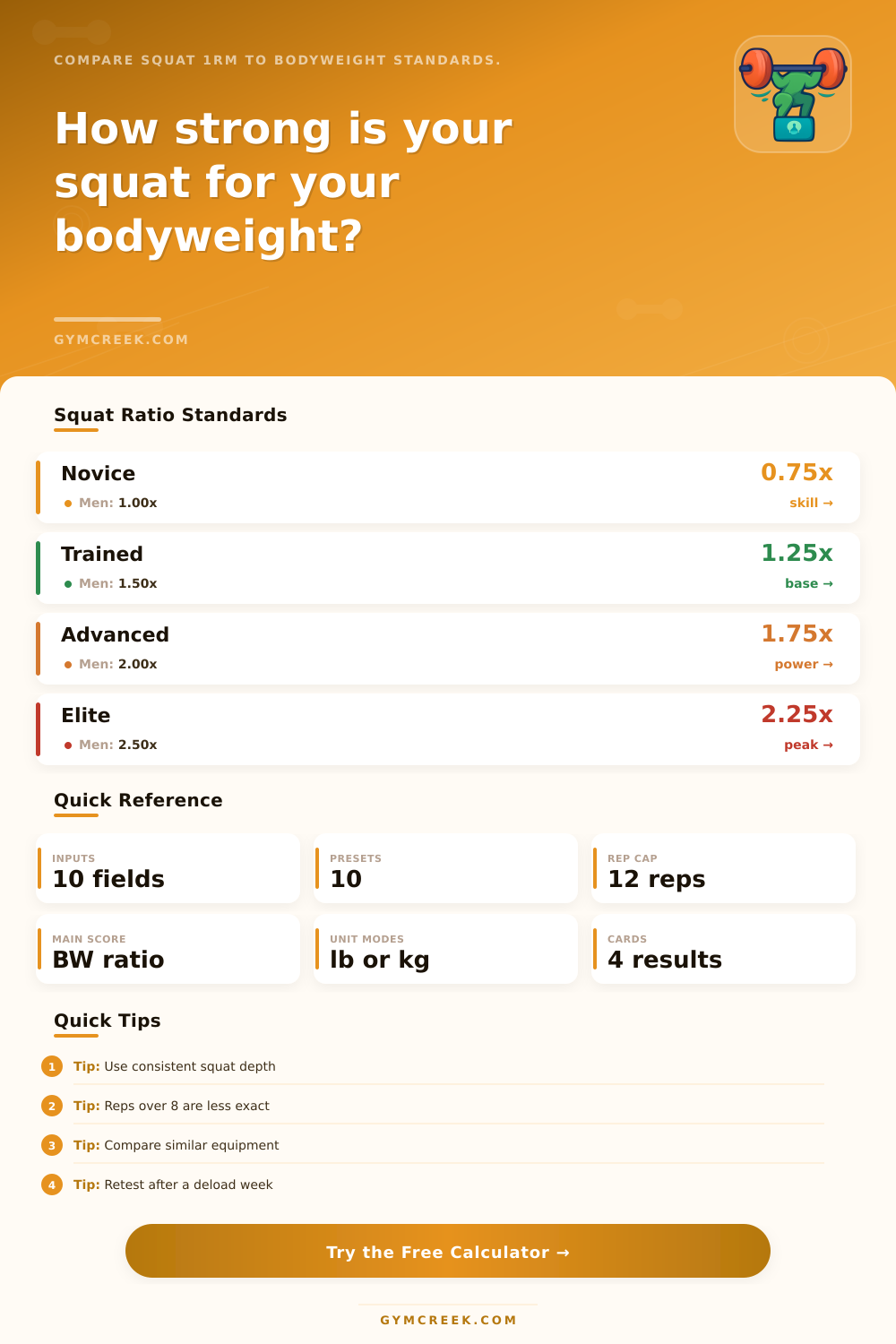
| Trained | 1.05x to 1.45x | 1.35x to 1.75x | 1.20x to 1.60x |
| Advanced | 1.45x to 1.90x | 1.75x to 2.25x | 1.60x to 2.05x |
| Elite context | Over 1.90x | Over 2.25x | Over 2.05x |
| Context | Calculator adjustment | Why it matters | Comparison caution |
|---|---|---|---|
| High-bar raw squat | Baseline | Common gym and sport-strength reference | Still depends on depth and torso proportions |
| Low-bar back squat | Style context slightly reduced | Low-bar mechanics often allow more load | Compare with similar low-bar technique |
| Front squat | Style context increased | Front squats are usually lighter than back squats | Do not compare directly to back squat tables |
| Knee wraps | Equipment context reduced | Wraps can add rebound and overload | Track a separate wrapped PR column |
| Partial or uncertain depth | Confidence reduced | Shortened range can inflate the load | Use consistent depth before ranking |
| Formula | Calculator use | Best rep range | Notes |
|---|---|---|---|
| Epley | 1RM = weight x (1 + reps / 30) | 1 to 10 reps | Smooth, common, and stable for squat estimates |
| Brzycki | 1RM = weight x 36 / (37 - reps) | 1 to 8 reps | Often a little stricter near moderate reps |
| Blended estimate | Average of Epley and Brzycki | 2 to 10 reps | Main estimate when reps are entered |
| Known 1RM | Uses entered load directly | 1 rep | Best when the lift meets your chosen depth standard |
| Training max | 90 percent of estimated 1RM | Program planning | Shown as context, not a workout prescription |
| Scenario | Typical ratio | What it usually means | Useful next check |
|---|---|---|---|
| New lifter learning depth | 0.50x to 0.90x | Technique and consistency may matter more than load | Video depth and bracing consistency |
| General gym strength base | 1.00x to 1.50x | Bodyweight squat is established and progress is trackable | Repeat same stance every test |
| Trained lower-body focus | 1.50x to 2.00x | Squat is a meaningful strength skill, not a casual lift | Compare similar equipment standards |
| Competitive raw squat | 2.00x and above | Strong relative result for many bodyweights | Use judged depth and meet-style commands |
| Front squat specialist | Lower raw ratio | Upright torso and upper-back demand limit load | Compare to front-squat history only |
💡Squat Calculation Notes
A relative squat calculator are a tool that allows you to compare your squat strength to your bodyweight. The only measure of strength dont provide an accurate representation of your strength. To determine your true skill level in squatting, you must compare your strength to your bodyweight.
The relative squat calculator will give you numbers that will show your strength level without guesswork. Bodyweight is one of the primary factor in calculating your relative squat strength. You must enter your bodyweight for the relative squat calculator to provide an accurate calculation of your relative squat strength.
How a Relative Squat Calculator Works
For example, a person who weigh 200 pounds and can squat 300 pounds will have a different relative squat strength than a person who weighs 140 pounds and can also squat 300 pounds. The 200-pounder has a relative squat strength of 1.5 time there bodyweight whereas the 140-pounder has a relative squat strength of more than 2 times their bodyweight. These different relative squat strength will place them in different category on a strength chart.
The relative squat calculator will tell you where you lie in terms of strength by entering your bodyweight and squat weight. Your experience level and your age can impact the reading of your relative squat strength. A new lifter may have a lower relative squat strength since they are still learning how to perform a squat proper.
However, with dedication to learning how to squat proper, a new lifter can improve their relative squat strength. A returning lifter may have a lower relative squat strength because of fatigue or loss of coordination in performing a squat. However, by entering your experience level in the relative squat calculator, the tool will provide you with a more accurate reading of your relative squat strength.
Your age also impacts the interpretation of your relative squat strength. The relative squat strength of an athlete peak between their late twenties and late thirties before declining with age. Therefore, the relative squat calculator takes into account your age so that you do not compare your later performances with those of a younger athlete.
The style in which you perform your squat and the squat equipment you use will alter the amount of weight that you are able to lift. Therefore, you must enter these factors into the relative squat calculator. For example, a low-bar squat allow for the lifting of more weight than a high-bar squat.
Additionally, the use of lifting belts or knee wraps can allow for lifting of more weight during a squat than if those pieces of equipment isnt utilized. A front squat allow for lifting of less weight than if an individual was performing a back squat. Therefore, you must enter the squat style into the relative squat calculator.
Additionally, the depth of the squat can also alter the strength ratio of an individual. An individual who performs a partial squat or a box squat can lift more weight than an individual who perform a full squat. Therefore, the relative squat calculator accounts for these variable.
A relative squat calculator use reference tables to compare your relative squat strength with other individuals. These tables use an individual’s sex, age, and relative squat strength to indicate the different category that an individual falls into. For example, if an individual reach the trained category, it indicates that the individual has developed a base of strength.
Additionally, the relative squat calculator can determine the strength required to reach the next category, allowing an individual to determine their future training requirement. The relative squat calculator use mathematical formulas to calculate your one-rep max based on the number of repetition you performed. You can use the Epley equation and the Brzycki equation to calculate an individual’s one-rep max. The relative squat calculator software average those two calculations to arrive at a number for an individual’s one-rep max. Because these equations are estimate of one’s one-rep max, the relative squat calculator also provides a confidence score for the result.
For example, if the individual performed the squat with high repetition, had an uncertain depth, or is a returning lifter, the confidence score will be lower due to the impact these variable can have on an individual’s one-rep max.
There are many variable that can impact an individual’s strength on any given day that the relative squat calculator does not account for. An individual’s sleep cycle, stress level, body weight, limb length, and previous injury can all have an impact on their squat strength. While these variable may impact the accuracy of the relative squat strength ratio, they dont make the tool useless.
It is simply one data point in measuring an individual’s strength over a period of time. To get the best results from a relative squat calculator, perform your squats in the same manner each time you calculate your relative squat strength. Your squat stance, the depth in which you perform your squat, and the squat equipment that you use should all be the same when you calculate your relative squat strength with the relative squat calculator.
By using the same parameter for all of your squat calculations, your relative squat strength ratio will be a trend line that accurately reflect your squat strength over time. Additionally, the relative squat calculator allow you to determine if your training effort are producing the results that you want in terms of your relative squat strength.