Relative Deadlift Calculator
Estimate your deadlift 1RM, compare it to body weight, identify a relative strength tier, and see the next target with stance, straps, and bar type context.
📌Deadlift Presets
Presets load body weight, deadlift weight, reps, sex, stance, straps, bar type, and formula. Edit any field to recalculate instantly.
⚙Calculator Inputs
Relative deadlift snapshot
Enter body weight, deadlift load, reps, and equipment details to calculate your ratio.
📊Metrics Grid
📑Deadlift Standards Tables
| Stance context | Beginner | Novice | Intermediate | Advanced | Elite |
|---|---|---|---|---|---|
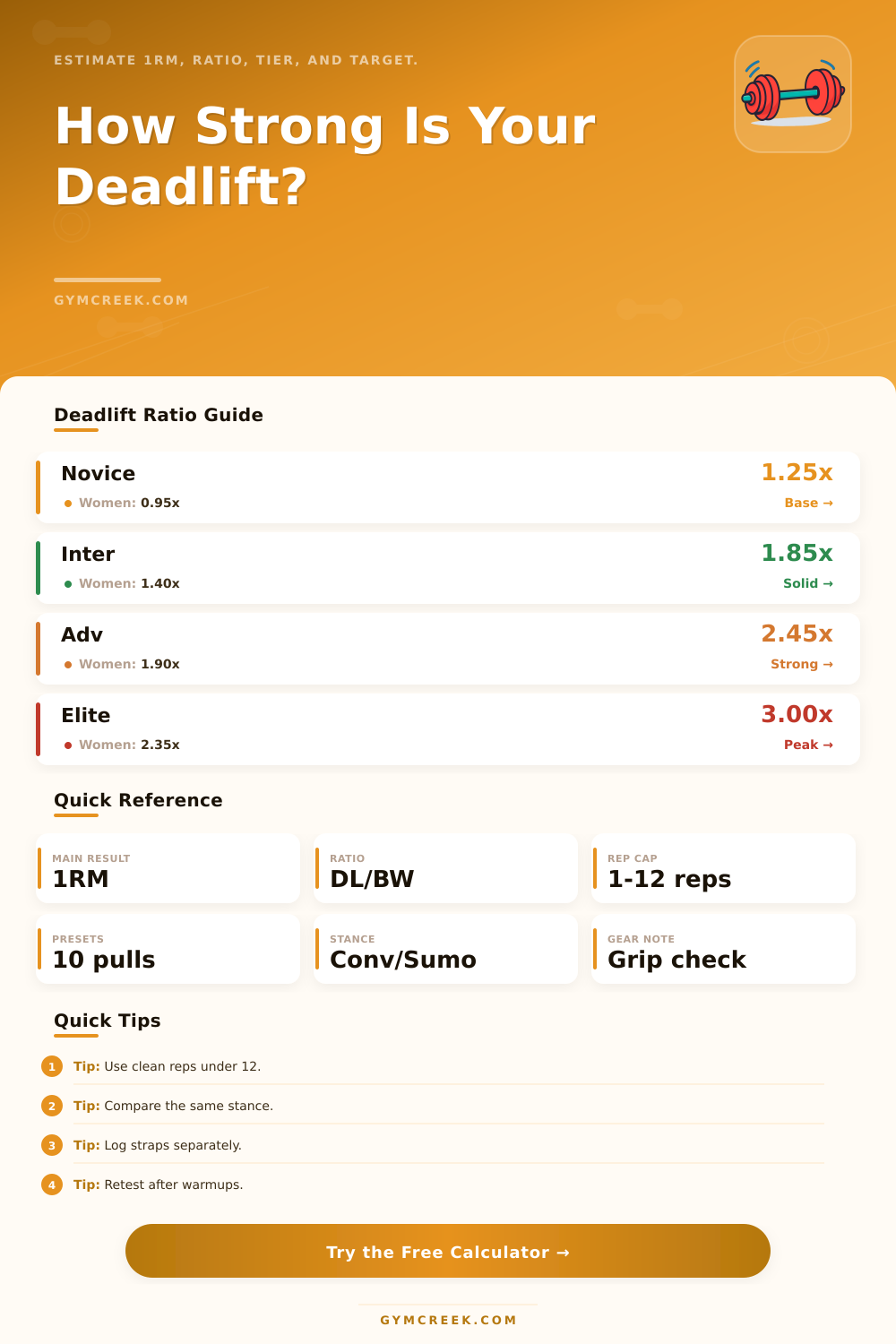
| Conventional or stiff bar | 1.00x | 1.25x | 1.85x | 2.45x | 3.00x |
| Sumo or hybrid | 1.00x | 1.25x | 1.85x | 2.45x | 3.00x |
| Trap bar, high handle | 1.10x | 1.40x | 2.00x | 2.60x | 3.15x |
| Romanian or deficit | 0.75x | 1.00x | 1.45x | 1.90x | 2.35x |
| Stance context | Beginner | Novice | Intermediate | Advanced | Elite |
|---|---|---|---|---|---|
| Conventional or stiff bar | 0.70x | 0.95x | 1.40x | 1.90x | 2.35x |
| Sumo or hybrid | 0.70x | 0.95x | 1.40x | 1.90x | 2.35x |
| Trap bar, high handle | 0.80x | 1.10x | 1.55x | 2.05x | 2.50x |
| Romanian or deficit | 0.50x | 0.75x | 1.05x | 1.45x | 1.80x |
| Formula | Equation | Best rep range | Deadlift note |
|---|---|---|---|
| Epley | Weight x (1 + reps / 30) | 1 to 10 reps | Common and slightly generous at higher reps |
| Brzycki | Weight x 36 / (37 - reps) | 1 to 10 reps | Often conservative near 8 to 10 reps |
| Lombardi | Weight x reps ^ 0.10 | 3 to 12 reps | Smooth estimate for rep work |
| O'Conner | Weight x (1 + reps / 40) | 1 to 8 reps | Conservative for deadlift AMRAP sets |
| Mayhew | 100 x weight / (52.2 + 41.9e^-0.055r) | 2 to 10 reps | Included in the average option |
| Input | Calculator treatment | Best comparison | Watch point |
|---|---|---|---|
| No straps | Raw grip note | Powerlifting-style pulls | Grip may limit high-rep sets |
| Mixed or hook grip | Raw-equivalent note | Heavy singles and triples | Use the same grip each test |
| Lifting straps | Strapped note, no 1RM reduction | Training pulls and volume | Log separately from raw grip PRs |
| Deadlift bar | 0.98 comparison factor | Compare to deadlift-bar history | Whip can change the start |
| Trap bar | 0.92 comparison factor | Compare to trap-bar history | High handles shorten range of motion |
| Axle bar | 1.04 comparison factor | Grip-strength context | Grip makes ratios harder to compare |
💡Deadlift Tips
The strength of a persons deadlift can be best understood through the use of a deadlift ratio. A deadlift ratio is more useful than a simple number that represent the total weight that can be lifted because a ratio takes into consideration the weight of the individual. A person that can lift 405 pounds that weighs 220 pounds have a different level of strength than another individual that can also lift 405 pounds but weighs only 160 pounds.
An individuals body weight can change throughout their deadlift career. As a result, one has to judge an individuals deadlift strength according to changes in their body weight. If an individual gain 15 pounds in body weight but their deadlift does not change, that individual has lost relative strength.
How to Use a Deadlift Ratio to Measure Strength
Conversely, if an individual loses body weight but their deadlift strength does not change, then the individual has gained relative strength. An individual can use calculators to calculate these figures by entering an individuals body weight, the weight that they lifted, and the number of repetitions that they perform. The calculator will compare an individuals one-repetition maximum to standards according to the individuals sex and deadlift stance.
An individuals stance for performing a deadlift can change the number of points that is earned for that individual according to there standing. Deadlifts can be performed in a sumo stance, a conventional stance, or in a trap-bar stance. Each of these stances have slightly different requirements for the individual, and as a result, their deadlift ratio should be adjusted according to the stance that they use when lifting the weights.
For instance, an individual using a trap-bar deadlift can stand on a high handle that shortens the range of motion for that individual. A shorter range of motion allow an individual to use more of their strength to lift a heavier load. By contrast, a deficit deadlift increases an individuals range of motion, thus requiring them to use more of their deadlift strength to lift the same load.
The calculator will record the stance that an individual use when performing their deadlift. Beyond stance, other equipment used in a deadlift can change the number of points earned according to that individual. For instance, if an individual use lifting straps when performing a deadlift, that individual eliminates the limitation of their grip strength.
A deadlift performed with lifting straps is, therefore, not the same as a deadlift performed with only a hook grip. Additionally, a deadlift bar has more whip then a standard bar. An axle bar require the individual to have a strong grip, thus increasing the difficulty of the lift.
The individual should log any equipment used during a deadlift by using the calculator that determines their deadlift ratio. Otherwise, attempting to compare a deadlift performed with lifting straps to a deadlift performed with no lifting straps can create incorrect conclusion regarding the individuals strength. Calculators use a variety of formulas to calculate an individuals deadlift strength.
Most individuals perform deadlifts in sets of three to eight repetitions. Each formula make different assumptions about an individual and their strength to perform a deadlift. By using a variety of these formulas, the calculator can more accurately smooth out an individuals data.
Smoothing out an individuals data will result in a more accurate estimation of their deadlift strength. Thus, the result of a calculator is an estimate of an individuals deadlift strength, but that estimate will be more reliable if a variety of formulas are used instead of just one single formula. The standards tables use tiers to make an individuals deadlift ratio actionable.
For instance, an individual will move from the novice to intermediate tier after learning to perform the deadlift correctly. An individual will move from the intermediate to the advanced tier with increased mastery of their strength to perform the exercise correctly. Ranks and tiers beyond the advanced tier are only established for elite deadlifters, indicating that the ratios required to reach these levels require specific leverages and genetics from that individual.
An individual can use their current tier to identify their goal for the next training period, as this is more effective than attempting to deadlift a specific number of pounds. Despite the usefulness of the deadlift ratio, there are some mistakes that can be made in testing an individuals deadlift strength. For instance, it is incorrect to perform a deadlift if an individual have not fully recovered from their previous sets of deadlifts.
Additionally, it is incorrect to change the stance that an individual uses for their deadlift between tests. Performing twelve repetition sets of deadlifts is less certain as a test of strength than performing sets of three repetition deadlifts, as both deadlift endurance and grip strength can wear down during the performance of such sets. An individual should only retest their deadlift if their warm-up sets for deadlifts feel fastly.
Otherwise, retesting their deadlift could indicate that their ratio is declining in strength. An individuals deadlift ratio can be used to make training decisions. For instance, if the calculator indicate that the individual is near the top of their current tier for deadlift strength, then they can adjust their training program to focus upon increasing that individuals ability to reach the next strength tier.
If the individuals deadlift ratio decreases after they lose weight, the calculator will indicate the number of pounds that the individual will have to lift to regain their previous level of deadlift strength. Thus, making small adjustments to an individuals strength according to the calculator over many months is more effective than simply attempting to lift more deadlift weights altogether.