Relative Bench Press Calculator
Estimate your bench press 1RM, compare it to body weight, classify a relative strength tier, choose the next target, and see a percentile-like band from a recent bench set.
📌Bench Press Presets
Presets load common bench situations. Edit the load, reps, body weight, formula, and rep standard to match your actual recent set.
⚙Calculator Inputs
Relative bench snapshot
Enter a recent bench set to estimate relative strength.
📊Bench Metrics Grid
📑Bench Standards Tables
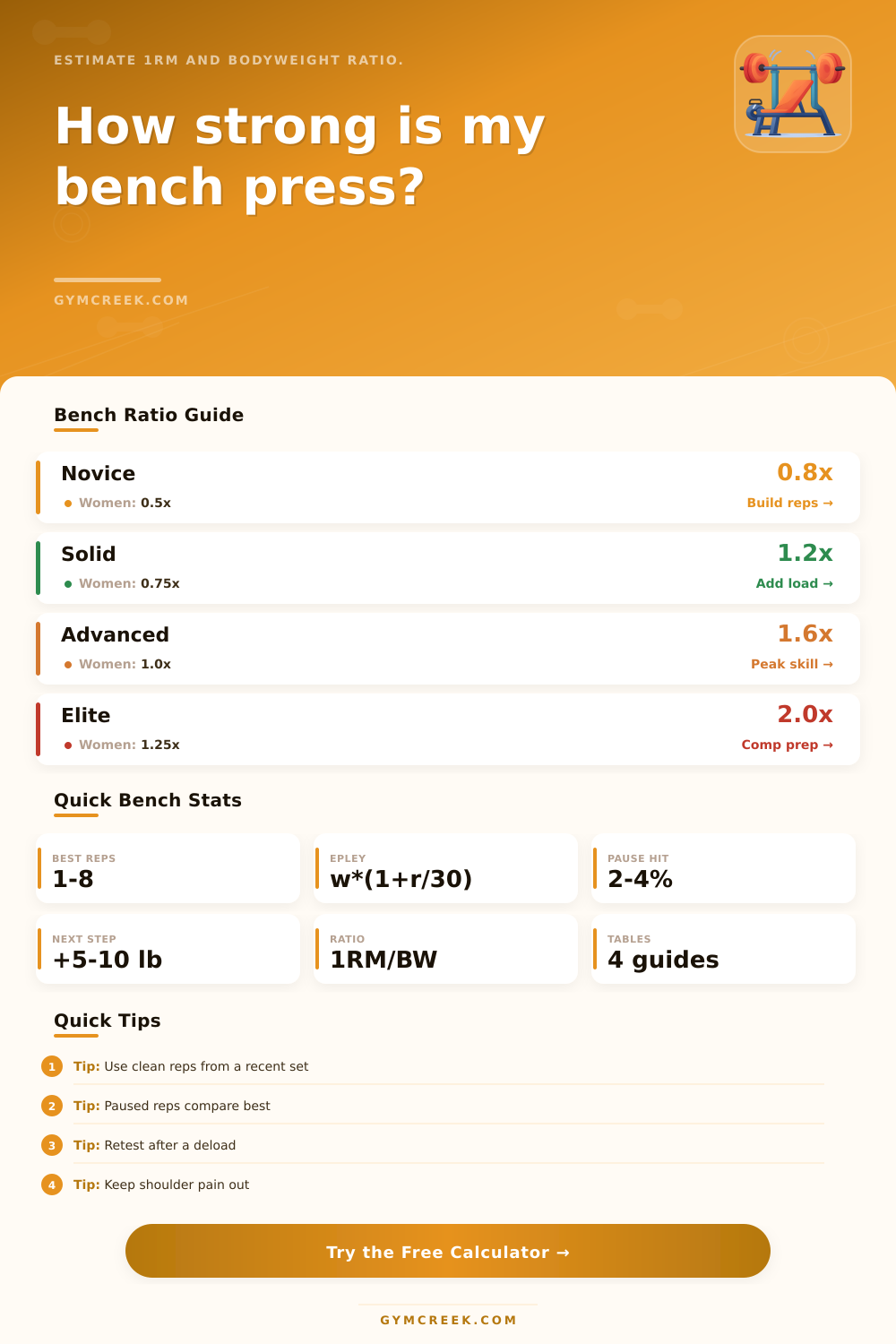
| Tier | Ratio | Typical meaning | Next focus |
|---|---|---|---|
| Beginner | Below 0.75x | Learning setup and bar path | Technique volume |
| Novice | 0.75x to 1.00x | Building a reliable bench base | Reach bodyweight bench |
| Intermediate | 1.00x to 1.35x | Solid gym strength | Progressive overload |
| Advanced | 1.35x to 1.75x | Strong relative bench | Paused specificity |
| Elite-like | 1.75x plus | High-level recreational or competitive | Peaking and recovery |
| Tier | Ratio | Typical meaning | Next focus |
|---|---|---|---|
| Beginner | Below 0.40x | Learning stable pressing mechanics | Controlled reps |
| Novice | 0.40x to 0.60x | Early strength foundation | Consistent weekly pressing |
| Intermediate | 0.60x to 0.85x | Strong gym benchmark | Volume and triceps work |
| Advanced | 0.85x to 1.15x | Very strong relative bench | Paused singles and triples |
| Elite-like | 1.15x plus | High-level recreational or competitive | Peaking and recovery |
| Formula | Equation | Best range | Bench note |
|---|---|---|---|
| Epley | Weight x (1 + reps / 30) | 1 to 10 reps | Common default for gym sets |
| Brzycki | Weight x 36 / (37 - reps) | 1 to 10 reps | More conservative at higher reps |
| Lander | 100 x weight / (101.3 - 2.67123 x reps) | 1 to 10 reps | Useful comparison formula |
| O'Conner | Weight x (1 + reps / 40) | 1 to 10 reps | Conservative for bench endurance sets |
| Input | Adjustment | Why it matters | Best comparison |
|---|---|---|---|
| Paused reps | About +2% strict credit | Already close to competition style | Paused standards |
| Touch-and-go | No extra credit | Normal gym benchmark | Gym standards |
| Soft touch | About -4% | Loose reps can overstate strict bench | Retest paused |
| Smith machine | About -8% | Fixed path differs from barbell control | Convert cautiously |
| Dumbbells | About +10% | Total dumbbell load is harder to map | Use as rough carryover |
💡Bench Press Tips
Bench press strength are teh measurement of how much weight a person can lift. However, bench press strength is also the measurement of how much weight a person can lift relative to there body weight. The importance of measuring relative bench press strength is in the ability of that measurement to reflect if an individual is naturaly strong for their size or if they are utilizing heavy weights.
A person that weigh 185 pounds but benches 225 pounds has a different relative strength compared to a person that weighs 280 pounds but only benches 225 pounds. Therefore, focusing on relative bench press strength allow for an individual to more accurately determine their strength. The bench press calculator will allow an individual to calculate their one-rep max based off their weight lifted, body weight, and the number of repetition that they performed.
Measure Your Bench Press Strength
That individual will determine the type of bench press by the number of repetitions performed as there are various types of bench press exercises that range in complexity. The calculator will account for these different types of bench press exercises so that the calculation of one-rep max remains accurate regardless of the type of exercise perform by that individual. Additionally, there is different formula for calculating one-rep max so that accuracy is maintained regardless of the number of repetitions performed by the individual.
The calculator will account for the sex and age of the individual that is performing the calculations as these factors may influence the strength that an individual can possess relative to others. The percentile band that is displayed with the calculations indicate the rank of an individuals strength relative to other recreational weight lifters. The percentile band provides a general idea of an individual’s strength and does not provide an overall indication of strength; many individuals may lie within the lower percentiles yet still exhibit strength and progress in their strength relative to previous strength calculation.
The reference tables displayed within the calculator can provide individuals with the ratio of an individuals bench press strength to their body weight based on their experience level with weight lifting. These ratios are not set to be followed by individuals but they can help to indicate the target that an individual should of strive to reach during their next training session. Many individuals who use these tables find that they are able to identify a target that allows them to increase their bench press strength that they did not previously believe possible.
It is important that individuals dont use the calculator with every training session. The calculator is best used for sets that contain between one and eight repetitions of the bench press exercise. Sets that contain high repetitions of the bench press may indicate strength in endurance rather than strength in the ability to perform the maximum bench press strength.
Furthermore, the Smith machine bench press is not the same than the barbell bench press. Therefore, using the calculator to determine one-rep max for bench pressing on the Smith machine or bench pressing with dumbbell weights will not yield the same calculation as the calculators indication for a standard barbell bench press. By understanding an individual’s one-rep max and their bench to bodyweight ratio, an individual can make training decisions that will allow them to exhibit the maximum strength in their bench press.
If an individual finds that their bench press strength is lower than their body weight, they should focus on their form and the number of set performed. If an individual finds that their bench press strength is higher than their body weight they should focus on their triceps and upper back strength so that they dont experience a stall in their bench press strength. The calculator will also allow individuals to determine their next training target based on where their current strength calculations indicate they lie in their strength category.
Small increase in the amount of weight that an individual lift during a bench press session is better than forcing an individual to perform large increases in that weight. Small increases allow the individual to maintain their best form throughout their sets. Additionally, the calculator can determine the frequency with which an individual performs their bench press.
If an individual rests and deloads from the exercises their strength will be more accurate calculated than if they attempt to perform their bench press when they are fatigued. The calculator will not provide an individual with a training program but it will allow them to remove the difficulty that is associated with performing the calculations for themselves regarding their bench press strength. An individuals relative strength can change due to their body weight changing or their technique changing with time.
Therefore, by using this calculator individuals can measure their strength to illustrate the change in their strength due to their training program.