Refeed Calorie Calculator
Estimate refeed day calories, carbohydrate targets, macro distribution, and the weekly calorie impact from your deficit, training stress, body size, and diet phase.
◎Presets
Presets load realistic refeed scenarios and recalculate instantly.
⚙Calculator
Refeed day plan
Enter your diet and training details to estimate refeed targets.
▦Fitness Metrics
▣Reference Tables
| Refeed style | Calorie target | Macro bias | Best use |
|---|---|---|---|
| Conservative | 80-95% TDEE | Moderate carbs | Early cut or small deficit |
| Maintenance | About 100% TDEE | Higher carbs | Most weekly refeeds |
| Small surplus | 105-110% TDEE | High carbs | Deep fatigue or hard block |
| Diet break entry | 95-105% TDEE | Stable protein | Several days to two weeks |
| Diet phase | Frequency cue | Watch point | Adjustment |
|---|---|---|---|
| Early cut | Optional | Unneeded surplus | Use conservative style |
| Steady cut | Every 7-14 days | Training dip | Maintenance refeed |
| Deep cut | Every 5-10 days | Fatigue and hunger | Hard-day placement |
| Peak prep | Individual | Scale water swings | Use tighter tracking |
| Training placement | Carb target | Timing | Why it helps |
|---|---|---|---|
| Leg day | High | Day before or day of | Supports high glycogen demand |
| Hard lift | High | Day of session | Better performance signal |
| Endurance | Very high | Before long session | Supports long-duration output |
| Rest day | Moderate | After hard block | Recovery without heavy training |
| Formula item | Calculator method | Typical range | Result affected |
|---|---|---|---|
| Refeed calories | TDEE times style and stress modifier | 90-110% TDEE | Main calorie card |
| Protein | Body weight times target | 0.8-1.1 g/lb | Protein grams |
| Fat floor | Calories times chosen percent | 15-25% | Fat grams |
| Carbs | Remaining calories after protein and fat | 2-8 g/kg | Carb grams |
◇Tips
Eight weeks later, you are cutting. The scale’s finally heading the right way. But Tuesday afternoon, your energy go AWOL and your lifts seem flat as a pancake. Now you’re looking down at a plate of broccoli and chicken, and you’d sell your soul for a piece of pizza.
That’s where most dieters goes wrong. Either they give up completely, or they fall off the wagon so hard they reverse three weeks of progress in just one night. But there’s another option, somewhere between total binging and giving up. This middle-ground approach require more strategy than willpower alone. The goal: Give your mood and glycogen levels a boost while avoiding an insulin spike for days afterward. You want the fuel; you don’t want the fat gain to stick around.
How to Do a Refeed Day
Once you enter both of these numbers (training stress + maintenance calories) into calculator above, it does the work for you. No need to guess how much of a surplus you want during a refeed. A refeed isn’t simply “eat more.” It’s intentionally tweaking carbs while keeping protein consistent and fats relatively low. Why? Because being in a calorie deficit alter your insulin sensitivity. If the window is small enough, your body will be more efficient at moving glucose into muscles instead of fat stores. You are tapping into a short-lived window of opportunity where the body gets good at it. Just don’t mess around by using those modes longer than needed for workout.
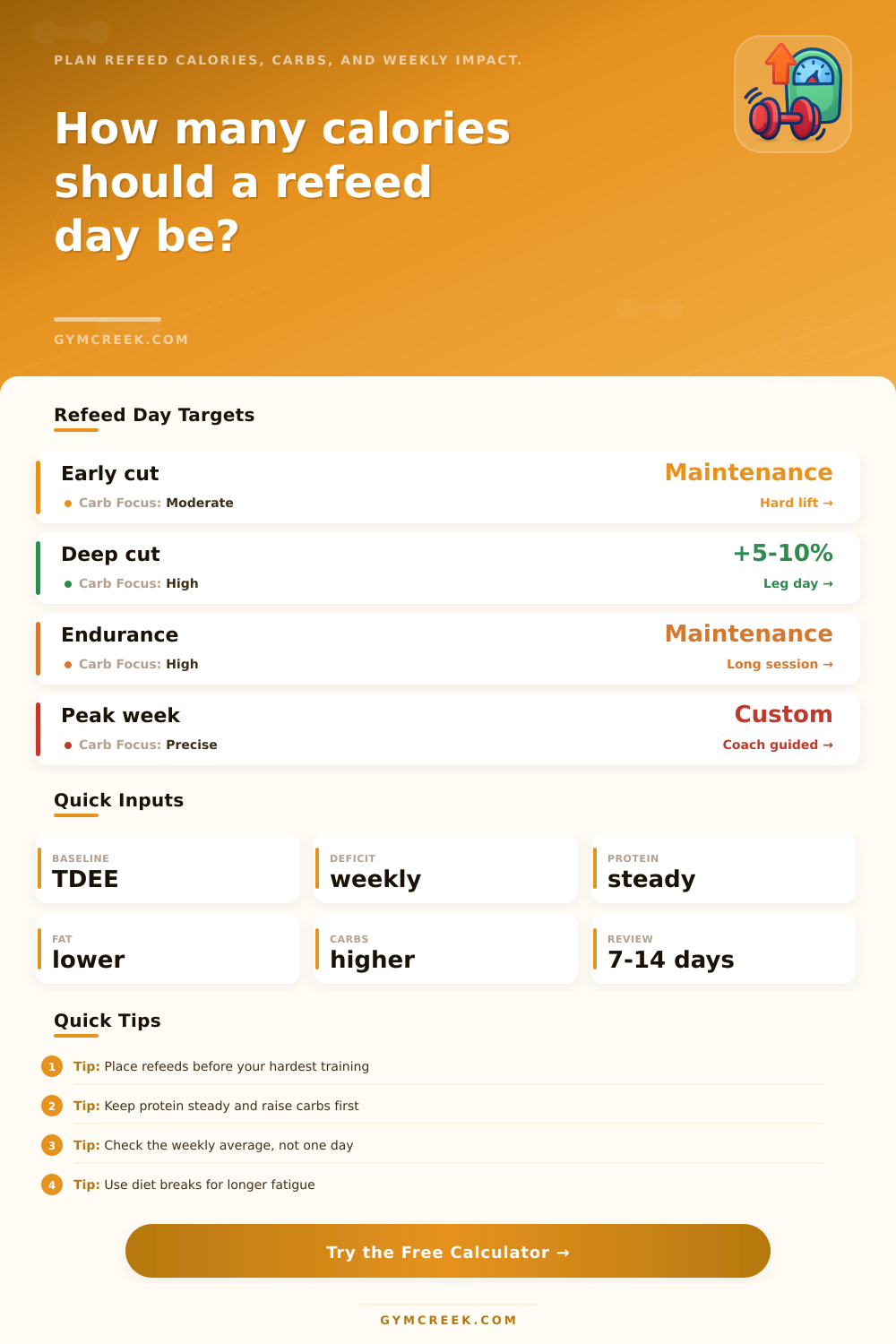
The second part of the equation is timing. Sure, it’s nice for the soul to put that higher calorie day on some random rest day. But it doesn’t do much for the muscle. Ideally you want the carbohydrate load to match up with the period when your muscles is crying out for glycogen. In other words: schedule it either before or during your toughest workout, something like a long endurance block or a heavy leg day.
The chart on the page spells this out nicely… Matching the level of carb focus to the type of training you’re about to do. The calculator dials back carbs if you’re doing light cardio. It pushes ’em up if you’re about to squat heavy weights. In short, it makes sure there’s somewhere useful for all that energy to go right away. Calories turn into performance, not just potential storage.
A refeed isn’t a cheat day. A lot of dieters gets caught up on this. They think they’re “cheating” during their refeed day. But cheating means: breaking rules. It’s usually high in sugar and fat. It slow down digestion, leading to bloating. While a cheat day often involves high fat and sugar, a strategic refeed is clean eating but with an increase in volume, mostly from oats, fruit, potatoes or rice. Because you’re still trying to preserve muscle, you don’t stray from your protein target. Regardless of the shift in calories, the calculator keeps that steady protein level to protect your lean mass while allowing carbs to do the heavy lifting in terms of recovery.
Also, it updates the weekly average so you can check if you’re still in a deficit throughout the week. This helps prevent panic whenever scale goes up two pounds overnight because you’ve retained some water. Water sticks to glycogen, so it’ll go away.
How often should I do these refeed days? This really varies based off where you’re at in the cut. Maybe initially, you don’t even need a refeed day at all. After a couple of weeks, you’ll feel more tired. Adding a day will help restore your mental state and leptin levels. To determine this pressure point, the tool requests that you enter the length of deficit. Have you been dieting for months? A small surplus or even maintenance refeed is more important then someone who just started last week.
It’s never about punishment… but about keeping things sustainable. You can’t out-train an under-fueled system constantly. Planning the macros in advance removes the anxiety from that day. You know when to stop, you know how much rice to cook. This reduces the urge to spiral out of control and eat without tracking later in the week.
So there you have it: A refeed is a longevity tool for achieving your physique goals. With a refeed, you can continue losing fat over time; all while maintaining intense workouts in gym. Your execution is what matters; the calculator provides the numbers. Use it. Time it around your hard training days. Stick to the plan and know that water weight fluctuation are just noise.
This is a long game. Keep the trend line pointing downward week after week, even if it points upward on some days. That’s what distinguishes sustainable progress from burnout. You should of used this sooner.