Recovery Days Calculator
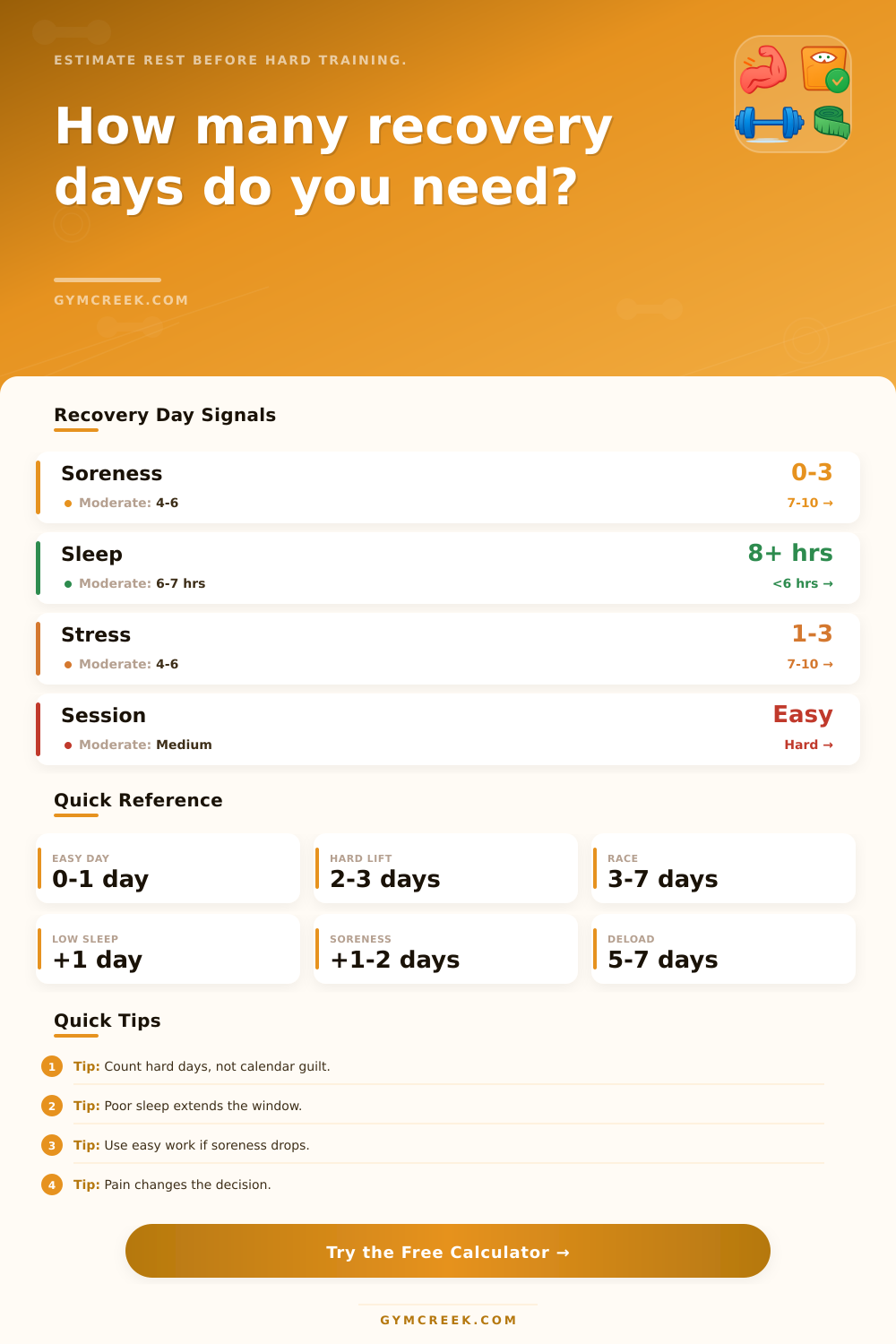
Estimate how long to wait before another hard session by combining training stress, soreness, sleep, stress, readiness, age, recent hard days, and the planned next workout.
📌Presets
Presets fill realistic recovery profiles. The estimate is a planning guide for training readiness, not a diagnosis or clearance decision.
⚙Calculator Inputs
Recovery window
Complete the form and calculate to estimate the next hard-session window.
📊Fitness Metrics Grid
📘Recovery Reference Tables
| Session type | Typical window | Watch signal |
|---|---|---|
| Easy technique | 0-1 day | Normal movement quality |
| Heavy strength | 2-3 days | Joint feel and bar speed |
| High-volume lifting | 2-4 days | DOMS and range of motion |
| Long endurance | 1-3 days | Leg stiffness and sleep need |
| Race or match | 3-7 days | Systemic fatigue and soreness |
| Readiness score | Training fit | Adjustment |
|---|---|---|
| 80-100 | Hard work possible | Progress if warm-up feels normal |
| 70-79 | Moderate to hard | Keep one reserve set or interval |
| 55-69 | Easy to moderate | Reduce intensity or volume |
| 40-54 | Easy only | Use mobility, zone 2, technique |
| Under 40 | Rest focus | Skip hard loading |
| Input signal | Low impact | High impact |
|---|---|---|
| Soreness | 0-3 adds little | 7-10 adds major delay |
| Sleep | 7.5+ hours supports readiness | Under 6 hours adds caution |
| Stress | 1-3 keeps plan stable | 8-10 may need a rest day |
| Hard-day count | 0-2 allows loading | 5+ suggests deloading |
| Rest-day count | 2-3 often balances load | 0 creates density risk |
| Formula step | Variable | Use |
|---|---|---|
| Training stress | RPE x minutes | Base fatigue estimate |
| Session modifier | Type factor | Weights eccentric or race stress |
| Recovery load | Stress plus signals | Combines sleep, soreness, stress |
| Readiness index | 100 - fatigue | Shows current training margin |
| RPE cap | Readiness adjusted | Limits next-session intensity |
💡Recovery Notes
Most folks don’t give recovery days nearly as much credit as they deserve. Your body never realy cleared out that fatigue. You might have felt strong after your tough workout and shown up the next day in spite of yourself, but you left some progress on table. The key is knowing when the body clear and didn’t clear.
Behind every single training decision. Whether it’s pushing one more set with a heavy weight or penciling in a long run on the calendar, lies that question. After this we can plug all these factors into the calculator up top to get a handle on it.
How to Know When You Are Ready to Train Again
We know different exercises has different demands, so we use the workout type + difficulty to calculate curve for each recovery time. Even though two workouts might feel equally difficult, they’ll leave varying amounts of residual stress (for example, an easy technique session have less residual stress then a heavy squat day). Time spent also plays a role; although it’s not as straightforward, more time equals more total fatigue from any given level of exertion. Sleep measures how much outside pressure is already taxing the system. And finaly soreness measures how muscles are feeling, how they’re responding to workout.
Recent training density also fits in age picture. Repair processes slows with age, so it’s often better to space harder workouts among older athletes. If they’ve had a string of harder days within the past week, there is less wiggle room for adding another. However, if sleep and soreness is holding steady, then that training density can be offset by a couple of real rest day.
And your choice of next session matters as well. The same readiness level that supports easy aerobics might not be sufficient for race-pace intervals or max testing. It tells you how long you should of stay at lower levels of stress before hitting the gas again, and what your intensity ceiling should be upon returning. If you see a shorter recovery time, that’s an indicator you’re safe going back into regular loading relatively quickley. If you see a longer one, that’s a signal to stick to easy-to-moderate work until those numbers start to come down.
To help take out some of the guesswork in deciding whether to pull back or push harder, the page has reference material showing how different readiness ranges correspond to training choices.
This is where most athletes go astray: They think about recovery as a calendar entry, not as a state. They say things like, “I’ll do it in X many days,” based off how they felt last time, or “I’m not going to recover if I feel good today,” even when sleep was bad and muscle soreness lingers. Instead, the calculator makes them have the discussion with all those cues simultaneously; and not let one trump the others. For instance, how much you’ve slept in the past week (sleep debt) doesn’t present itself as soreness but consistently delay your readiness for the next hard training session. The same applies to life stress. And each is prone to being forgotten until an injury occurs or a dip in performance.
But the real value comes from watching the trend rather than any single score. A bad night’s sleep, heat or travel can all deliver one low readiness day. After a solid warm-up or even a better night, run the numbers again. The picture will likely shift. And that’s the key to keeping training decisions rooted in what is happening now, not what happened last week or what needs to be done to stick with a schedule.
Training hard doesn’t mean recovering poorly. Recovering well means you’re doing something that actualy sticks.