Rear Delt Fly Calculator
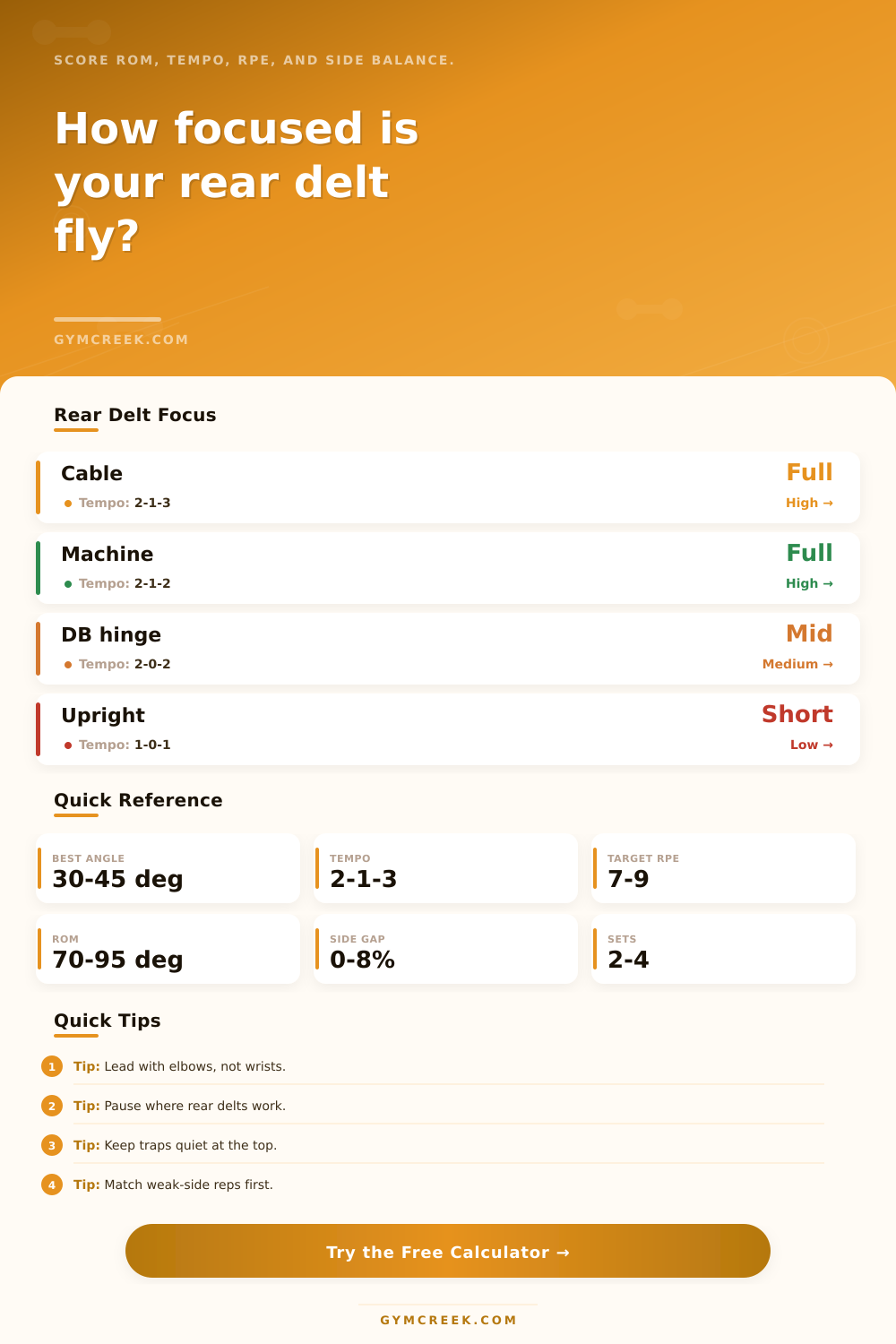
Score shoulder isolation, compare left and right sides, and tune load, arm path, ROM, tempo, torso angle, reps, and RPE for dumbbell, cable, or machine rear delt flyes.
📌Presets
Each preset loads a complete rear delt fly setup and recalculates the live output.
⚙Calculator
Rear delt fly snapshot
Enter your setup to score isolation and side balance.
📊Metrics Grid
📑Reference Tables
| Equipment | Resistance Feel | Setup Strength | Common Watchout |
|---|---|---|---|
| Cable | Steady tension | Best line tuning | Crossing too far |
| Dumbbell | Top-biased | Easy to load | Swinging reps |
| Machine | Guided arc | Stable torso | Seat too high |
| Bench support | Cleaner torso | Less momentum | Short ROM |
| Variable | Low Range | Target Range | High Range |
|---|---|---|---|
| Torso angle | 0-20 deg | 30-60 deg | 70-90 deg |
| ROM arc | 20-55 deg | 70-95 deg | 100-120 deg |
| RPE | 5-6 | 7-9 | 9.5-10 |
| Set time | 20-35 sec | 40-75 sec | 80+ sec |
| Tempo | Rep Feel | Isolation Impact | Best Use |
|---|---|---|---|
| 1-0-1 | Fast | Lower | Warm-up sets |
| 2-0-2 | Controlled | Moderate | Basic volume |
| 2-1-3 | Strict | High | Main sets |
| 3-2-3 | Very strict | Very high | Technique work |
| Score Band | Meaning | Likely Limiter | Adjustment |
|---|---|---|---|
| 85-100 | Excellent | Load tolerance | Progress slowly |
| 70-84 | Strong | Minor leakage | Add pause |
| 55-69 | Mixed | Trap or ROM | Lower load |
| Under 55 | Poor focus | Momentum | Reset setup |
💡Tips
Take rear delt flyes: They’re easy to write off as a boring stretch move. People generaly guess their way through it using light weight. It is important to note that proper form is critical (controlled tempo, torso angle) to hit the target muscle. Mess up the setup and you’ll have your traps and upper back doing all the heavy lifting.
When you plug in your body stats and load here, the calculator does the dirty math for you. No need to mess around with conversions or coefficients. That hazy feeling of exertion becomes a solid isolation number.
Why Form Matters for Rear Delts
The first thing to consider here is torque. Because leverage changes the force placed upon your shoulder joint, physics impact the workout. With a greater arm length, the same amount of weight in your hand place more resistance on your joint. This is how it accounts for your arm length; it calculates the true force being applied by your muscle fiber. Fifteen pounds might seem light yet your long limbs cause great stress from such a load. The calculator accounts for this fact to prevent underestimating how intense it’ll be.
That’s where most folks go wrong. They see the plate on the bar and forget about their own lever arm.
Isolation hinges on tempo. If you bounce the weight up and down in a fast rep, it’s easy. Momentum is doing all the work. When you try a slower pace, its difficult. That’s because momentum kills isolation.
The tool measures how long you lift, pause, and lower the weight. How long are you generating time under tension? If you’re using a strict two-one-three tempo, you have no choice but to control that eccentric phase. Slow lowering the weight stimulates muscle growth. Rushing the movement results in a lower score. Reps don’t count for much when quality of every contraction is poor. As you can see from the reference table on the page, stricter tempos gives higher isolation ratings.
Another problem is side balance. Most people are more dominant on one side. Maybe they do reps with better form or handle more weight on one side. The unilateral mode allow you to directly compare each side. If you notice your right shoulder is stronger, you may be tempted to load up both sides. That creates an imbalance which will reinforce bad habits.
The calculator highlights this gap between sides. It encourages you to match the capacity of weaker side. This keeps the dominant side from compensating for the lagging side. You don’t want symmetry based off total volume but rather symmetry itself.
The other variable is what piece of equipment you choose to do this on. On cables, there’s always a tension during the arc. With dumbbells, there is a dead spot at the bottom where gravity takes over. On machines, they show you the way, making it more stable but perhaps not aligned to how your joints line up. Those are all variables built into the tool.
It knows you don’t feel the same using a dumbbell as a cable for something like a press or a fly even though you use the same amount of weight. That background info give you the clue as to why one might produce a higher score different than another. It is not because one is superior, but because the tension curve matched your desired outcome.
Lastly, observe your traps in motion. Are you shrugging at the top of the rep? That’s not good because it lets your rear delts rest and that attracts a penalty from the calculator. Quiet shoulders and stable scapulae are rewarded.
Why? Because this feedback loop teach you to get better. It exposes precisely what’s robbing the work from your target muscle. By the time you walk out of the gym, you know whether you engaged the rear delts or merely warmed up your neck.
The score is a mirror. It reflects your form as faithfully as you can feel in your muscles. You should of started with the numbers; let your feeling be your guide.