Realistic Weight Goal Calculator
Check whether a target weight and deadline fit a sustainable pace, then estimate daily calories, weekly change, review targets, and the main formula assumptions.
◎Presets
Presets load full examples and calculate immediately. Replace the values with your own weekly average weight and desired target.
⚙Calculator Inputs
Weight goal snapshot
Enter your current weight, target, and timeline to test the required pace.
▦Fitness Metrics Grid
▣Reference Tables
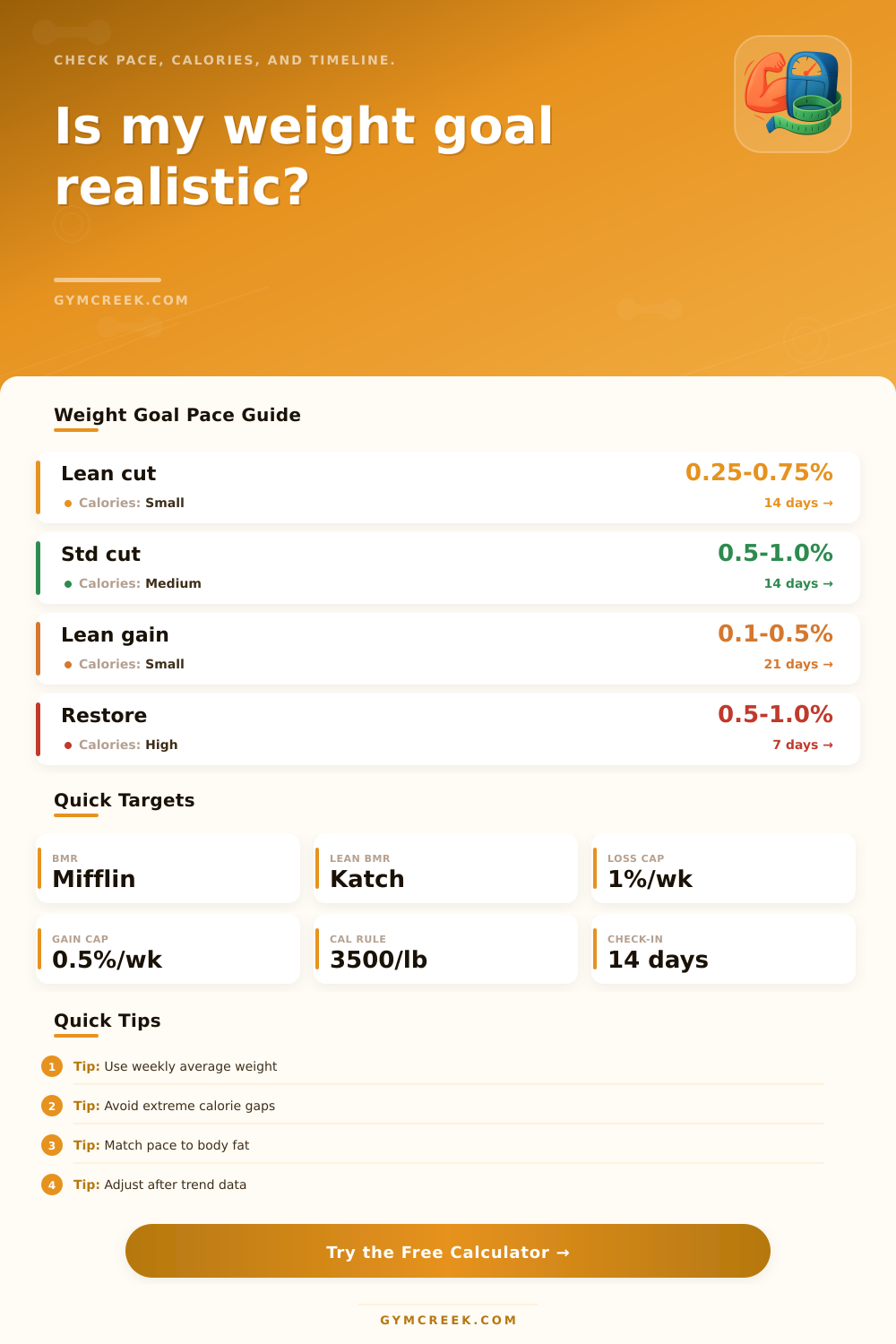
| Goal type | Typical rate | Calorie gap | Best fit |
|---|---|---|---|
| Lean fat loss | 0.25-0.75%/wk | 250-500 kcal | Already lean or performance focused |
| Standard fat loss | 0.5-1.0%/wk | 500-750 kcal | Most sustainable cuts |
| Lean muscle gain | 0.1-0.5%/wk | 75-350 kcal | Intermediate and advanced lifters |
| Restoration gain | 0.5-1.0%/wk | 350-750 kcal | Use with qualified support |
| Signal | Lower range | Higher range | Planning cue |
|---|---|---|---|
| BMI healthy band | 18.5 | 24.9 | Use as context, not a verdict |
| Male athletic BF | 8% | 17% | Prefer slower loss near this range |
| Female athletic BF | 16% | 24% | Prefer slower loss near this range |
| Waist trend | Slow change | Fast change | Use alongside scale weight |
| Trend result | Loss goal | Gain goal | Action |
|---|---|---|---|
| On pace | Hold calories | Hold calories | Keep the same target |
| Too slow | Reduce 100-150 | Add 100-150 | Change one variable |
| Too fast | Add 100-200 | Reduce 100-150 | Protect recovery |
| Noisy data | Wait 7 days | Wait 7 days | Use more weigh-ins |
| Output | Formula | Inputs | Purpose |
|---|---|---|---|
| BMR | Mifflin-St Jeor | Age, sex, size | Resting metabolism |
| Lean BMR | Katch-McArdle | Lean body mass | When body fat is known |
| TDEE | BMR x activity | BMR and multiplier | Maintenance estimate |
| Goal calories | 3500 kcal/lb | Weekly weight change | Daily calorie target |
◇Tips
The day after that, you hop on scale and a number pops up that doesn’t align with what you imagine. Monday is around the corner. There’s a wedding (or at least the desire for a slimmer bod for summer) in sight. It makes sense, but it rarely works out.
When we go after a certain date, we gets ourselves into unsustainable calorie deficits, which cause our hunger hormones to kick in and our metabolism to adapt. This makes staying the course damn near impossible.
How to Set Realistic Weight Loss Goals
The trick isn’t finding some magical number to slash. The trick is setting a reasonable target weight. You can input all your starting stats (with optional body fat) and compare them to your goal.
The app use proven equations for your basal metabolic rate, such as the Mifflin-St Jeor equation. If you enter a body fat number, it adjust to the Katch-McArdle formula. This is more precise because it is based off your lean body mass instead of just your weight and height. The reason this matters: Muscle tissue has a higher resting calorie burn than fat tissue.
Then you choose how long you want it to take, and it will shows how much weight you should of lose each week. The rate of healthy fat loss is often much slower then most assume. Your best bet is typically on the order of 0.5-1% of body weight per week, at which point it’s usually sustainable.
Faster is not better. It just increases your risk of shedding both fat and muscle, lowers your resting metabolism, and makes transition into maintenance even more difficult. Aggressive goals gets flagged here because they’ll show you a realism score and recommend a more realistic timeline.
It considers adherence too, if you’re planning to account to the reality that nobody sticks to their calories every single day, this lets you adjust accordingly. Higher adherence means less cushion against slip ups, so it adjusts the calorie deficit up a bit to compensate. This adds grace while keeping you on track.
The numbers are best understood when you get comfortabley with the reference tables on the page. These lay out normal rate ranges depending on what your goal might be. For example, they cover restoration phases after restrictive dieting or lean cuts for an athlete. There is no one-size-fits-all.
Generally, if you’re still on the high end of the body fat spectrum, you’ll likely be able to sustain a greater calorie deficit than if you’re already lean. That’s taken into account with the tool, which will adjust its warning to match your priority settings and training context. Reminding you that losing weight isn’t simply about reducing calories but retaining energy and function as we shed excess mass.
The only way to determine whether your plan is succeeding (or failing) is to track it over time. Your body’s sodium levels fluctuates each day; so do your glycogen levels and your water weight. Fat gained or lost may be obscured by these daily ups and downs. To account for the daily noise, the calculator suggests reviewing every couple of weeks, typically enough time to see where your body composition have trended.
At that point, if you stall on scale, there’s some simple advice: Change just one variable at a time. Don’t cut back on your calories more, unless you’re already down to a healthy minimum. Review your activity level instead. Or maybe it is sleep quality. Maybe it’s not the food that’s the problem, maybe you’re simply not recieving as well from your workouts.
So ultimately, what’s a realistic goal? A realistic goal is something you can maintain indefinitely (or at least long enough for it to have an impact) while avoiding burnout. This also takes some patience and an understanding that when the scale isn’t telling you a story, it is telling you how to move forward. When you use these tools to anchor your expectations to bodily reality, you’re not frustrated anymore; you’re consistent. And that’s what transforms your body composition over time. You decide where you want to go; the math show you how to get there. The difficult part is trusting that process; because if you don’t, you won’t be able to stay lean when you arrive.